Ad

Theory, practice and activism at ISS
The auditorium on The Hague’s elegant Kortenaerkade, a stone’s throw from Noordeinde Palace, is gradually filling up. Looking out over the colourful crowd, it isn’t hard to guess where we are: the International Institute of Social Studies (ISS). People converse among themselves in English, Dutch or Spanish.
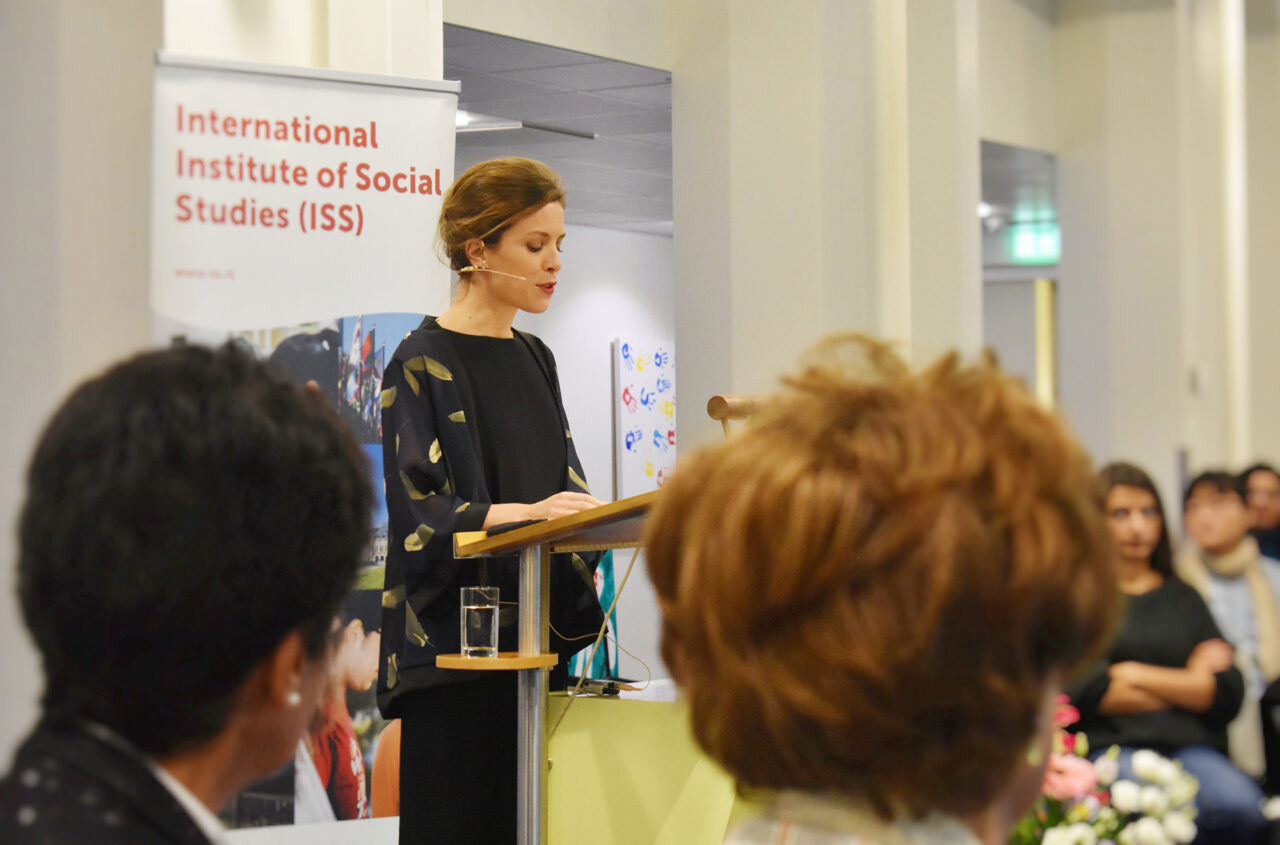
Sara Vigil Díaz-Telenti, the 200th recipient of an ISS doctorate
Image by: Fabienne Hoogendoorn
A lady welcomes everyone who enters the hall, enthusiastically introducing herself as ‘Sara’s mom’. In a few minutes, her daughter Sara Vigil Díaz-Telenti, will be defending her doctoral thesis: Geopolitical Ecologies of Environmental Change, Land Grabbing and Migration: comparative perspectives from Senegal and Cambodia.
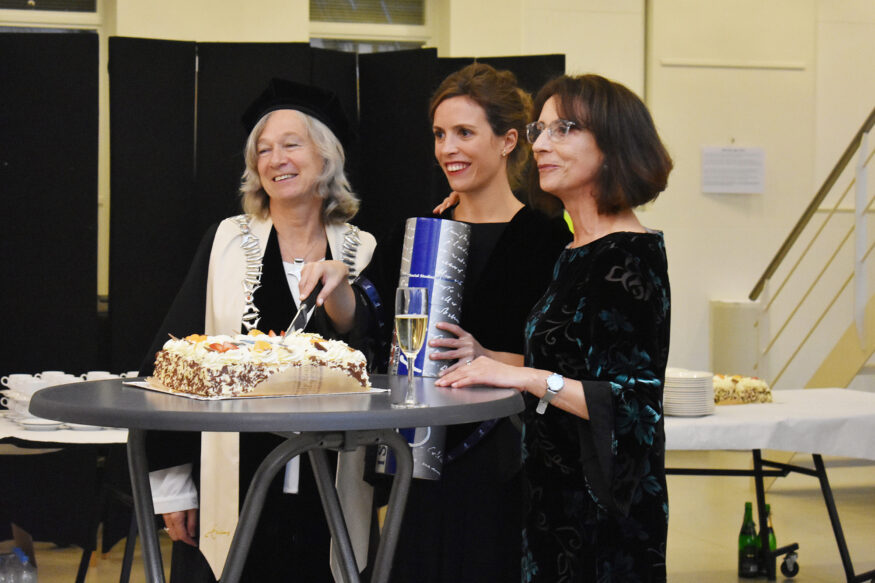
Vigil Díaz-Telenti together with her mother and rector Inge Hutter.
Image by: Fabienne Hoogendoorn
This is cause for celebration in its own right, but today’s extra special: Vigil Díaz-Telenti has the honour of being the two-hundredth recipient of an ISS doctorate. The institute, which became an official part of Erasmus University Rotterdam just over a decade ago, has taken the occasion to put out the flag. Since 1952, ISS has been educating students – most of them from developing countries – in ‘policy-oriented critical social sciences’ that focus on research into development issues.
Vigil Díaz-Telenti, who hails from Spain, performed her doctoral research in Senegal and Cambodia. Her ‘lay presentation’ about her dissertation is a brief but passionate account of small farmers who are forced to migrate under the pressure of foreign investors and climate change.
Interests of the farmers
Image by: Fabienne Hoogendoorn
After this, the candidate is given the traditional public grilling by the doctoral committee. This committee is as international as the ISS itself, consisting of an American (Jesse Ribot), a Fin (Anja Nygren), a French-speaking Belgian (Philippe Lebailly) and a Turk (Murat Arsel). The alleged ‘opponents’ more or less unanimously call Vigil Díaz-Telenti’s thesis ‘ambitious’ while simultaneously lauding its high quality.
The Walloon professor does initiate a topical discussion after posing various searching questions to the doctoral candidate about the fate and autonomy of peasants who are often lost out to developments like scaling up. Lebailly: “As a social institution, it should be evident that our duty always lies in defending the interests of the individual farmer.”
Jewel in the crown
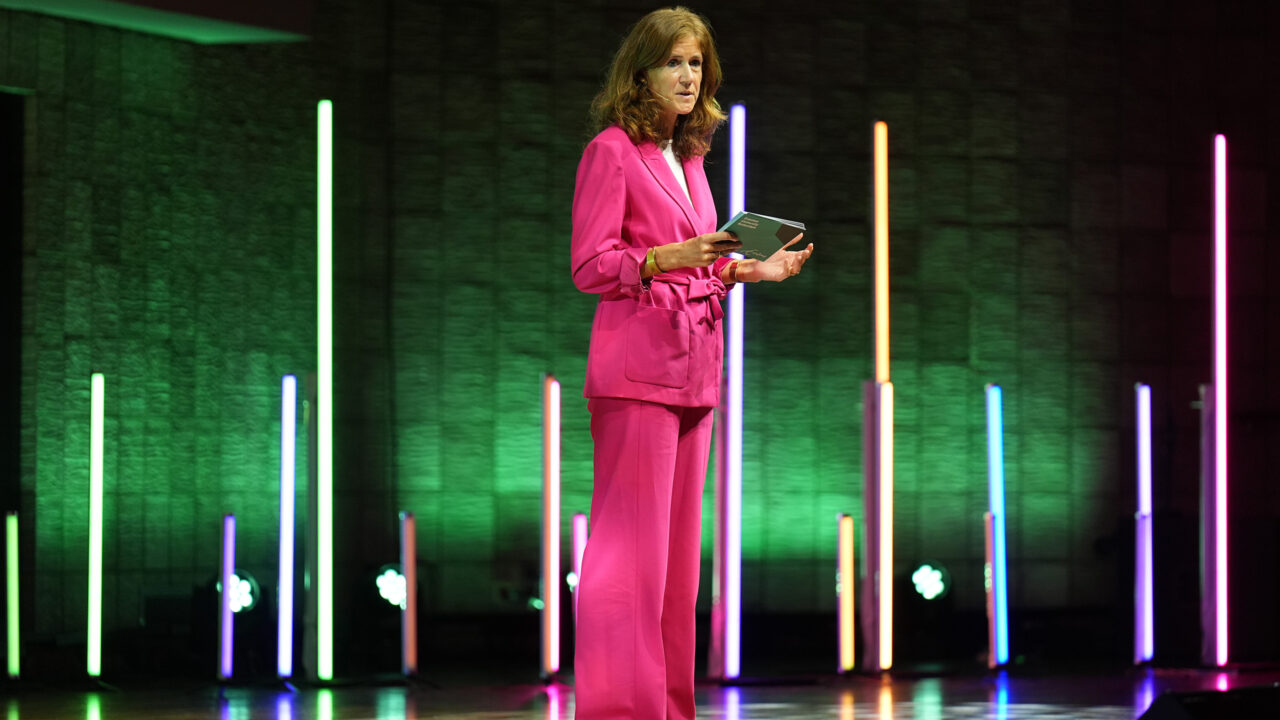
Per tradition, the lay presentation and the doctoral defence last exactly one hour. This part of the programme ends with the jingling sound of the beadle’s sceptre, at which point the doctoral committee retires. While a relieved Vigil Díaz-Telenti hugs the numerous family members who have come to her ceremony, The Hague’s Deputy Mayor for Education Saskia Bruines takes the stand. “It’s an honour to be here. Two hundred doctorates is quite an achievement! This is a major milestone. We’re a jewel in the crown of Erasmus University – and in that of The Hague itself.” She is happy that the institute calls ‘her’ city its home. “The ISS’s fields of study and profile are a good match with this city: peace and security, peace and justice, humanitarian issues, women’s rights, migration. How to hold wicked regimes accountable. It is clear that many students from countries faced with a lot of challenges find it an honour to study here.” Bruines occasionally checks in on the institute. “And vice versa, your rector Inge Hutter is also closely involved in what goes on in our city.”
Social engagement
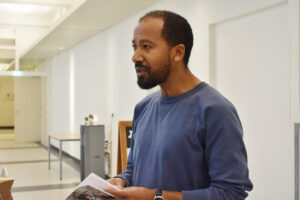
Tsegaye Shegro.
Image by: Fabienne Hoogendoorn
Hutter’s speech is followed by the official conferral of Vigil Díaz-Telenti’s doctorate and the presentation of a booklet celebrating the 200th doctoral ceremony to the Deputy Mayor. And after that, it’s time for the reception: the non-alcoholic bubbly and cream pies have already been laid out. Out of the 200 doctoral candidates, several alumni are present. Tsegaye Shegro for instance: after rounding off his dissertation in 2016, he has been researching land politics for ISS in the capacity of assistant professor. “I wanted to obtain a doctorate after I finished my degree programme in Ethiopia. This is one of the few institutes worldwide where they perform research into developing countries.” According to him, the ISS is the best place you could imagine for developing a critical perspective on global developments and social justice. “I learn something new here every day. We don’t just work on theoretical science. For me, working in the field and activism are just as important. At the ISS, we contribute in all sorts of ways to greater social justice and a sustainable climate.”
Rector Inge Rutte agrees that the ISS has a pronounced social commitment. “This has been in our genes from the very beginning. Some of us achieve this by combining research with activism. I refer to myself as a ‘researcher for action’.” When it comes to this feature of the faculty, today’s festivities are about more than just the number 200. Rutte: “Our students and doctoral candidates take everything they’ve learned here back home. It’s this impact that we are celebrating here today.”
De redactie
-
 Tara Lewis
Auteur
Latest news
-

New code of conduct for science emphasises ‘distinctiveness and autonomy’
Gepubliceerd op:-
Science
-
-
Executive Board regularly uses AI for speeches and LinkedIn posts
Gepubliceerd op:-
Artificial Intelligence
-
Governance
-
-
TU Delft may not favour women in admissions to courses
Gepubliceerd op:-
Education
-

Comments
Comments are closed.
Ad
Read more in Science
-
New code of conduct for science emphasises ‘distinctiveness and autonomy’
Gepubliceerd op:-
Science
-
-

Hate campaigns and political pressure: KNAW wants legal protection for academic freedom
Gepubliceerd op:-
Science
-
-
Why Philip Hans Franses had students look in wallets at a DIY store
Gepubliceerd op:-
Eureka!
-