Ad

Art workshops and dance performances play important role during inaugural lecture The art of healing
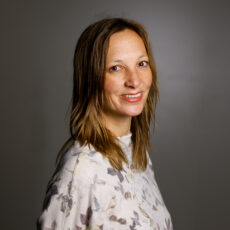
Tineke Abma assumed the chair in art and care on Friday 12 June during a special inaugural lecture full of art, dance and singing. “Art can bring more humanity to care.”
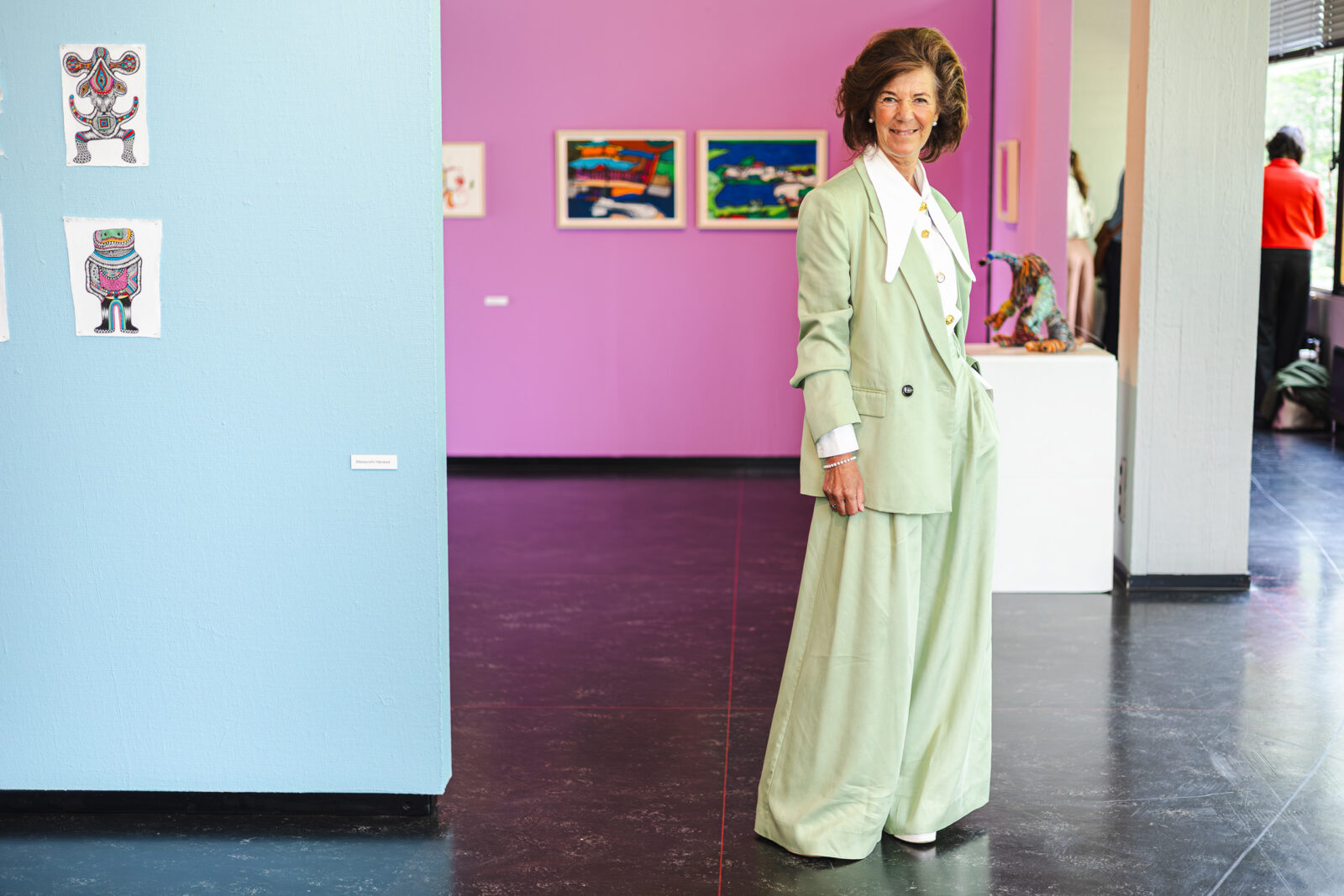
For Abma’s inaugural lecture, the exhibition Outside in – inside out is on display in the Erasmus Gallery.
Image by: Pien Düthmann
Abma dedicated the day of her inaugural lecture to her father, who could not be there because of his Alzheimer’s disease. She saw how much joy singing in the men’s choir De Freulesjongers gave her father, who became increasingly withdrawn due to his illness. As a tribute to him, the choir ended the day with a duet with mezzo-soprano and host Tania Kross. Art, in its broadest sense, Abma concludes in her inaugural lecture, has the power to make people forget that they are merely patients; art can heal people.
Improvised dance
Entirely in line with her research, art played an important role during the inaugural lecture titled The art of healing. Thus the audience in the auditorium was treated to two performances of R.A.A.F. danst – a dance programme by Scapino Ballet Rotterdam in which young adults with and after cancer learn to relate to their bodies again, away from medical interventions. During the symposium the dancers began their improvised dance somewhat tentatively, first as individuals who drift past one another across the stage, then as a single organism, holding one another, moving together. As they dance the women became progressively freer, smiles appeared on their faces, and by the end their enjoyment was infectious. “Healing to watch”, Kross praised afterwards.
“You can say and substantiate all sorts of things when it comes to art, but experiencing it yourself is the most convincing”, Abma explains of her choice to combine her inaugural lecture with music and dance performances. At the festival preceding the inaugural lecture, visitors could take part in art workshops. During the subsequent symposium, a panel discussion and a keynote speech by Christopher Bailey, an expert by experience and policy-maker at the World Health Organization, were interspersed with singing and dancing.
‘Art can be healing’
Art, Abma wants the audience to feel during The art of healing, can be healing. That is not the same as curing: healing means coming to terms with things as they are, being ‘whole’ again as a person. In her inaugural lecture Abma explains: “Modern medicine has no model for what it means to be whole as a person. It divides people into separate specialties, puts measurable facts above personal experiences and leaves little room for meaning, spirituality and emotional experience. It is precisely in this that it falls short. That is exactly where the power of art lies: artists draw attention to meaning, imagination and the inner life. As a result they form an indispensable complement to curative care. Art can bring more humanity to healthcare.”
But how do you capture the healing people experience when making art in scientific knowledge? That is precisely the task given to Abma by care organisation Cordaan and the Museum van de Geest, who co-fund the professorship. What artists and care professionals know from experience has not always been systematically researched and scientific evidence has long been fragmented. That makes it difficult for organisations such as Cordaan to meet the requirement for scientific evidence that, for example, health insurers set for the reimbursement of treatments.
Abma gained her PhD at Erasmus University Rotterdam (EUR) and, as professor, focused on the chronically ill and on the participation of older people in care at, successively, VUmc and the Leiden University Medical Center, and served as director and chief executive of the knowledge institute Leyden Academy on Vitality and Ageing. She is professor of Arts and care at the Erasmus School of Health Policy & Management.
Yet another expert
So Abma has the task of strengthening the scientific basis of art in healthcare. She is not starting from scratch. With the chair she builds on a long research career in which she combined themes such as care, inclusion and diversity, participation and art. “The role of art has become increasingly important in my work, because I gradually noticed that through art I made much deeper connections with people than when I turned up with a questionnaire. People then saw me as just another expert, and I only got socially desirable answers. But if I asked people about a personal photo or a poem that had moved them, that sparked much richer conversations and reflections. That’s why I started collaborating with artists; after all, they are the professionals. I learned a lot from that, I saw what it brought to people.”
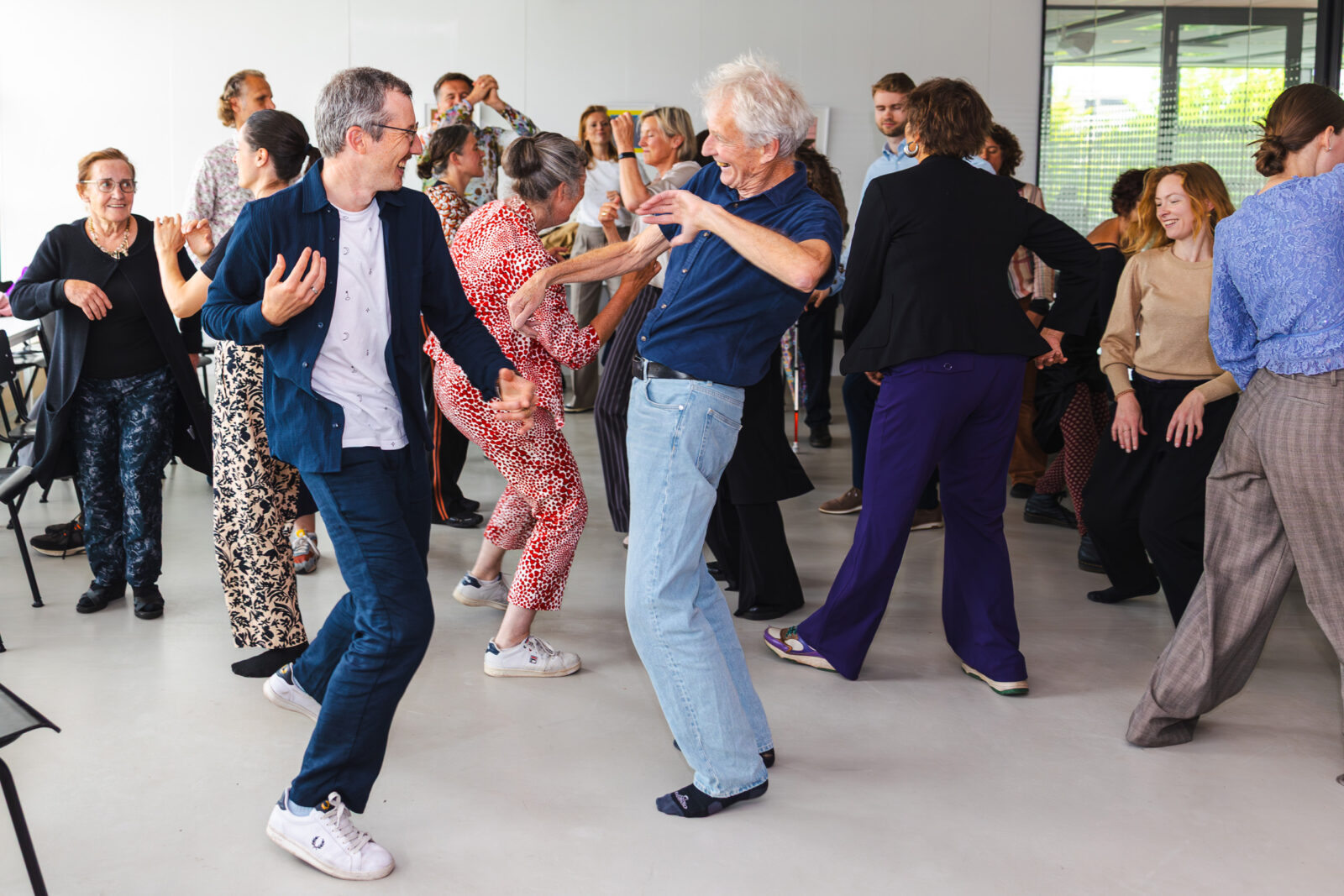
During the festival for the inaugural lecture, visitors will be offered a dance workshop.
Image by: Pien Düthmann
Artist Sella Molenaar, attached to Cordaan’s outreach art team, has a case in point. When she was paired with a woman with Parkinson’s and Alzheimer’s who could paint well, Molenaar decided she wanted to celebrate her as an artist. “We organised an exhibition of her work in the community centre, there was an interview in the neighbourhood paper. She got to know so many new people. It has enormously enriched her life and her world.” Cordaan has ongoing collaborations with seventy arts organisations in Amsterdam. Together with a PhD candidate at the EUR, Abma is studying this collaboration so that the knowledge can be transferred to care organisations elsewhere in the country.
Dancing researchers
Also in the dance programme R.A.A.F. danst Abma investigates how dancers’ experience can be translated into scientific frameworks. That requires methodological innovation: the researchers themselves have a dance background and join in the dancing. In this way the researchers become part of the participants’ experience, which enables them to gain a clearer picture of those experiences than through questionnaires afterwards.
In addition to research, Abma is using her professorship to promote innovation in education. She wants to focus on the healthcare managers of the future and envisages a ‘new pedagogy’ for them. That is not only about training students in new research methods, but also about the importance of ‘creating and maintaining space for authentic dialogue and daring to feel and explore one’s own vulnerability, corporeality and humanity’, Abma said in her inaugural lecture.
Abma offered the audience of The art of healing ample opportunities to explore their own vulnerability, corporeality and humanity through art. Singer Tania Kross (who has a hearing impairment) performed, together with blind pianist Bert van den Brink, three songs by composers with a disability or illness. And Janna Lint of R.A.A.F. danst explored the mortality of her own body through dance. Art enables them to express themselves fully. Or as the chorus on which Lint danced puts it strikingly: I have broken down walls. I defined, I designed my own recovery.
The exhibition Outside in – inside out is on display at the Erasmus Gallery until 8 August.
Read more
-
Limited places at graduation ceremonies: ‘I wish I could have brought more family members’
Gepubliceerd op:Article type: Video-
EM TV
-
De redactie
Comments
Comments are closed.
Ad
Read more in Science
-
Did your parents know what your sex life was like when you were eighteen?
Gepubliceerd op:-
Eureka!
-
-
Universities must demonstrate their economic value, says House of Representatives
Gepubliceerd op:-
Politics
-
Science
-
-
Leaving money to a university? Many people do not know it is possible
Gepubliceerd op:-
Science
-