Ad

Student union starts petition against increase in tuition fees for international students

The Rotterdam student union STUUR has launched a petition against the increase in tuition fees for international students from outside Europe. According to the union, the increase will create major financial uncertainty.
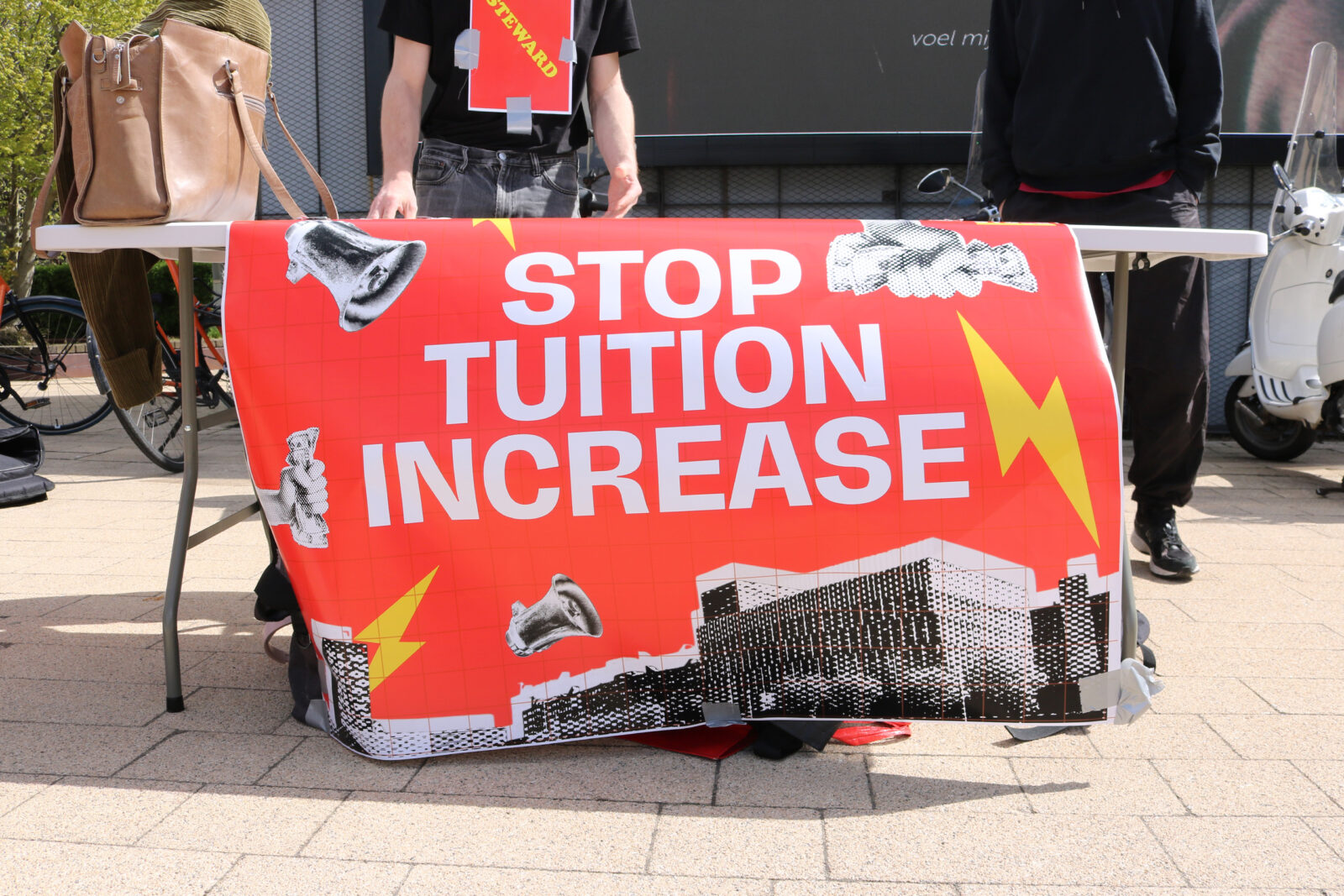
STUUR protested on campus against tuition increase.
Image by: Esther Dijkstra
The petition has already been signed more than 400 times. It was prompted by the university’s proposal to increase tuition fees for non-EEA students on bachelor’s programmes by 8.9 per cent and by 8.6 per cent for master’s students from the 2027-2028 academic year. Students from outside Europe currently pay between 11,400 euros (ESE) and 30,900 euros (EMC) per year. From September 2027, this would rise to between 14,700 euros (ESE) and 35,000 euros (EMC).
Tuition fees have doubled over the past five years
According to a university advisory committee, the increase is needed to ‘bring the fees in line with the national average’. But University Council member Borja Ranzinger does not consider that a valid reason. Through his party Erasmus International, he represents the interests of international students on the University Council. “Non-EEA students already pay six to ten times more than Dutch and European students. It is unfair that they should have to pay even more simply because they happened to be born outside Europe.”
Dutch and European students pay 2,694 euros in tuition fees this year, the so-called statutory tuition fee. Non-EEA students – in other words, students from outside the European Union, Iceland, Liechtenstein or Norway – pay the institutional tuition fee instead of the statutory tuition fee. Universities determine the level of this fee themselves. In recent years, institutional tuition fees have risen sharply at most faculties and have more than doubled as a result. While a bachelor’s student paid around 7,000 euros at most faculties in 2022, under the new proposal that would rise to 14,700 euros in 2027.
Students getting into financial difficulty
STUUR chair Joerie Kivits fears that the increase will prevent non-European students from completing their studies, push them into financial difficulty or even leave them without enough money to cover their basic needs. And Ranzinger argues that the higher fees are not even worth it. “The university is expected to earn around 1.5 million euros in additional income from this measure. That amounts to just 0.2 per cent of the university’s annual budget. The impact on students is therefore considerable, while the financial benefit for the university remains limited.”
Transitional arrangements scrapped
The proposal also states that transitional arrangements will be abolished. This means students who have already started their studies will receive less protection against future fee increases. Ranzinger is also concerned about this. He says it is unfair that first-year students who began their studies with a particular financial outlook could later be required to pay significantly higher fees. “A student who now pays around 13,000 euros would end up paying at least more than 15,000 euros by their third year.”
'Because of the rising tuition fees, the best students will no longer come here, only those who can afford it'
Stress
According to Ranzinger and Kivits, the consequences of the proposal are already becoming visible. Students say they are under intense pressure to be able to continue paying for their studies, says Ranzinger. “It is also a missed opportunity for the university: because of the rising tuition fees, the best students will no longer come here, only those who can afford it.”
Petition to be presented
STUUR wants to present the petition, together with personal stories and letters from students, to the Executive Board. “So that the board can see that this is not just about numbers, but about real lives”, says Kivits. “I hope the board realises that the university cannot keep squeezing its students for a bit of extra money.”
On 14 July, the University Council will discuss the proposal. The final decision will then rest with the Executive Board.
Een lijst met artikelen
-

International students under stress due to doubling of tuition fees in five years
Gepubliceerd op:-
Money
-
De redactie
-
 Feba Sukmana
Editor
Comments
Comments are closed.
Ad
Read more in Money
-

For the first time, student debt in the Netherlands falls
Gepubliceerd op:-
Money
-
-

Interest on student debt at highest level in 17 years
Gepubliceerd op:-
Money
-
-
After a second compensation payment, that must be it for students who missed out
Gepubliceerd op:-
Money
-
Politics
-