Ad

Executive Board regularly uses AI for speeches and LinkedIn posts

Speeches and social media posts by chair of the Executive Board Annelien Bredenoord and rector magnificus Jantine Schuit were written or rewritten with the help of generative AI around half of the time over the past year, according to an investigation by EM. Schuit confirms that communications staff use AI for their texts and regards it as a ‘useful tool’.
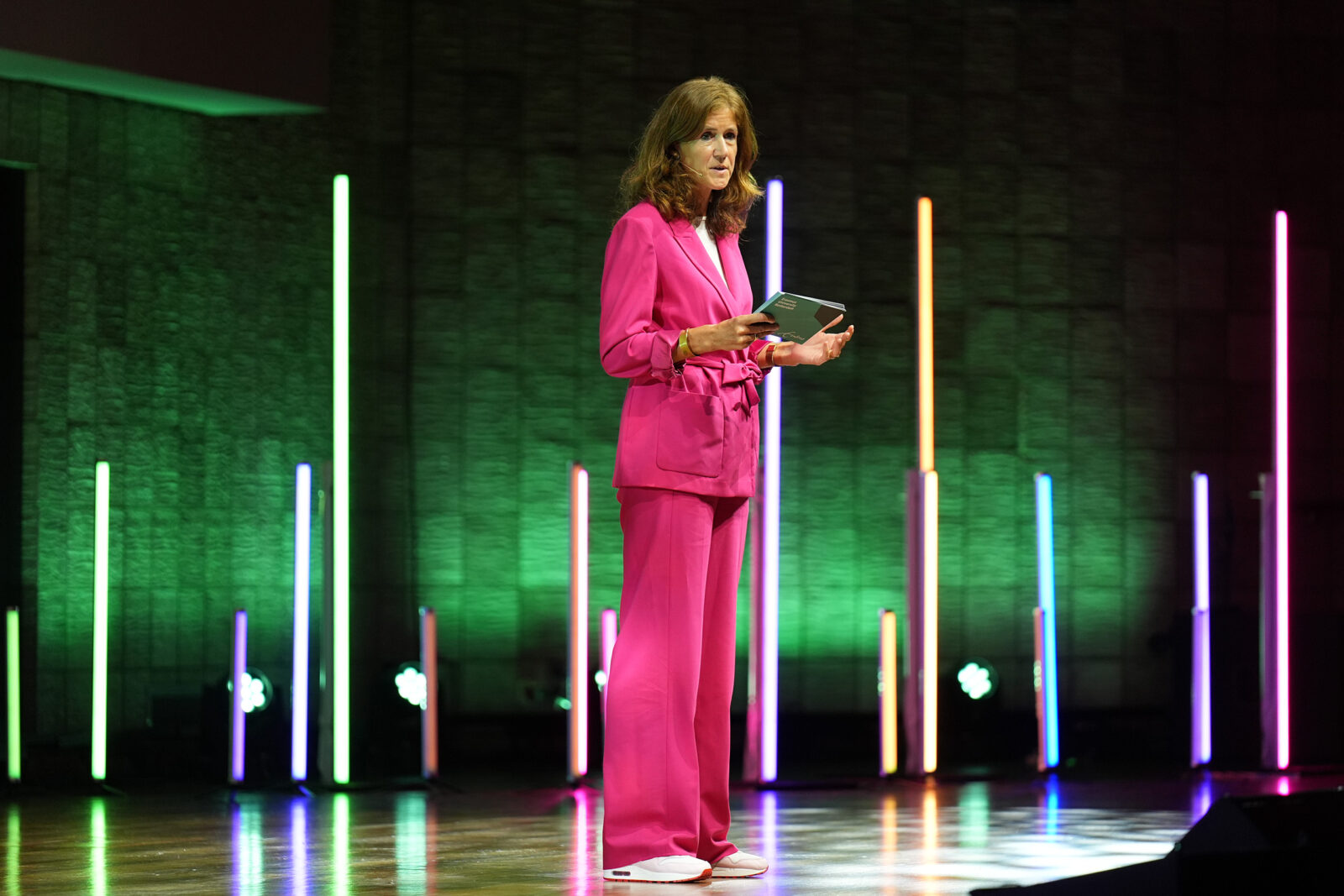
Executive Board chair Annelien Bredenoord gave a speech during the opening of the Academic Year that was made up of partially AI-generated text according to Pangram.
Image by: Arie Kers
In this article:
- AI detector Pangram found AI generated text in 4 out of 5 analysed speeches by Bredenoord and Schuit
- Pangram also detected AI in roughly 50 percent of Executive Board LinkedIn posts
- The amount of AI-generated text seems to increase over the past year
- The Executive Board confirms the use of AI and considers it a useful tool for staff
- Experts warn for the risk of plagiarism, loss of credibility and increase of ‘polished hot air’ in speeches and posts
For this investigation, EM analysed five speeches and 87 LinkedIn posts by the three members of the Executive Board using Pangram, the same AI tool de Volkskrant used to detect prime minister Rob Jetten’s use of AI. The tool is good at detecting text generated or rewritten by AI, but has more difficulty to distinguish between the two.
The amount of AI detected in Bredenoord’s and Schuit’s work increased in recent months. Of the five speeches examined, Pangram detected more than 50 per cent AI in three. One speech was AI-free, while one was found to contain 6 per cent AI. According to Pangram, half of the LinkedIn posts published over the past year by the chair of the Executive Board and the rector contained AI-generated text.
Liminal times
It is Monday 31 August, the Opening of the Academic Year. Chair of the Executive Board Annelien Bredenoord speaks on the stage in the Aula about ‘liminal times’. “The old is gone, the new not yet shaped. That brings uncertainty, but it also creates room. Room for new narratives, a new order. Room for new ways of living together. Room that calls for creativity and moral courage, and for people and institutions willing to make a difference in it.”
According to AI detector software Pangram, the three-part phrase (with Room repeated three times) was entirely generated by AI. Pangram marked around 60 per cent of the entire speech as AI. This was not the only speech in which AI was detected.
Een lijst met artikelen
-
Opening of the academic year: ‘Beware of arrogant tech optimism, but also of doom-thinking’
Gepubliceerd op:-
Science
-
Board members provide information
Spokesperson Annika Heerekop confirms by email that staff in Marketing & Communications have been using AI for some time when preparing speeches and social media posts for the Executive Board, but denies that texts are generated in their entirety. They are always written ‘based on input from the board members’, says Heerekop.
The AI guidelines do not prohibit spokespeople or board members from using AI. But it can undermine the credibility of board members, says reputation strategist Paul Stamsnijder. Other experts stress the importance of greater transparency. The speeches and posts do not currently mention that AI has been used. “If you say that you use AI and you don’t plagiarise by accident, then I personally have no problem with it”, says Rens Bod, professor of Computational Humanities at the University of Amsterdam.
Pangram: 100 per cent AI
Bredenoord also received help from AI with a speech she gave in April during a working visit by the Estonian president. According to Pangram, the speech text was generated entirely by AI. One caveat: this refers to the written version of the chair of the Executive Board’s speech, not necessarily the words actually spoken. EM was not present when the speech was delivered, so cannot confirm whether they were exactly the same.
Een lijst met artikelen
-

Estonian president Alar Karis in Erasmus Paviljoen: ‘We are not at war, but also not at peace’
Gepubliceerd op:-
Politics
-
Student life
-
In January 2026, at the launch of the dialogues on academic freedom, rector Jantine Schuit gave a speech. Pangram detected 100 per cent AI in the written version. EM was present on this occasion; the version delivered largely matched the written one.
Half of LinkedIn posts contain AI text
EM also examined all LinkedIn posts of at least fifty words published over the past year (Pangram can only check for AI in texts longer than fifty words), a total of 87 posts.
EM found 21 posts by Bredenoord that contained AI text in full or in part, or 47 per cent of the posts examined. On average, 65 per cent of those 21 posts consisted of AI text. Jantine Schuit also had 21 such posts, representing 55 per cent of her posts. Pangram marked an average of 93 per cent of the text in her 21 posts that may have contained AI as AI. AI was detected in one of vice-chair Ellen van Schoten’s four LinkedIn posts, but it was not work-related.
Pangram distinguishes between AI-generated and AI-assisted text. It detected AI assistance in just one LinkedIn post (by Schuit); in all the other posts and speeches, the tool identified AI generation.
‘Polished hot air’
EM found no factual inaccuracies with serious consequences in the speeches and LinkedIn posts containing AI text. One consequence of using AI, however, is that the speeches contain several passages that Suzan Verberne, professor of Natural Language Processing at the Leiden Institute of Advanced Computer Science, describes as ‘polished hot air’.
One example cited by Verberne is the use of false contrasts, such as: ‘[it] isn’t just important for us as scientists; it’s also vital for a healthy democracy’ in a speech by Schuit. Or ‘It is not just a necessity; it is our purpose’ in Bredenoord’s speech at the meeting with the Estonian president. This rhetorical construction appears no fewer than eight times in the speech.
Three-part phrases
Another passage with typical features of AI-generated text is the following from Bredenoord’s speech at the 2026 Opening of the Academic Year. First comes the classic false contrast, followed by a three-part phrase: “Not because resilience is easy, but because it arises in everyday places. In groups, in communities, in institutions that learn to deal with uncertainty.”
The written version of Schuit’s speech at the launch of the dialogues on academic freedom ends with the words ‘Warm regards, [Your name]’, which is more like the sign-off to a letter than the end of a speech (Schuit did not, of course, say this part out loud). Verberne also sees ‘other possible signs of AI in Schuit’s speech, such as the long em dashes without spaces’, something that is, of course, not noticeable in the spoken version.
Een lijst met artikelen
-
Education minister Rianne Letschert also used AI in speech
Gepubliceerd op:-
Artificial Intelligence
-
Board aware of AI use
Spokesperson Annika Heerekop explains by email that although the Marketing & Communications department uses AI when writing speeches, they are not generated blindly. “It is important to stress that the board member always chooses the positions, messages and topics. Every speech or LinkedIn post is first discussed in terms of its content. The board member indicates a particular theme they want to put on the agenda, and the positions and messages are discussed and may be supplemented with material from previous speeches, notes, conversations, reports and so on.”
AI is a tool that writers can use to process text or draft wording, Heerekop writes. “This could mean summarising, combining, structuring, shortening or translating text, converting speech to text, adapting existing text to a different editorial format, or adding a personal tone of voice.” Often, several versions of the text go back and forth between the department and the board member.
Rector Jantine Schuit confirms through Heerekop that she is aware of staff using AI. “With our full schedules, it is impossible for us to write all our speeches ourselves, so we are glad of the support from the press team. They help with the structure and further development. It works well for the team to use AI as a tool for these kinds of texts, because it saves a lot of time.” She also stresses that she reads all the documents herself and makes changes where necessary. “That can still change right up until the moment I, so to speak, walk onto the stage.”
Risk of plagiarism
Is it actually a problem for board members to use AI? For Rens Bod, professor at the University of Amsterdam, it depends very much on how the text is produced. “There is an important difference between generating a speech based on a few short prompts and having it rewrite text you wrote yourself. If you have it written entirely by AI, plagiarism can easily occur. There have been cases where entire sentences from existing texts were copied into such writing. So you need to be very careful.” Bod recommends always running AI-generated text through the plagiarism detector Turnitin before publishing or delivering it.
Old speeches
To check Pangram’s reliability, EM also had ten old speeches scanned. They had been delivered before ChatGPT came along and therefore could not, by definition, have been generated by AI. The tool found no indication of AI use in any of the speeches.
EM also ran several dozen of its own articles through the tool. EM’s policy is that articles must not contain AI-generated text. The sample showed that Pangram found text written or rewritten with AI in one article. It was a column written by a student. The author confirmed using AI, but only to rewrite paragraphs after receiving feedback, not to generate text from scratch. This is also not permitted at EM.
AI can also invent quotes rather than plagiarise, Bod warns, as happened with a speech by Ghent rector Petra De Sutter. In that case, AI-hallucinated quotes were attributed to Albert Einstein. Bod says the most important thing is for board members to be transparent about their use of AI.
Greater risk of reputational damage
Board members have always had others write their speeches, so perhaps nothing has changed with the advent of AI. Reputation strategist Paul Stamsnijder disagrees. “A communications staff member understands a board member’s views, knows their sense of humour and can add empathy to a speech. That is not so easy to replace with AI. You can also expect staff to know their facts and check them.”
According to Stamsnijder, education leaders face a greater risk of reputational damage than leaders in other sectors. “In education, you teach students to think critically and train them to become sensible, independent citizens of the world with their own views. Authenticity and credibility with students are very important. They are, of course, extremely critical of a teacher who, for example, checks exam answers with AI at the last minute. It is not at all a crazy idea to use AI for that, but it can be very awkward for students, since it is often forbidden for them.” At Erasmus University, its use is by no means forbidden for all students, as the AI guidelines also show.
False positives are rare
De Volkskrant carried out extensive research into Pangram’s reliability for its articles on Rob Jetten’s use of AI. The paper cites two academic articles. The first study states that false positives were ‘rare’ across all tested tools, while Pangram performed best in detecting AI-generated text. The other study confirms this and also finds that Pangram is the only tool out of four tested (the others being OriginalityAI, GPTZero and RoBERTa) that recognises almost all AI-generated text (false positives rate below 0,005).
Nevertheless, false reports are still possible. “Pangram is a black box. It responds to statistical features, based on machine learning”, says Verberne. The studies into its reliability were also conducted using English texts. “As far as I know, its reliability in Dutch has not been investigated.” The speeches in EM’s study were all in English, while some of the LinkedIn posts were in Dutch.
Verberne also says it is entirely possible that speeches were written by people and only rewritten with AI. “In that case, the content is entirely original, yet Pangram still gives it a score of 100 per cent.” Verberne herself is unwilling to draw absolute conclusions when Pangram flags a student assignment. “I don’t think that would hold up before the examination board.” Rens Bod agrees. “It is the start of a conversation with that student.”
Een lijst met artikelen
-
RTL: More than half of master’s theses contain AI-generated text
Gepubliceerd op:-
Artificial Intelligence
-
Education
-
De redactie
-
 Elmer Smaling
Deputy editor-in-chief
Comments
Ad
Read more in Governance
-

Staff will soon be able to use new risk guide to assess for themselves whether a collaboration is sensitive
Gepubliceerd op:-
Governance
-
-
Universities want to work more with Defence
Gepubliceerd op:-
Governance
-
Politics
-
-
University president on powerhouses: ‘If we do nothing, we will hit a wall’
Gepubliceerd op:-
Governance
-
Leave a comment