Ad

Staff will soon be able to use new risk guide to assess for themselves whether a collaboration is sensitive

The Advisory Committee on Sensitive Collaborations wants to help staff to recognise risks in new international collaborations at an early stage. To that end, the committee is working on a digital ‘risk guide’.
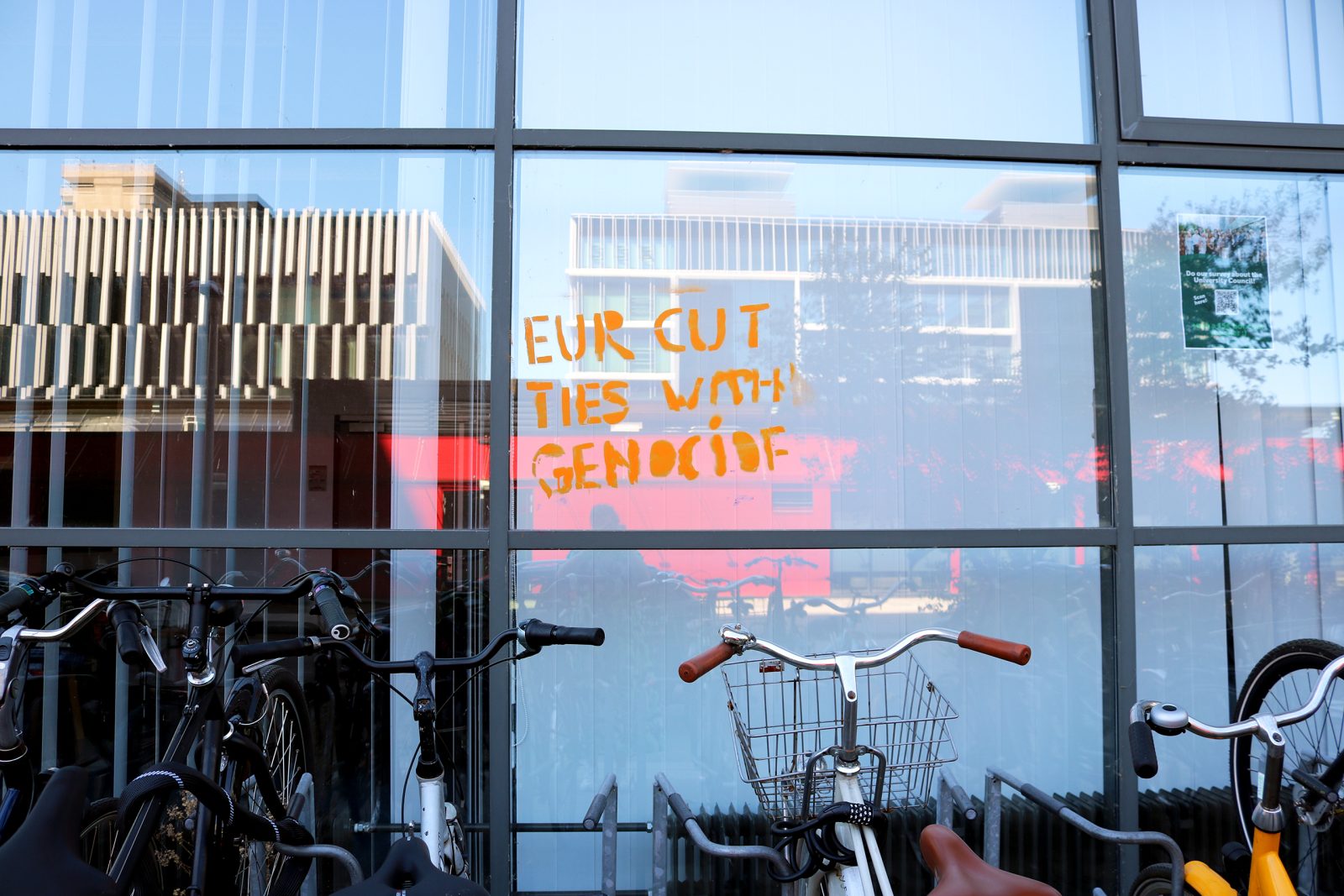
Graffiti on the Van der Goot Building after protests in May 2025.
Image by: Esther Dijkstra
During a walk-in session last Tuesday, members of the Advisory Committee on Sensitive Collaborations gave an update on the current state of affairs and developments around sensitive partnerships. Unlike earlier, well-attended walk-in sessions, only one staff member turned up this time. “I think it is very important to be here”, said knowledge security adviser Joy Konstantopoulos. “There are clear overlaps between knowledge security and the sensitivity of partnerships.”
Risk guide
Alongside the Advisory Committee on Sensitive Collaborations, the university has several different desks for knowledge security, integrated safety and ethics. According to the committee, this means it’s not always clear to staff where they should go with questions about the risks of a collaboration.
To help staff with this, the committee is currently developing a risk guide. Staff are asked a series of questions. If a partnership may involve risks, they will be referred on to the appropriate committee or expert. “The starting point is that a staff member shouldn’t have to assess all the risks themselves. If the answers show that there are heightened risks in a particular area, the tool must indicate where the staff member can turn to”, committee member Liesbeth Enneking explained during the walk-in session.
Increasingly called in at an early stage
The committee has noticed that staff are increasingly able to find their way to it at an early stage. Researchers, for example, bring up the question of whether they should accept a particular conference invitation, or how they can shape a research project with a foreign partner in a responsible way. Sometimes such a conversation leads a staff member to decide not to take part in a project or invitation. In other cases, the committee thinks along with them about the conditions under which a partnership is possible.
“That last aspect is becoming more and more important”, said chair Ruard Ganzevoort. “When a researcher only gets in touch once a collaboration has already been fully set up, there is very little room left to adjust any conditions. If potential problems are discussed at the outset, the partnership can still be designed with those risks in mind.”
Not intended as a political instrument
The committee says it consciously refrains from political considerations about, for example, boycotts. According to Ganzevoort, the central question is not whether the university can change the behaviour of a country or partner, but where the university itself becomes involved in societal risks and what responsibility it has in that regard.
This also means that the committee does not look solely at specific countries. Israel and China are examples of countries with which the university has extensive cooperation and, as a result, the committee receives relatively many questions about them. “We have, for example, not yet had to issue any contextual advice about Sudan. That is mainly because we actually have virtually nothing to do with the country”, said Ganzevoort.
At the same time, societal developments or questions from within the university community may be reason to take a closer look at a particular context. “As with Israel-Palestine, our community is asking whether we can review the collaborations.”
From awareness to policy
The fact that more and more staff are finding their way to the committee also leads to a growing number of questions. “We are pleased that awareness is increasing, but we want to turn that awareness into policy”, said Ganzevoort. The committee is currently carrying out its work with limited capacity. “If the university wants to tackle this seriously, we need more support. Ideally, each faculty would have a clear point of contact, for example.”
In addition, the committee wants to link attention to sensitive partnerships more closely to existing training courses. “In various places within the university, safety issues are already being discussed, but specific awareness of sensitive partnerships has not yet been structurally embedded there”, said Enneking.
The ultimate goal is that staff do not only think about potential risks when a problem arises. It should become part of the working culture, Enneking said. “Automatically pausing to reflect on possible risks when starting a new partnership, and knowing when it is wise to ask for advice.”
Committee to remain in place for now
The future of the committee itself is still a topic of discussion. The committee was set up as a temporary body, with the idea that a structural solution would eventually be needed. The Executive Board is currently in talks with the committee to shape a structural approach.
Read more
-
Criticism of academic powerhouses: ‘A university is not a power station’
Gepubliceerd op:-
Governance
-
De redactie
-
 Feba Sukmana
Editor
Comments
Ad
Read more in Governance
-
Universities want to work with Defence even more
Gepubliceerd op:-
Governance
-
Politics
-
-
University president on powerhouses: ‘If we do nothing, we will hit a wall’
Gepubliceerd op:-
Governance
-
-
‘Academic powerhouses’ to launch by end of 2027
Gepubliceerd op:-
Governance
-

Leave a comment