Ad

‘Academic powerhouses’ to launch by end of 2027

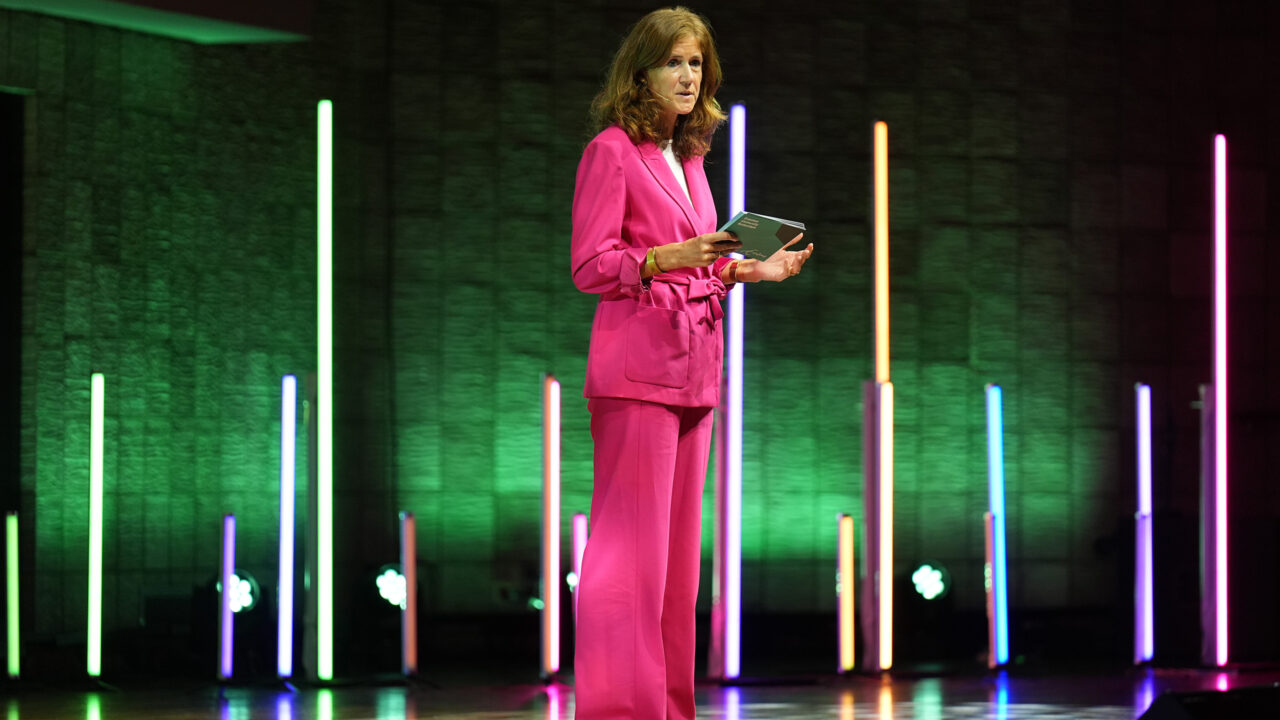
The clustering of faculties into academic powerhouses will actually be implemented in the final quarter of 2027. President of the Executive Board Annelien Bredenoord announced this in a presentation during a town hall on the FutureEUR plan in the Senate Chamber on Tuesday.

Image by: Sonja Schravesande
During the town halls, which have been organised around four times a year since last year, the Executive Board (EB) explains its policy choices. This time, around seventy people attended in person and, according to Bredenoord, an ‘even larger group’ joined online.
Future plan
The main topic of this town hall was the Future EUR plan, with which the EB and the deans want to make the university more resilient in the face of a turbulent future. “We expect there to be forty thousand fewer students in the Netherlands in 2030, the government will not amend the Internationalisation in Balance Act and additional government funding will mainly go to the STEM sciences, and we do a lot of things at Erasmus, but not that.”
According to rector magnificus Jantine Schuit, mergers between faculties have deliberately not yet been discussed. “With this plan, we mainly want to show what we are good at, and in doing so become interesting partners for other universities, the municipality and students. A merger itself is not the aim.” She did not rule out mergers in the future, but said it was too early to say. The plan is currently between the preparation and design phases. The development phase is due to begin in the second quarter of 2027, after which the plan should be implemented by the end of 2027.
Contentious issue
Besides the Future EUR plan, several other topics were discussed. Vice-president Ellen van Schoten had more bad news about hot issue DGI Travel. The travel agency, which has already received so many complaints, has suffered a data breach. “It mainly concerns trips booked in July and August”, Van Schoten said. “The employees involved have already been informed.”
She also said that preparations were already under way for a new tender for the university’s business travel once the contract with DGI expires. “We will set up sounding-board groups for this, so that we can take employees’ wishes into account.”
Sustainable Tinbergen
The final topic, the presentation of the 2025 Impact and Sustainability report, was dealt with at speed by strategy dean Arwin van Buren because of a lack of time. The report was handed out to the Executive Board members and is available to read online. According to Van Buren, it contains so many examples of initiatives in the fields of impact and sustainability that employees had engaged in ‘intense lobbying’ to be included in the report. In his limited speaking time, he still managed to mention that the renovation of Tinbergen “is a leading example” of sustainable renovation and how an important study into child poverty had been taken up by the municipality of Rotterdam.
There were then a few minutes left for questions from the audience. This was initially followed by a long silence, until someone asked what would replace buildings earmarked for demolition, such as V, F, G and Q. Van Schoten: “There are ideas, but it is a careful process. The number of students is declining, so we may also need fewer buildings. You can also think about greater diversity on campus, for example by making room for other partners.”
Een lijst met artikelen
De redactie
-
 Elmer Smaling
Deputy editor-in-chief
Comments
Comments are closed.
Ad
Read more in Governance
-
Executive Board regularly uses AI for speeches and LinkedIn posts
Gepubliceerd op:-
Artificial Intelligence
-
Governance
-
-
Staff will soon be able to use new risk guide to assess for themselves whether a collaboration is sensitive
Gepubliceerd op:-
Governance
-
-

Universities want to work more with Defence
Gepubliceerd op:-
Governance
-
Politics
-