Ad

Executive Board and deans present far-reaching plan for the future: ‘Making choices before others make them for us’
The Erasmus University plans to cluster faculties in order to be more resilient to future threats, such as declining student numbers. Mergers are not on the table in the first phase of this far-reaching plan. However, the academic community is being asked to prepare for ‘tough choices’. By 2028, the plans must be concrete.
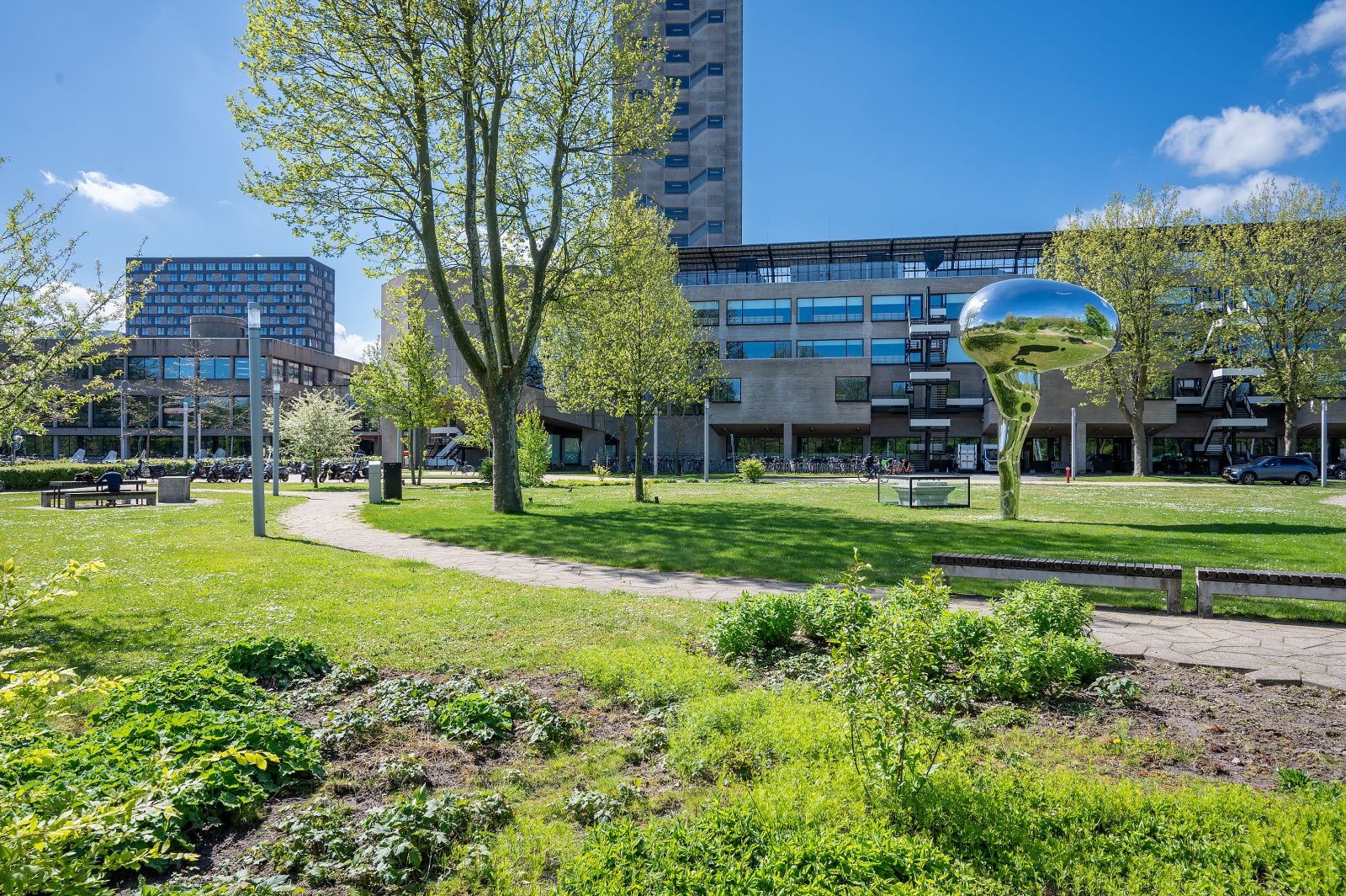
Campus Woudestein.
Image by: Ronald van den Heerik
Update 10 June: An initial response from the Executive Board can be found at the bottom of this post.
“What the EUR delivers is indispensable, yet risks being overlooked”, an email sent to all staff on Friday reads, under the title ‘Stronger together: EUR’s future scenario’. ‘We still have the space to choose for ourselves’, but that’s ‘a luxury with an expiry date’, it reads.
Faculties will be grouped into clusters to promote more collaboration so that the organisation – the Executive Board expects – is more agile, financially more resilient and more in balance.
Powerhouses
Faculties will become part of three so-called ‘academic powerhouses’. The ESE and the RSM will together form Economics & Management, the Faculty of Medicine and Health Sciences (FGG, the faculty divison of the Erasmus MC, red.) and the ESHPM will form the Medical & Health Sciences cluster. The ESSB, the ESHCC and the ESPhil will cluster into Social & Humanities. The two remaining faculties, the ESL and the ISS, are expected to provide so-called ‘cross-cutting, unifying perspectives’ on, respectively, the legal domain and the Global South.
What does this mean for Professional services?
It’s not yet clear whether clustering will also have consequences for the support services. MyEUR says the following about this: “It’s not yet clear whether clustering will also have consequences for the support services. MyEUR says the following about this: “The exploration also looks at how support functions can be organised more intelligently and effectively around the academic powerhouses and the connecting forces. Not only to improve efficiency, but also to ensure support is better aligned with education and research.”
Threats
For a year now, the Executive Board and the deans have been working, alongside the new strategy presented last September, on outlining a future scenario that will make the university resistant to cutbacks, a shrinking student population and government budgets that are shifting towards technical universities.
The national shift of research funding towards technical and natural sciences research and the fact that technical programmes are exempted in the Internationalisation in Balance Act make it necessary to harmonise processes so that ‘significant capacity and resources become available for renewal’.
The decline in student numbers is also a concern. In a report on the financial future of the university landscape published last week, the Education Inspectorate warned that student numbers at universities will fall by 10 per cent over ten years. In concrete terms this means 33,000 fewer students in 2034 than in 2024.
Marjolijn Antheunis, dean of the Erasmus School of Social and Behavioural Sciences, on this: “This shrinkage is substantial – comparable to the size of a large university. To strengthen the position of the Erasmus University it is necessary that we collaborate more and smarter, and we also need to intensify our collaboration with other universities.”
Clustering is a ‘breakthrough’
The Executive Board describes the proposal to cluster faculties as a ‘breakthrough’ towards a stronger profile so that the university is more recognisable locally and internationally and exudes more authority.
Aukje Hassoldt, dean of the Rotterdam School of Management, shares that view: “If you want to explain how the Erasmus University is structured at the moment, that is not so easy.”
The design of the clusters is mostly based on an ‘internationally recognisable classification’ and the national sector plans in which economics and business administration, but also Socials Sciences and Humanities, coincide and, for example, law often retains a distinct position, explains Maarten IJzerman, dean of the Erasmus School of Health Policy and Management. That is something that Harriët Schelhaas, dean of the Erasmus School of Law, recognises. “Lawyers are involved in virtually every problem or research question. The legal perspective is therefore omnipresent, which is why we play a connecting role and why joining one of the powerhouses would not do justice to the importance of the legal perspective.”
'With a merger you spend the first four years setting up governance and sorting out internal discussions, whereas I prefer to start from content and keep looking outwards'
In an initial response, Marjolijn Antheunis says she is pleased with the cluster in which her faculty has been placed, but she also stresses that nothing is set in stone yet. “The ESSB will, together with the ESHCC and the ESPhil, two wonderful faculties, explore how cooperation can be further deepened and possibly organised more efficiently. Forming this cluster is one of the options being explored. In the exploration phase, we will also look at whether another form, such as alternative clustering or a powerhouse structure, would better match the ambitions of EUR.”
According to dean Maarten IJzerman of the ESHPM, forming an academic powerhouse with the Erasmus MC may be logical, but this cluster will also face its challenges, if only because of the difference in size between the two organisations. “The ESHPM is the size of a department within Erasmus MC, so we have to avoid just becoming a 49th department.”
At the same time, he is positive about the ‘synergy’ that can be achieved through collaboration and about the fact that the starting point is first to look at cooperation in terms of content. This is different from, for example, the University of Groningen, where the merger of eleven faculties into seven was recently postponed because there was no agreement on the organisational structure. “With a merger you spend the first four years setting up governance and sorting out internal discussions, whereas I prefer to start from content and keep looking outwards.”
Rising in the rankings
According to the Executive Board’s email, clustering the faculties will also benefit the university’s international ranking, because ‘we will collaborate more effectively’.
Aukje Hassoldt of RSM, a faculty traditionally strongly focused on the international rankings, says: “For RSM specifically, I see opportunities through this initiative to further strengthen the position of a broad business school with a strong international brand name and reputation. The same applies to ESE: by collaborating smartly and learning from each other, both schools can emerge stronger from this. Other business and economics schools worldwide show that this is possible.”
Next phases
Presenting the clustering structure is the first phase of a process that is expected to result in a concrete plan by mid-2028. Whether mergers between faculties will ultimately take place and whether the university will reorganise is not an issue at this point. The MyEUR page with frequently asked questions states: “A merger is not the aim, nor is it what we are investigating. The aim is to strengthen joint efforts in education, research and organisation, not to give up identity or autonomy. Whether any structural steps might follow in the future is a matter for a later phase.”
Schelhaas points out that one and a half years is quite a short time to come up with concrete plans. “And it is not just about coming up with nice new collaboration plans, because you cannot keep piling things up; ultimately we also have to make choices, and that is not something we, as universities, are always good at.”
IJzerman agrees: “This first phase is an exploration of possibilities, after which we will have to set a course, possibly with difficult choices.”
Response Executive Board
Executive Board President Annelien Bredenoord wants to respond in more detail to the scenario at the start of the coming academic year but says in an initial reaction: “With Strategy 2030 we have jointly chosen what EUR stands for. With this Future scenario we are translating that into how we want to be organised. Because we are finding that we can bring out everything we are stronger and more powerfully. Technological innovation is not possible without thinking about what the social preconditions are, and that is exactly what Erasmus University is needed for. That is what we want to present to the outside world.
“What I hope is that academics gain energy from this. That they think: great, the themes I am working on actually align very nicely with an impact domain of the strategy or with the powerhouse of their faculty.
“Together with the deans we will first focus on the design phase. This will yield serious input on the do’s and don’ts and the possibilities of the academic powerhouses, which we can then build on later this autumn. That is, for now, my goal on the horizon.”
Een lijst met artikelen
Comments
Comments are closed.
Ad
Read more in Governance
-

Staff will soon be able to use new risk guide to assess for themselves whether a collaboration is sensitive
Gepubliceerd op:-
Governance
-
-
Universities want to work more with Defence
Gepubliceerd op:-
Governance
-
Politics
-
-
University president on powerhouses: ‘If we do nothing, we will hit a wall’
Gepubliceerd op:-
Governance
-