Ad

The 2025 EM TV newsflash year in review


From Fouad L.’s court case to a fire in Tinbergen, from protests to politics. A lot of things happened this year on and off campus. Some events full of love, others full of tension due to impending budget cuts. This is the EM TV newsflash year in review.
U kunt deze ingesloten inhoud bekijken nadat u akkoord bent gegaan met cookies van YouTube.

January
The year started of with Fouad L.’s court case. The former medical student was on trial for the triple murder of his neighbour and her 14-year-old daughter and a lecturer from the Erasmus MC. The trial lasted four days, and EM was present in the court every day. Eyewitness, experts, survivors and family of victims spoke. It was a very emotional time for those involved, extra because Fouad L. showed no remorse. The judge sentenced L. to lifelong imprisonment a month later.
Also in January, there was a cyber-attack that made the wifi slow down. The Erasmus University was not the only victim of the DDoS attack. At the end of the month, a report showed that men at EUR still get paid 15 percent more than their female colleagues. The results are described by Executive Board Chair Annelien Bredenoord in an interview on the university’s intranet as ‘quite a bitter pill’.
February

Gregory and Victoria met while studying Business Administration.
Image by: Private photo
In February, the university announced that five buildings will be closed in 2025. This is due to budget cuts. The buildings were already earmarked for demolition but will now close before the end of this year. In December some haven’t closed yet, G for example will stay open for a few more months.
There was love in the air this month. Alumnus Gregory got down on one knee and proposed to his Victoria in the Van der Goot building, the place where they first met. They started the day with breakfast in Kralingen. Later in the morning, they walked towards campus. “I thought: wow, this is absolutely perfect”, Victoria told EM. “We were just going back to where it all began. I suddenly got so excited.”
March
March started with a demonstration from OccupyEUR, against a Shell sponsored wine tasting in the Erasmus Pavilion. Thirteen protesters gathered in front of the entrance to the Pavilion. According to protesters, it is unacceptable that the university portrays itself as a sustainable institution with its own climate strategy, while at the same time allowing the fossil fuel industry to take part in events on campus.
And Vicky Maeijer, a PVV State Secretary in the Schoof cabinet,, had her master thesis at the Erasmus School of Law retracted by the university. About half of her thesis turned out to be plagiarised.
April
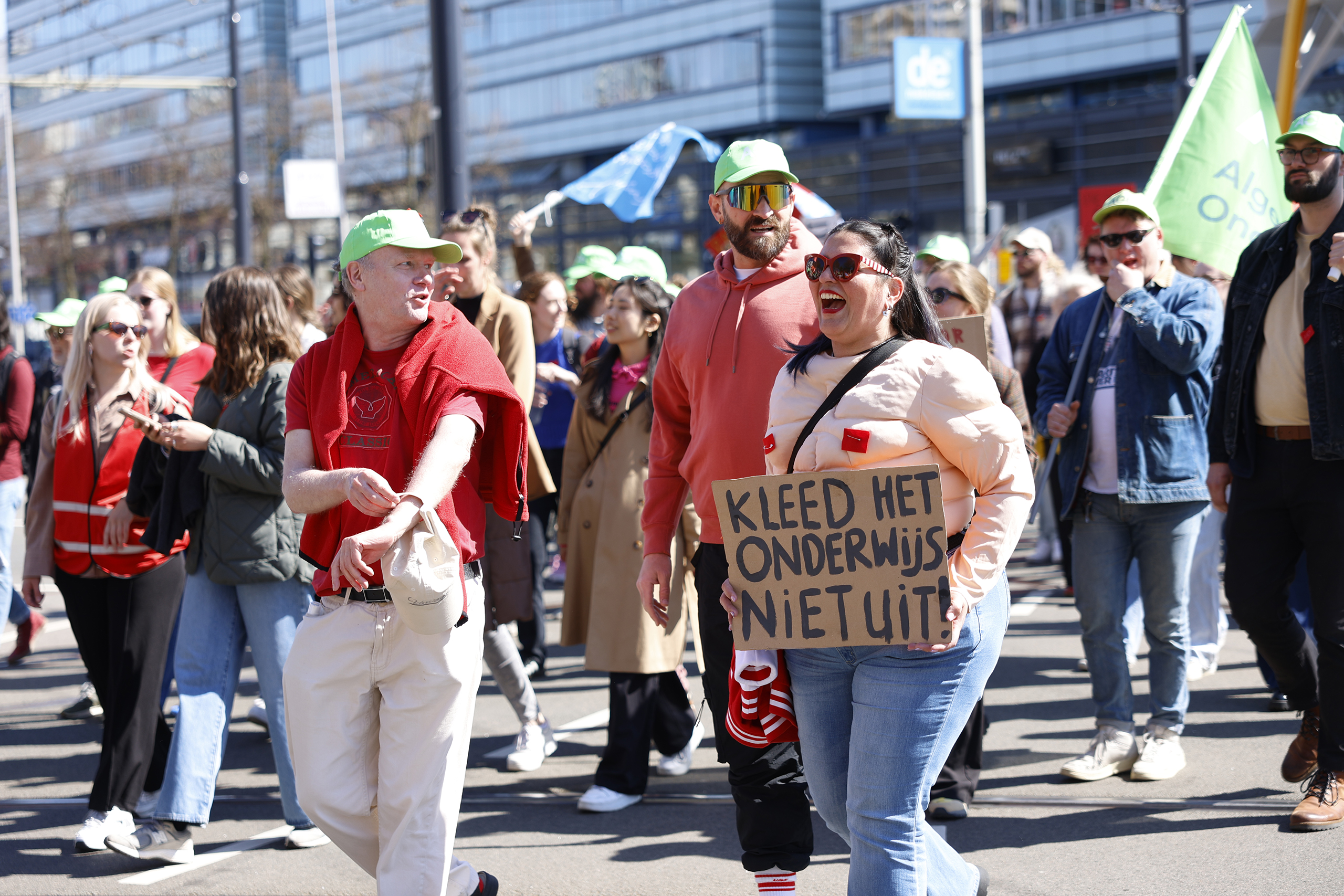
Image by: Daan Stam
The month of a relay protest: all universities protested against the budget cuts of 1 billion euros that are looming over higher education. They protested one by one. On 8 April, it was the Erasmus University and Rotterdam University of Applied Sciences’ turn.
The elections for the University Council were won by the Erasmus Student Coalition. Many students came out to vote: nearly one and a half times as many compared to last year.
May
In May, the university warned students and staff with an X in their passport to not go to the Unites States. They could get in trouble at the border and send back. Additionally, individuals suspected of criticising the US or Israel are being barred.
On Tuesday 13 May, OccupyEUR set up an encampment on the Erasmus Plaza, in protest of the universities ties with Israeli institutions. They left during the night from Saturday to Sunday. They wrote ‘we’ll be back’ on the Van der Goot building.
And why is it so difficult to expel unsuitable medical students? Too many medical students about whom there are serious doubts regarding their suitability as doctors receive their diploma, examination committees and programme directors say. Research from EM shows that Erasmus MC has been trying to find more possibilities to expel unsuitable students since the beginning of this century, but the existing regulations are inadequate.
June
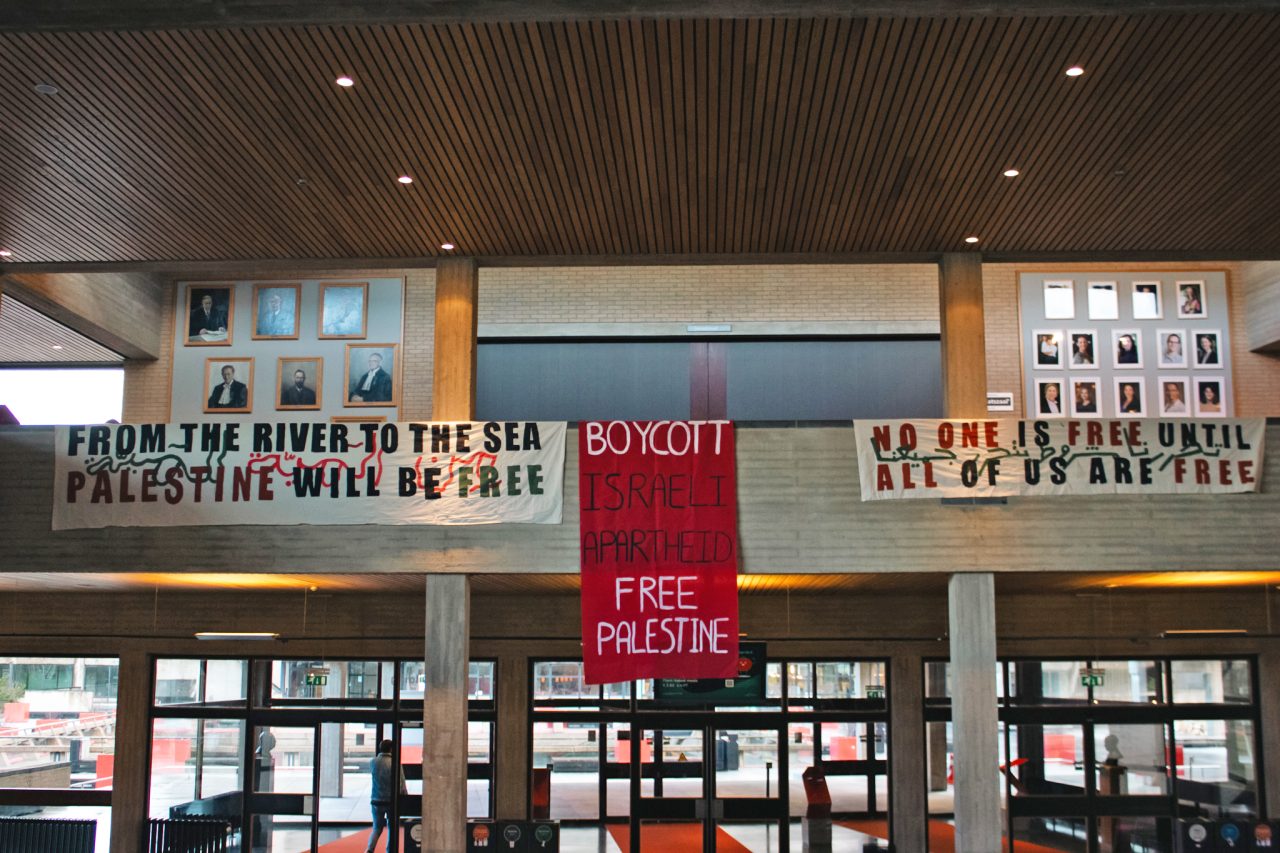
Protests have long been held at Erasmus University against ties with Israeli universities. This was in December 2023.
Image by: Shrey Khurana
To prevent the risk of complicity with war crimes and human rights violations, the university decided to freeze ties with three Israeli universities. Collaborations with Bar-Ilan University, Hebrew University, and the University of Haifa were immediately put on hold. This decision was based on advise of a committee. “Our international collaborations are based on academic freedom and scientific diplomacy. But that freedom has limits when fundamental human rights are at stake”, said chair Annelien Bredenoord regarding the decision on the website of Erasmus University.
Study associations raised the alarm over board positions in June. Board members of study associations are struggling to find successors. “This year the situation is more urgent than ever”, they wrote in a letter to the Executive Board. The consequences? Some associations are at risk of disappearing. To reverse this trend, council members from the OUR Erasmus party are advocating for study credits to be awarded to students who take on a board year.
August
Rotterdam welcomes new students with the shortest Eurakaweek ever. For the first time, students from universities of applied sciences (hbo) are also welcome. The introduction ‘week’ lasts only three days and attracts four hundred fewer students that the previous year. The hope was to attract more students and thus generate more income.
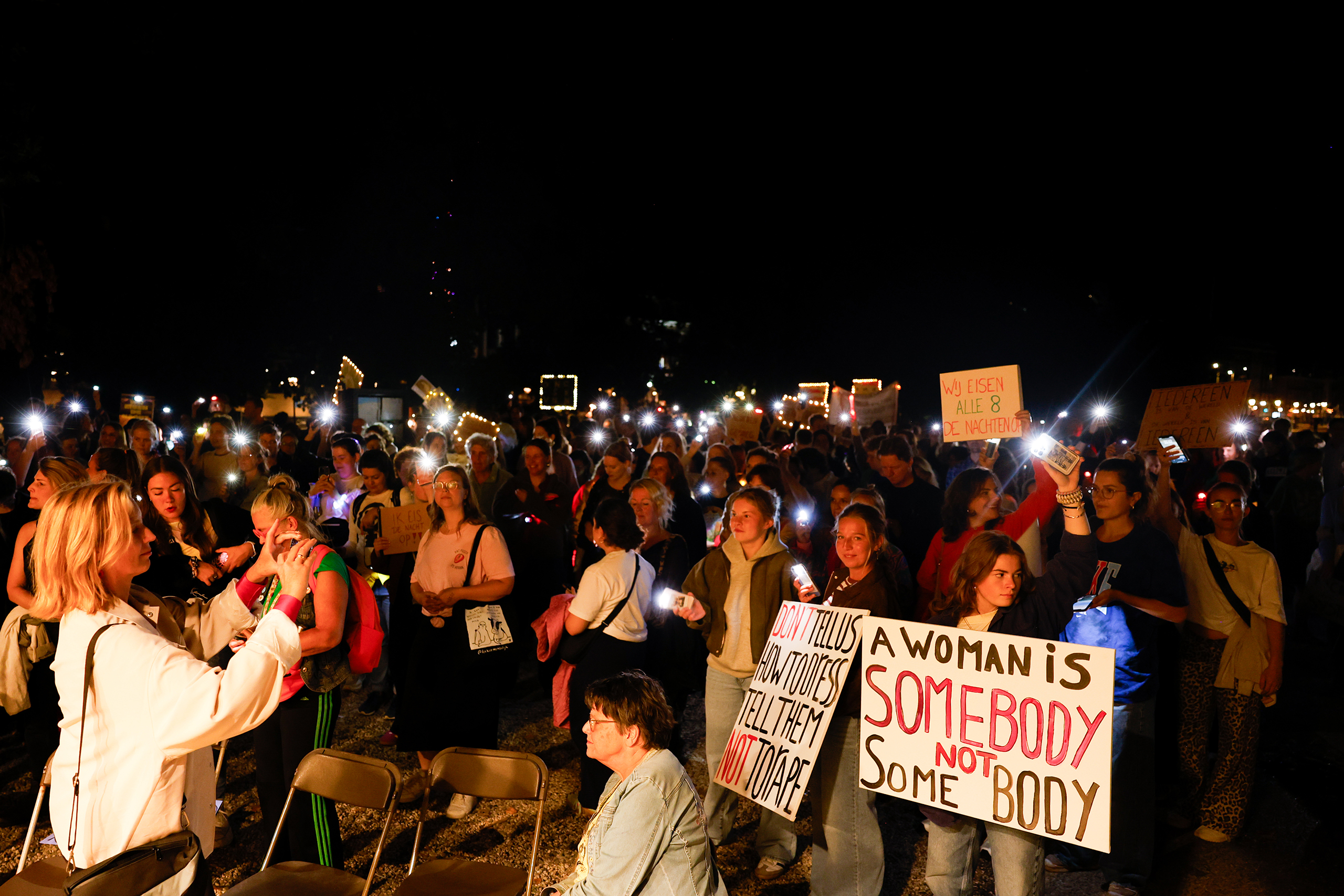
Under the slogan 'the night is ours' demonstrations were held at dozens of locations across the Netherlands at the end of August. In The Hague hundreds of people gathered.
Image by: Daan Stam
September
The academic year started with two protests on the same day. In the plaza, just over a hundred people made noise to draw attention to the situation in Gaza. An hour later the ‘alternative opening’ of the year in protest of the budget cuts began. A few days later, under the slogan ‘the night is ours’, demonstrations were held at dozens of locations across the Netherlands.
October
All food establishments on campus signed a deal in October. They all agreed to work towards a planetary health diet over the next five years. This means that by 2030, half of all menu items must be plant-based and carbon emissions from food and drink must be halved, according to the signed covenant.

Still from a video by a student.
Image by: Justin Tse
Mid-October, there was a fire on the sixteenth floor of the Tinbergen building. It was quickly extinguished, but the entire campus was up in arms because many people saw the black smoke coming out of the monument in renovation. Later, it became clear that some insulation caught fire when a worker was cutting old drain pipes, which caused sparks. Nobody was injured.
A PhD candidate lost his job at the Erasmus school of Law. The PhD, who has Palestinian roots, believed that his supervisor and another professor had made unacceptable statements about Gaza and Palestinians. His supervisor, for example, signed an open letter calling the accusation of genocide antisemitic. The PhD candidate requested a new supervisor, but wasn’t allowed one.
At the end of October, national elections were held. At the polling station in the Langeveld Building, D66 received 36 percent of all votes. The PVV, which was the largest in the country two years earlier, won less than 2 percent. D66 also came out on top at the polling stations at Erasmus MC, Erasmus University College and RSC/RVSV.
November
In November, EM reported that some medical students are afraid to go to their doctor. Because the assistant on the phone might be a fellow student, housemate or friend. That leads not only to discomfort but also to mistrust: what if that familiar face looks into your file or talks about you during a break?
This month, it became more apparent what the budget cuts will mean for staff and students. It’s always the small stuff that goes first: no more printed sashes for graduates with distinction, no more fresh fruit in the office, no one-off bonuses, and the sports café will be closed at weekends. Each faculty is dealing with them in its own way.
December
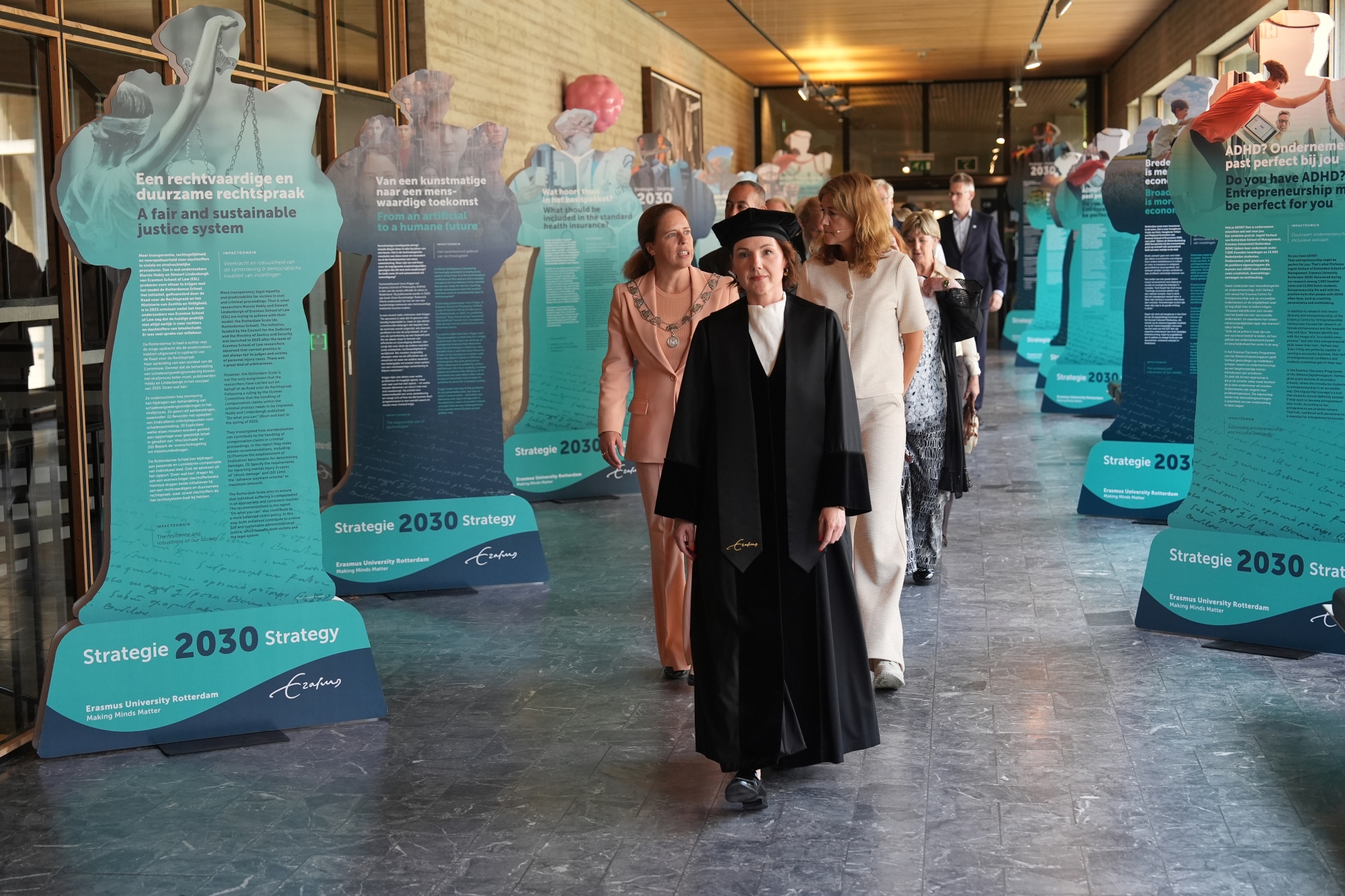
During the Opening of the Academic Year 2025/2026, with Mayor Carola Schouten behind the padel, next to her professor and chair of the board Annelien Bredenoord.
Image by: Arie Kers
December started with Found L.’s appeal. L. will again be examined by psychiatric experts from the Pieter Baan Centre, at the request of the Public Prosecution Service and of the defense of Fouad L. Both want L. to be given TBS, compulsory psychiatric treatment. The Public Prosecution Service sees TBS as the best way to keep L. out of society. L. says he wants the treatment.
Latest figures showed that three in ten professors at Dutch universities are women. Erasmus University is still well below that, at 26.7 per cent, but has set the ambition of reaching 40 per cent by 2030.
Read more
-
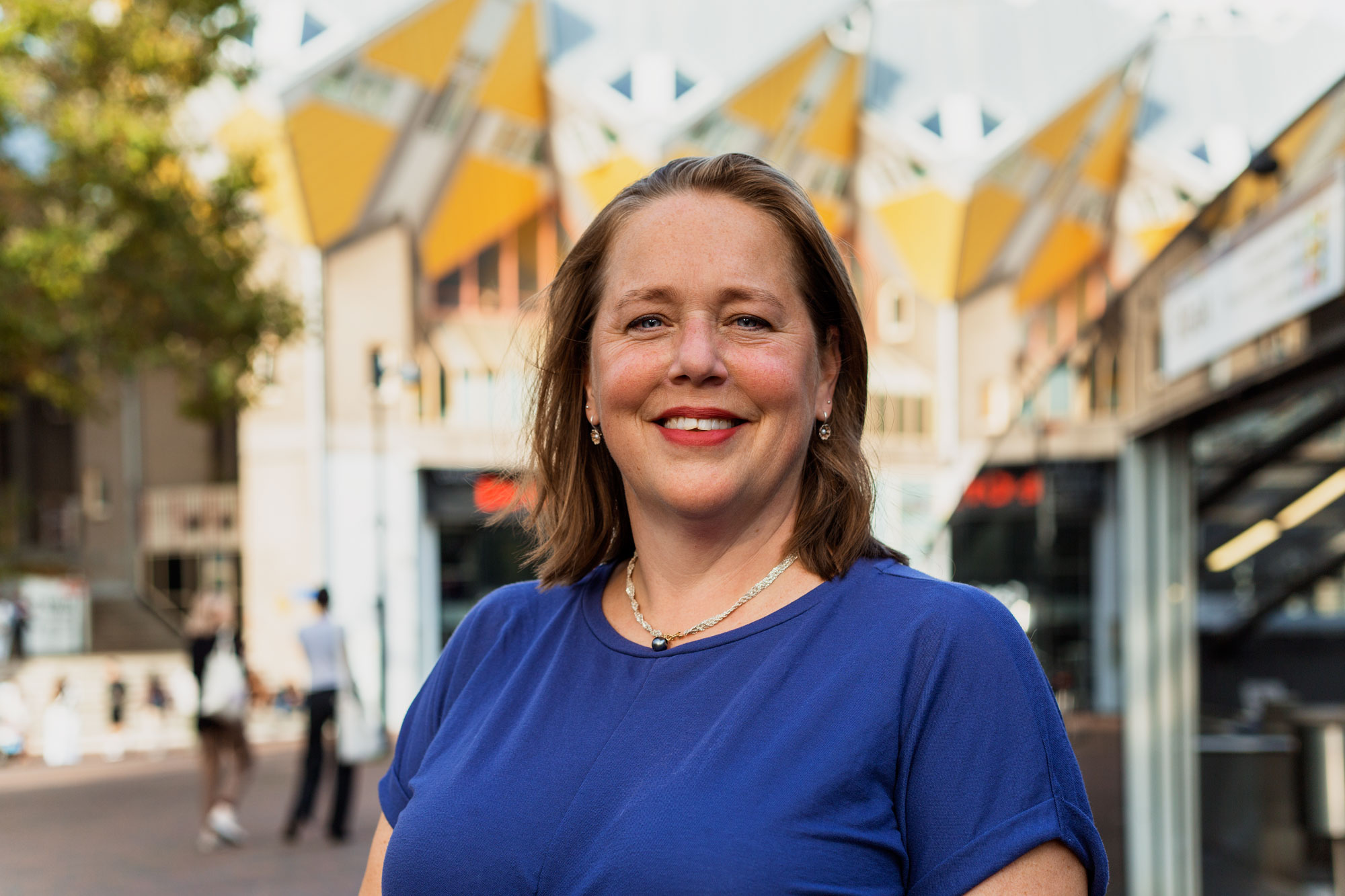
At the end of the year, Erasmus Magazine wishes everyone an empty head, warm hands and a full heart
Gepubliceerd op:-
Editorial
-
De redactie
-
 Nora van der Schoor
Video editor
-
 Defne Işık
Student Video reporter
Latest news
-

New code of conduct for science emphasises ‘distinctiveness and autonomy’
Gepubliceerd op:-
Science
-
-
Executive Board regularly uses AI for speeches and LinkedIn posts
Gepubliceerd op:-
Artificial Intelligence
-
Governance
-
-
TU Delft may not favour women in admissions to courses
Gepubliceerd op:-
Education
-

Comments
Comments are closed.
Ad
Read more in EM TV
-
EM TV newsflash: Many more reports of social unsafety, poop in Utrecht and a smaller carbon footprint
Gepubliceerd op:Article type: Video-
EM TV
-
-
Some students resort to AI to find study announcements: ‘It gave me fake information’
Gepubliceerd op:Article type: Video-
EM TV
-
-
EM TV newsflash: Porn in Pavilion, no joint Eurekaweek and highest interest rate for student debt in decades
Gepubliceerd op:Article type: Video-
EM TV
-