Ad

Campus food companies aim for 50 per cent plant-based by 2030

Catering and retail entrepreneurs on campus solemnly pledged on Thursday afternoon to work towards the planetary health diet over the next five years. This means that by 2030, half of all menu items must be plant-based and CO2 emissions from food and drink must be halved, according to the signed covenant.
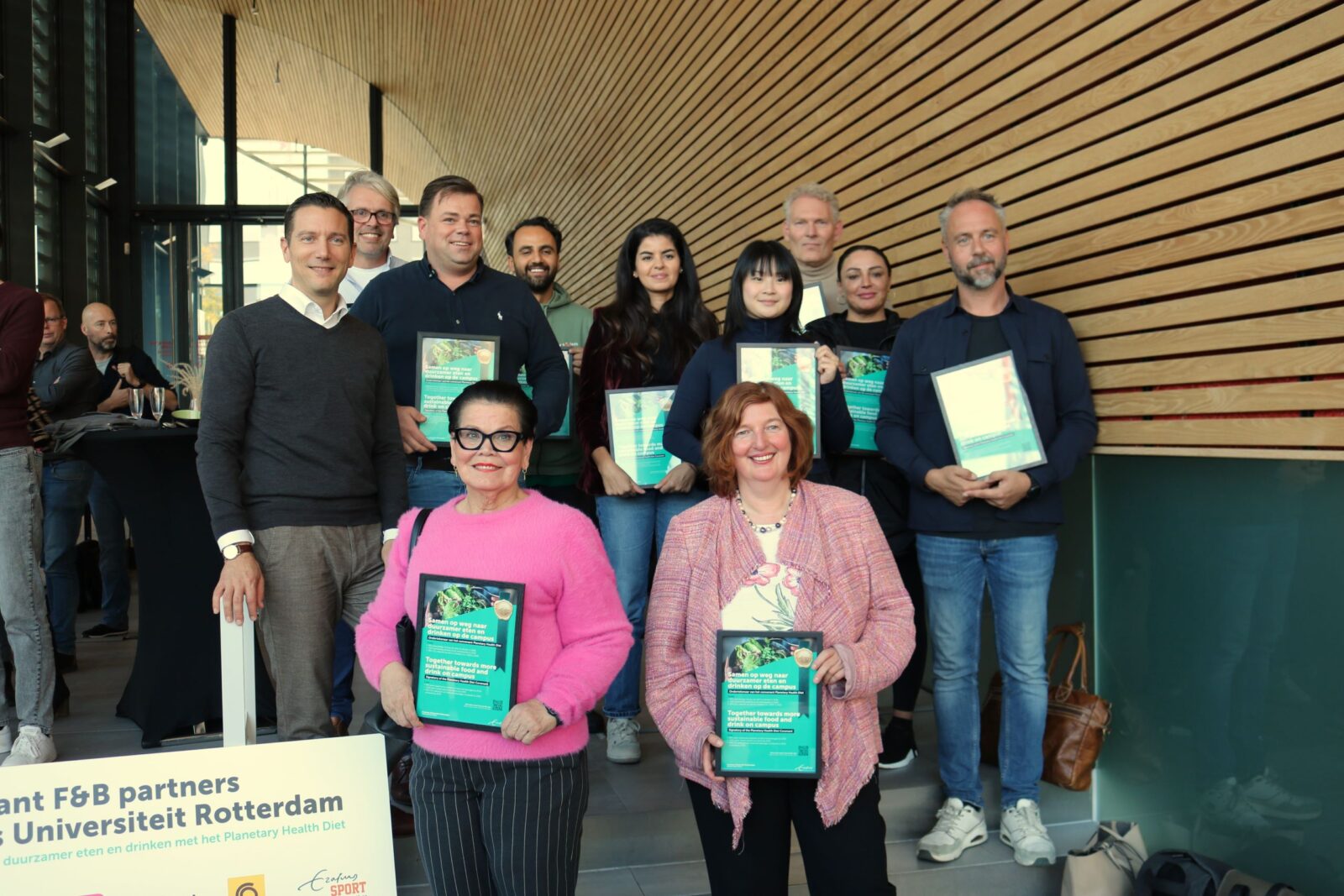
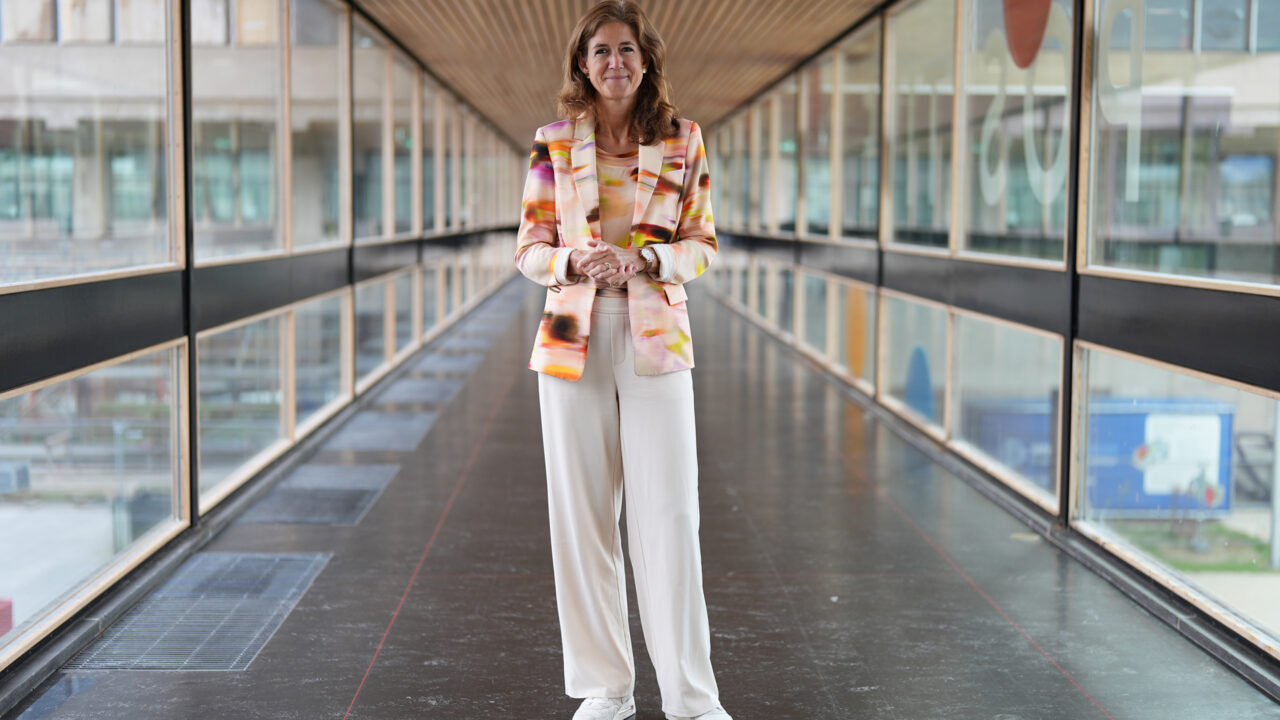
Executive Board member Ellen van Schoten (front right) and the campus entrepreneurs.
By 2030 half of the options on the menu should be vegan dishes. For purchasing, the intention is that 80 per cent of the food (measured by weight) is plant-based, explains sustainability policy advisor and the driving force behind the covenant Annemiek Strijker. “So, for example, a plate of pasta bolognese may now still be 30 per cent mince, that then has to be a maximum of 20 per cent. That can be done by using less mince, but also by partly using meat substitutes”, she said.
An example of this can already be found in the Spar supermarket, where the new ‘hybrid’ sausage roll now contains half meat and half meat substitutes. The objectives for the campus supermarket apply only to certain product categories, such as sandwiches, dairy, hot snacks and ready meals. For dairy the ambition is to emphasise plant-based alternatives such as soy, oat and almond.
The coming years also include various experiments, says Strijker. “We will look at how we can nudge people towards more sustainable choices.” One example was the vegan soup that was previously available in the Pavilion. “When we later called it autumn soup, with the same recipe and still with that little green tick but without the word vegan, the soup suddenly sold much more often.”
Averages
Not every location has to exactly reach the 50 per cent: the operators agree to work with averages, so that one business does not have to go as far as another. For a vegan salad bar the objective is simply easier to achieve than for a kebab shop. “They can make arrangements among themselves. For the kebab shop it is, for example, quite possible to work towards the objective of reducing carbon dioxide emissions. If you replace beef with chicken, for instance, that already saves a lot of CO2”, Strijker explains.
‘It was at times also very complicated, because when you touch people’s food, you touch emotion’
Executive Board vice-chair Ellen van Schoten explained in her speech that it was not an easy path to get to this covenant. “Decision-making processes at the university often take a long time, but this one took very long. And it was also very complicated at times, because when you touch people’s food, you touch emotion. I think we have all experienced that. But we did manage it eventually”, she said proudly.
Not entirely vegan
The ambitions in the agreement are slightly lower than the original plans of the Executive Board. After declaring the climate emergency in 2023, the Executive Board wanted to create an entirely vegan campus by 2030. But that proved unfeasible.
The university has no direct control over most food retailers on campus; there are direct contracts only with Vitam (canteens and catering) and coffee supplier MAAS. But those companies saw their competitive position seriously threatened if they were the only campus hospitality required to become fully plant-based. The University Council also argued for a watering down of the fully vegan ambition.
Therefore an ambition was sought that all operators on campus could voluntarily commit to. That became the planetary health diet, which still allows some animal products but clearly shifts the course towards plant-based and more sustainable food.
The restaurants and shops taking part in the covenant are CoffeeCompany, MAAS, Spar University, Erasmus Paviljoen, MOZZA, Tosti World, Erasmus Sport Café, RSM BV Cantina, Vitam, Sally’s Salads, HAS and Sohmi. These comprise all outlets selling food and drink on the Woudestein campus.
Lees meer
De redactie
-
 Elmer Smaling
Deputy editor-in-chief
Latest news
-
In memoriam Rob van der Wal
Gepubliceerd op:-
In memoriam
-
-
Lively trade in tickets for graduation ceremony: ‘Excessive prices are undesirable’
Gepubliceerd op:-
Student life
-
-
University president on powerhouses: ‘If we do nothing, we will hit a wall’
Gepubliceerd op:-
Governance
-
Comments
Comments are closed.
Ad
Read more in Sustainability
-
EUR and UvA are the only universities where fossil fuel companies are no longer welcome at career days
Gepubliceerd op:-
Sustainability
-
-
Students cut, cook and compost correctly during Sustainability Days
Gepubliceerd op:-
Sustainability
-
-
Committee on fossil industry: Collaboration must meet ‘moral minimum’ or stop
Gepubliceerd op:-
Sustainability
-