Ad

EUR and UvA are the only universities where fossil fuel companies are no longer welcome at career days


The EFR study association is no longer allowed to work with fossil fuel companies due to stricter rules at Erasmus University on collaboration with polluting companies. But what is the situation at other universities and their study associations? Together with the University of Amsterdam, Erasmus University appears to be top of the class, according to a survey by EM.
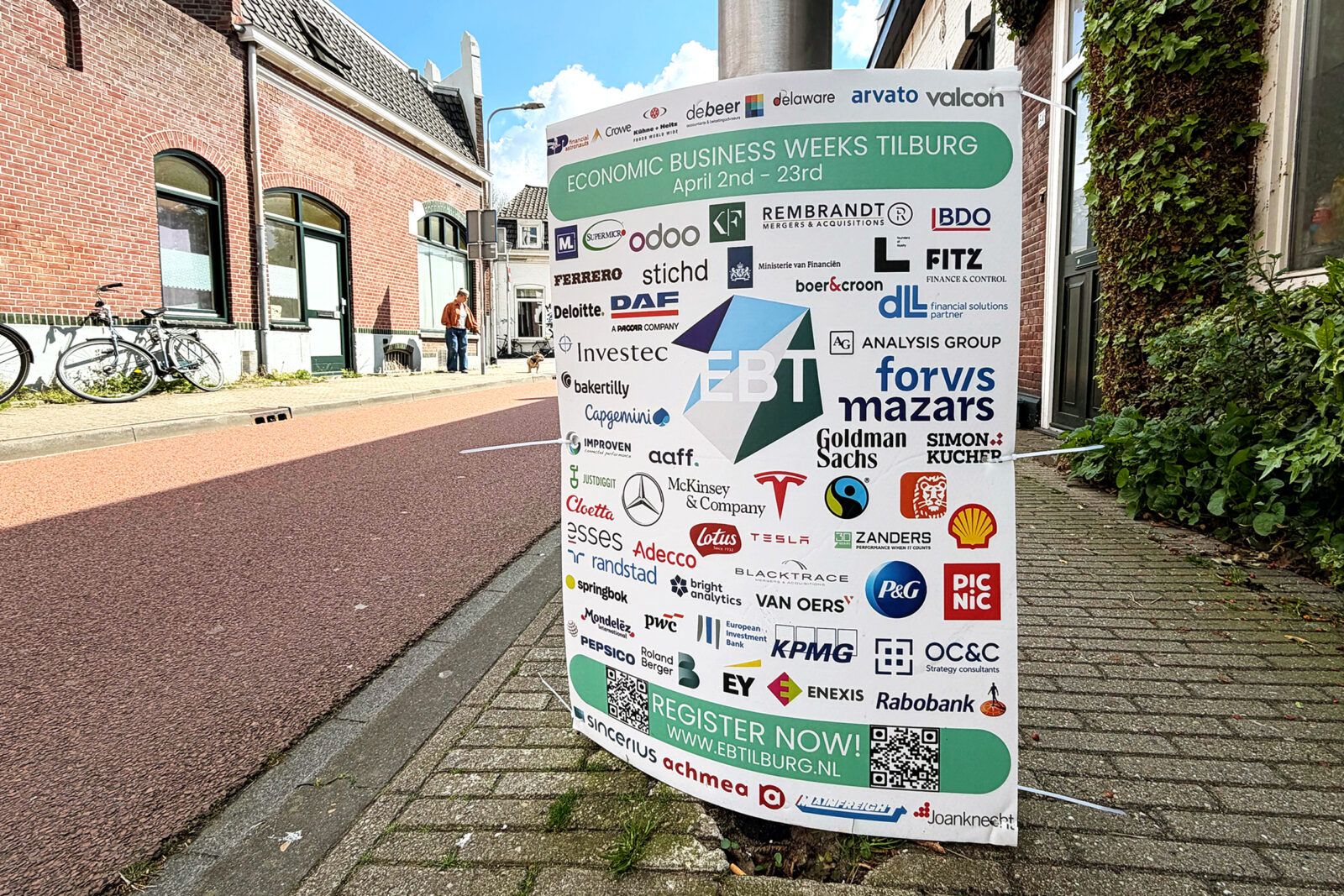
A poster showing the companies that attended The Economic Business Weeks in Tilburg.
Image by: Wieneke Gunneweg
Two Dutch universities have largely suspended collaborations with the fossil fuel industry. In addition to Erasmus University, the University of Amsterdam (UvA) has also introduced restrictions on working with polluting companies. These rules extend to study associations that organise events such as company days. At three other universities there are restrictions but no outright bans. At the remaining universities there are no rules, although at several this seems to be only a matter of time.
New rules
Since this academic year, companies and organisations must meet a ‘moral minimum’ before they are allowed to collaborate with Erasmus University. This is how the Executive Board described last year’s new rules for collaboration with companies in the fossil energy sector. Existing contracts, such as the annual contract that study association EFR has with Shell, may run their course. This long-standing collaboration will end next academic year. Only after passing the partner assessment of the specially established Expert Committee on the Fossil Industry may a company still collaborate with the university.
Moral minimum
The moral minimum at Erasmus University is set out in the assessment rules for collaborations: “The minimum requirement is that the project has no negative effects on the climate or living environment. In addition, a balanced partnership must be ensured and dual use and greenwashing based on (the results of) the project or collaboration must be prevented.” The partner must support the objectives of the Paris Climate Agreement and in practice also ‘move towards’ those objectives.
In this respect, Erasmus University is not entirely unique: one other Dutch university has had similar rules since 2023 – the UvA. “Individual collaborations, such as a joint paper, presentations at a conference, guest lectures, or a student internship, do not have to be assessed”, a UvA spokesperson says. However, formal collaborations with fossil energy companies, such as data sharing, research collaborations, one-sided funding and student exchanges, are no longer possible without approval from its own advisory committee. As a result, no companies from the fossil sector were present at the Amsterdam Career Days in March.
No rules
The survey by EM further shows that seven universities have no, or not yet any, rules on fossil collaborations or stricter rules for student organisations. These are Tilburg University, the University of Twente, Maastricht University, Vrije Universiteit Amsterdam, Wageningen University, Radboud University and TU Delft.
At most universities, collaborations are being examined. TU Delft, for example, is working on an ‘evaluation framework’ based on advice to the Executive Board to increase transparency in collaborations with the fossil industry. How this will affect the university remains to be seen, but any restrictions on collaboration will also apply to student organisations, a spokesperson says.
Collaboration with conditions
At Eindhoven University of Technology, collaboration with the fossil sector is only allowed if the research focuses on sustainability and the energy transition, a spokesperson says. “This rule also applies to student organisations. For example, the Career Expo, which is organised by students, may only admit fossil fuel companies if they are recruiting for roles in the energy transition and/or sustainability.” A special committee that will assess collaborations will soon be set up in Eindhoven.
In Leiden, since March 2025 only new collaborations with the fossil industry are assessed by its own committee. “The guiding question in such an assessment is whether a potential partner complies with the Paris Climate Agreement”, a spokesperson says. “Exceptions to this rule of thumb can only be made for projects that demonstrably contribute to the energy transition.” In such cases it is assessed whether a collaboration is necessary, for example if the company concerned has indispensable data for the research. This policy applies only to research collaborations, the spokesperson notes, not to student and study associations.
Collaborations between the University of Groningen and the fossil industry must ‘make a substantial contribution to the climate transition’, a spokesperson there says in writing. The collaboration itself must also be carbon-neutral and run on renewable energy from day one. The results of the collaboration must be published via open access. “These criteria have been established, but have not yet been widely communicated to the university community at Groningen”, the spokesperson says. That communication is expected in the coming months. Students organising activities on behalf of the university must also comply with these criteria.
Other assessment questions
Several universities say they are working on other assessment frameworks for collaborations. Here too, the UvA is leading the way. Last year it added three more questions to the assessment of collaborations, a spokesperson says. “Are there risks that a project contributes to an armed conflict or to the violation of human rights? Are there risks to knowledge security or of knowledge being misused for undesirable military or terrorist purposes? Are there risks that a project contributes to irreversible harmful impacts on the environment, biodiversity, human health, cultural heritage or animal welfare?” According to the UvA website, these guidelines are intended to help assess ethical risks.
Read more
-
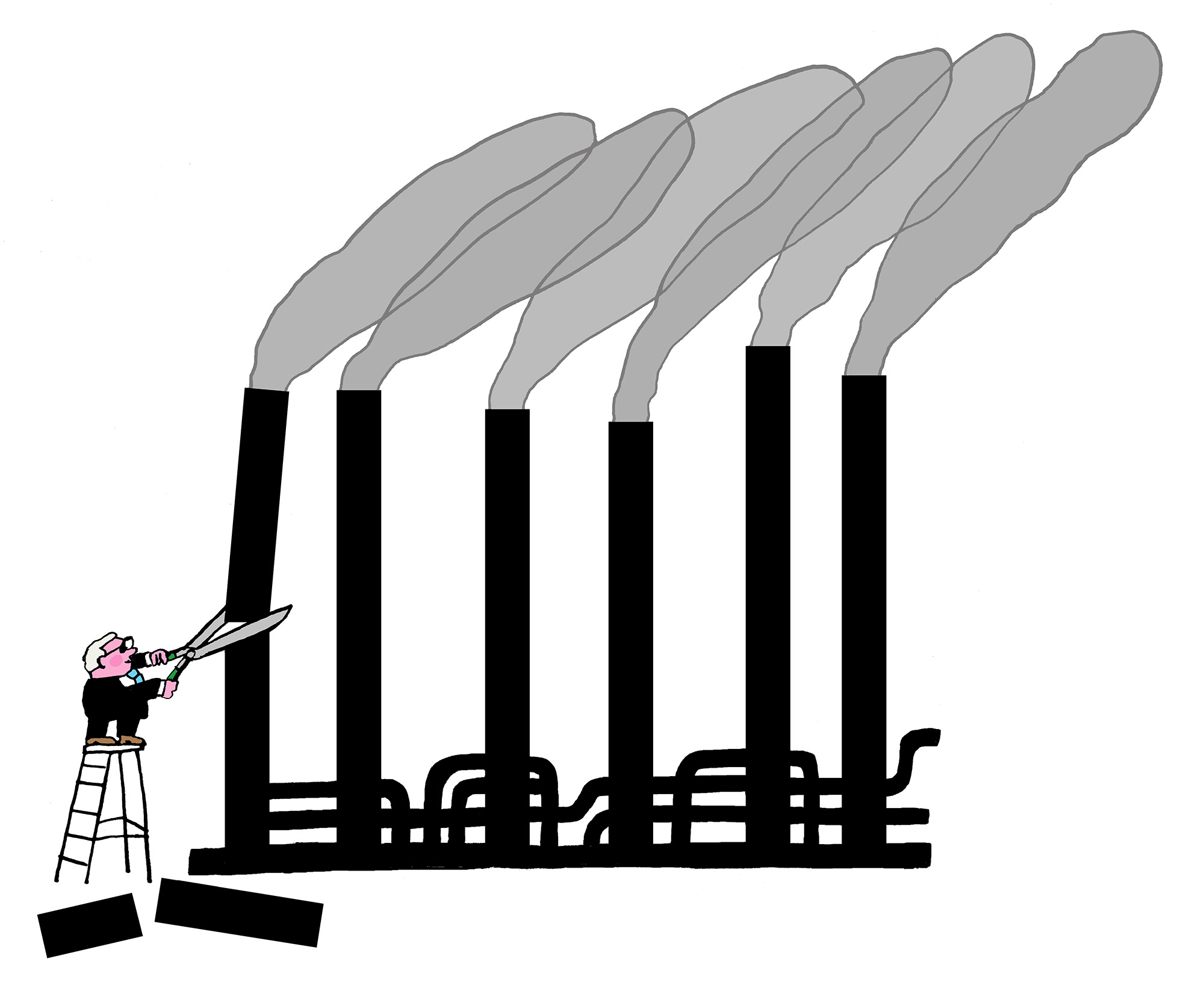
Committee on fossil industry: Collaboration must meet ‘moral minimum’ or stop
Gepubliceerd op:-
Sustainability
-
De redactie
-
 Wieneke Gunneweg
Editor-in-chief
-
 Tessa Hofland
Editor
Comments
1 reactie
Comments are closed.
Ad
Read more in Sustainability
-
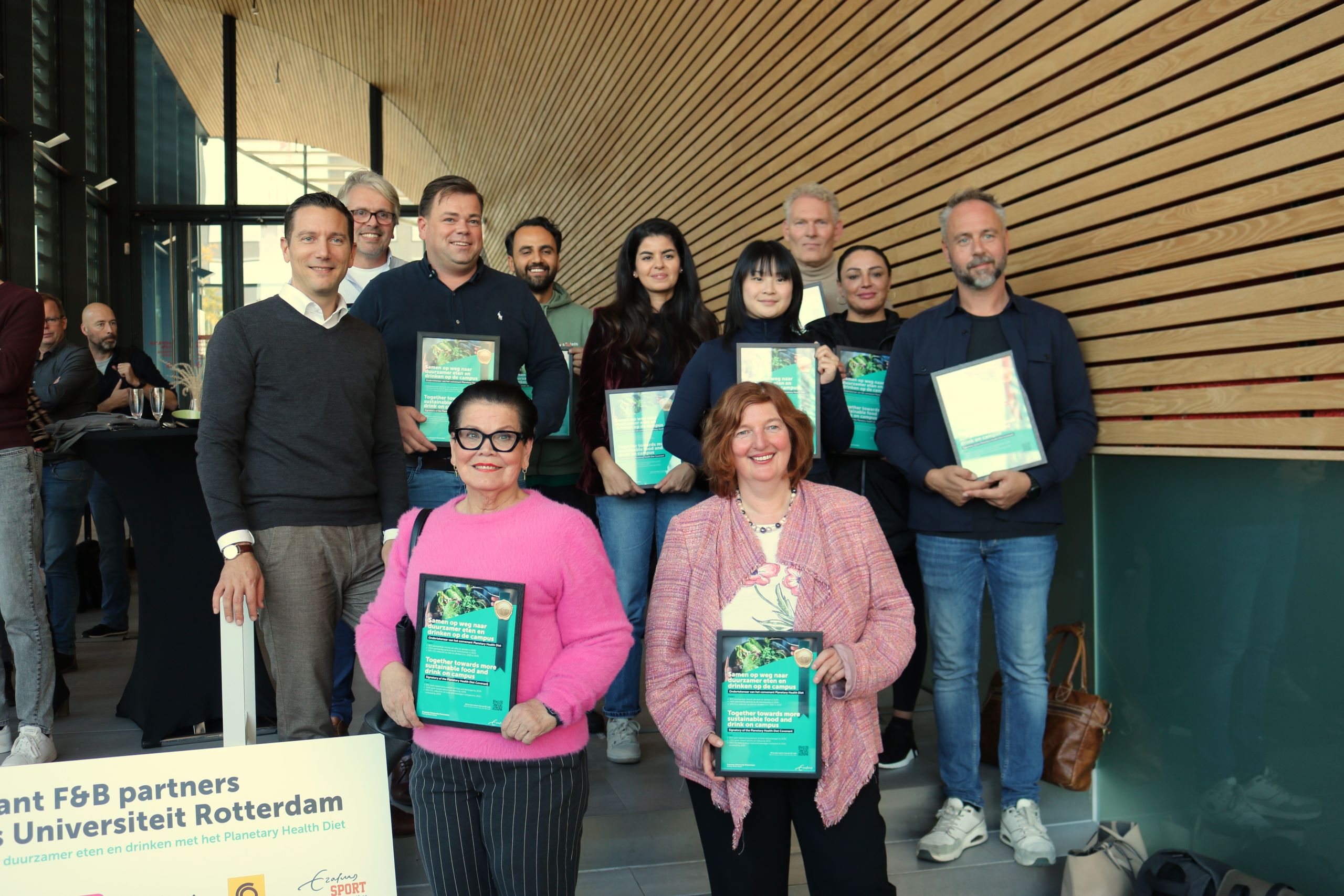
Campus food companies aim for 50 per cent plant-based by 2030
Gepubliceerd op:-
Sustainability
-
-

Students cut, cook and compost correctly during Sustainability Days
Gepubliceerd op:-
Sustainability
-
-
Committee on fossil industry: Collaboration must meet ‘moral minimum’ or stop
Gepubliceerd op:-
Sustainability
-
alice op 7 May 2026 om 21:53
could be nice to acknowledge the pressure protests from students and Occupy played in this, no? The university pats itself on the back enough as it is for all their greenwashing without EM adding on top of it. Don’t get me wrong, these are steps in the right direction but it’s important to acknowledge and repeat how students have been advocating this for years if not decades at EUR and that it is the university itself that has always been resisting.