Ad

Gen Z still drinks, but no longer considers it normal
Are students still dancing? Clubs are closing, going out is becoming increasingly expensive and students seem to be drinking less. In a series of stories, EM explores how Rotterdam's nightlife is changing.
Gen Z is said to drink less than previous generations. Yet the figures show that alcohol consumption among students is declining little, if at all. “18- to 24-year-olds still drink the most. They actually use the most of every drug.”
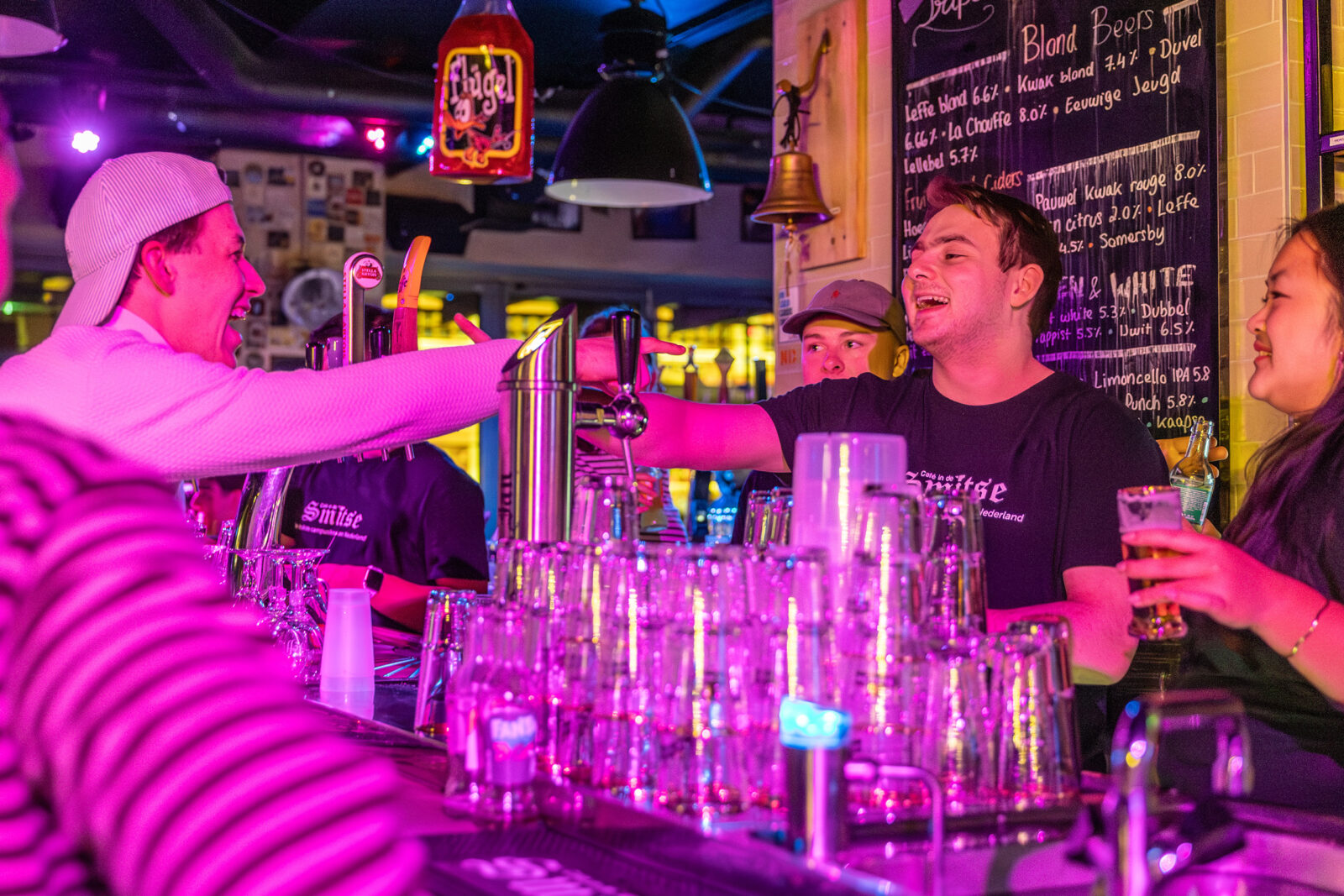
Pleasantly busy at the bar of the Smitse.
Image by: Pien Düthmann
“People have been drinking alcohol for as long as humanity has existed. We’ve always drunk together”, says August (26), having a beer with his friends on the terrace at the Smitse. “But Gen Z drinks far less than all generations before it. I think that’s because we’re a puritanical generation that thinks alcohol has no place in a healthy, good life.”
Why are young people drinking less and less? And is that really the case, or does it just seem that way? Nine in ten students drink, according to recent figures from Statistics Netherlands covering the period from 2022 to 2024. That is a slight decline compared with 2015 to 2017. But the number of heavy drinkers has not fallen. 27 per cent of students are heavy drinkers. The proportion sticking to the alcohol guidelines is growing, however: not drinking at all, or drinking no more than one glass a day. Among young people, university students consume the most alcohol and are least likely to follow those guidelines.
In this series, freelance journalist Giselle Maria Timmers and photographer Pien Düthmann examine the state of Rotterdam’s nightlife. To what extent are students still dancing? Is it true that people are drinking less? And how can nightlife be made safer?
Still, August has the impression that people his age are giving up drinking, although he is not contributing to that trend himself: “I usually have two nights a week when I go really hard, and other times when I just have a beer. I drink an average of thirty glasses a week.” His friends can hardly believe it.
Andreea (20) does things very differently. A little further along the same terrace, she takes tiny sips from her almost-full glass. “I’m having a beer now, but only because it’s part of a social drinks gathering. When I’m talking to people the whole time, I don’t like having empty hands, but I don’t think I’ll actually finish it”, says the Business Administration student.
Alcohol and student life go hand in hand
Research at Erasmus University Rotterdam is consistent with the national figures from Statistics Netherlands. According to the latest Student Wellbeing Monitor, from 2023, more than one in eight students still drink heavily. The large-scale survey of EUR students also found that more than a quarter struggle with problematic drinking behaviour. These figures have remained stable in recent years. Marilisa Boffo, who helps shape the research, explains: “Drinking behaviour has not changed significantly overall. It remains by far the most common and serious form of substance use.”
'Drinking behaviour has not changed significantly overall'
Emese Kroon researches the social processes surrounding substance use and addiction. Data from recent decades show that drinking is declining across the population as a whole, but students still drink the most relative to other groups. “18- to 24-year-olds still drink the most. They actually use every drug the most. And those who drink regularly still drink large amounts.”
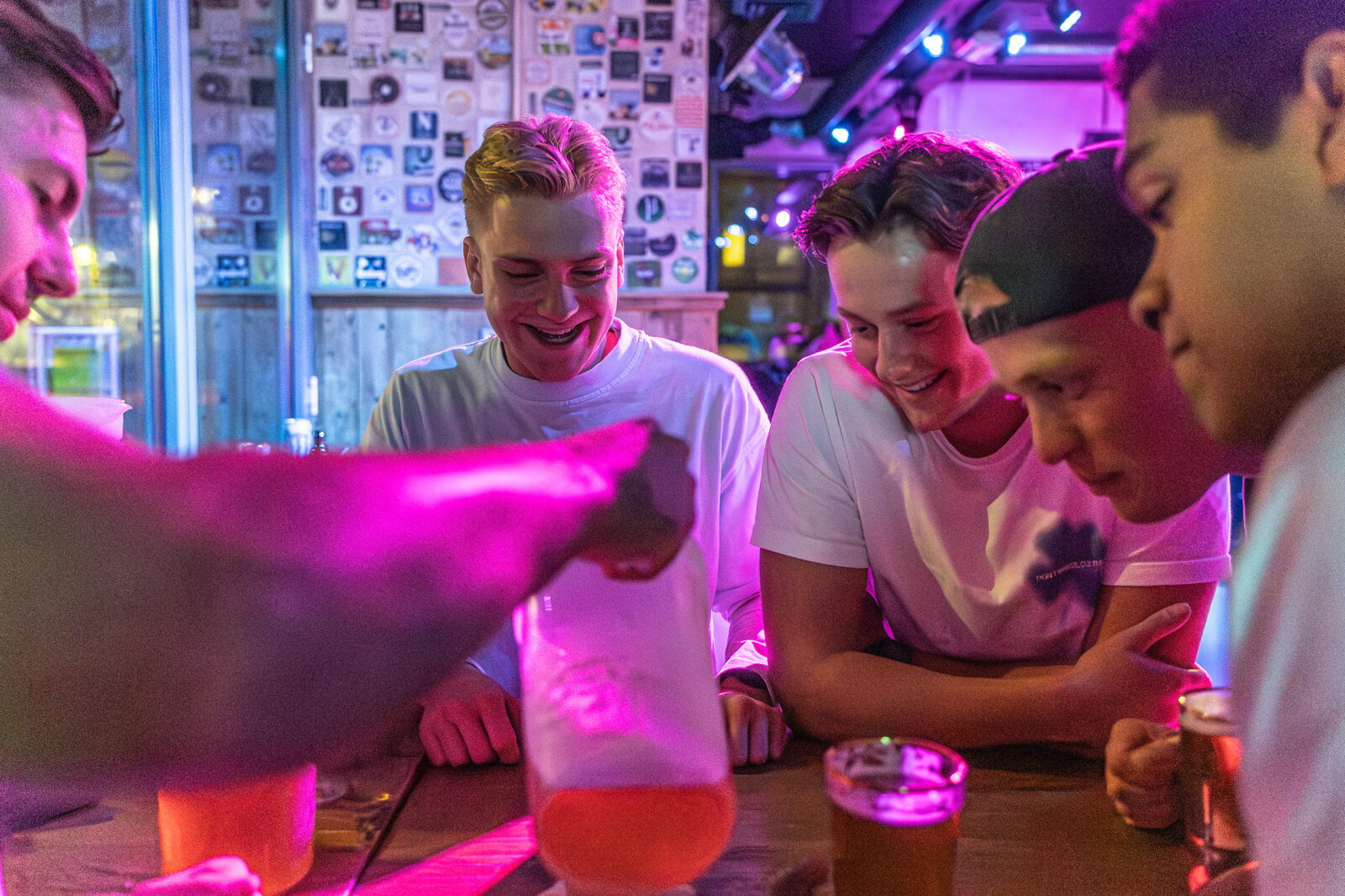
Students (that are not in this article) drink a beer in the campus bar.
Image by: Pien Düthmann
This is partly due to students’ young age. “All forms of substance use begin in adolescence”, Kroon explains. “People of that age are sensitive to rewards and do not always realise the long-term consequences. And that is even more true for alcohol, because it lowers inhibitions.”
“You see that students drink more. I think that has to do with student culture”, says Kroon. “People who move out of home and into student accommodation encounter different norms around alcohol. If you live with your parents, you are obviously much less likely to drink every evening.”
Changing norms
Earlier this year, Statistics Netherlands reported that students are moving out of home later and that more students continue living with their parents throughout their studies. Applications to student societies and events such as Eurekaweek are also falling. These are environments where norms around alcohol use are shaped. Places where students learn to drink, such as student accommodation, societies and parties, are therefore seeing fewer visitors.
But norms are increasingly being questioned in those places, too. “There are more consequences for inappropriate drinking behaviour”, says Zofia, who chaired the study association ERA until the end of last year. “I tried to keep an eye on the effect that students getting very drunk had on the people around them, and I would talk to them when they went too far.”
'Having the Smitse on campus encourages people to drink. The beer there is so cheap!'
“Calling each other out on behaviour is the most effective way of changing it”, Kroon explains. Behaviour changes when people decide together to do something, or not to do it. “That has more impact than having a rule imposed from above. Just look at how many people still smoke on this campus.”
Alcohol is expensive
Various factors can bring about a change in attitudes towards drinking alcohol. Kroon cites cost as one of them: “But the cheapest drinks are not expensive enough at the moment for price to make a big difference.” How could it, when you can still get a beer for 1.50 euros at affordable venues such as the Smitse? A non-alcoholic option costs just as little. Zofia thinks alcohol is more readily available in the Netherlands than in Poland, where she grew up: “Having the Smitse on campus encourages people to drink. The beer there is so cheap! I only started drinking more once I came to the Netherlands.”
Nevertheless, universities have agreed to share responsibility for discouraging alcohol use among their students. They have had a role to play in this since the government introduced the National Prevention Agreement in 2018. The agreement aims to reduce, among other things, problematic drinking among young people, with a target of a 50 per cent reduction by 2040. In 2024, it emerged that the current approach was not enough to meet this target.
Healthy living
Alexander (28), who is drinking with August, has cut back in recent years for another reason: fitness. “I’m paying more attention to my health. Since I started exercising more, I’ve also been drinking less”, he says. “I’m thinking more about my future.”
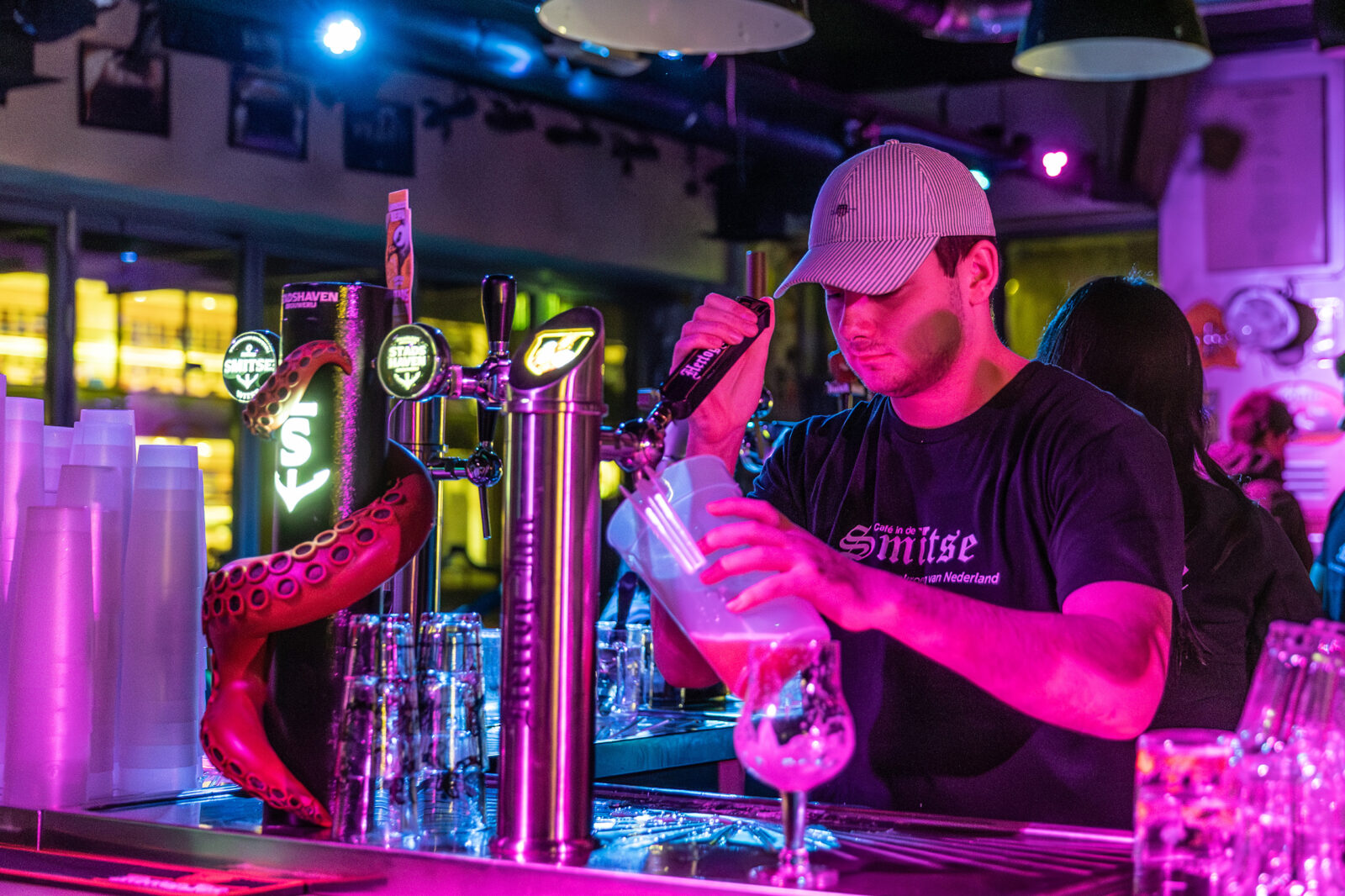
One of the bartenders at the Smitse pours a pitcher.
Image by: Pien Düthmann
Kroon thinks a focus on physical health could help reduce drinking among young people. “You can see that health is a hot topic: social media is full of sport and strength training. Alcohol is linked to unhealthy food more directly than other substances. People immediately think about the calories in a drink, for example.” At the same time, it is not possible to prove a direct link between greater attention to health and people giving up drinking. “You can’t establish a causal link.”
The Trimbos Institute, the national knowledge institute for substance use and mental health, has seen the market for alcohol-free alternatives grow, and students have also been drinking more alcohol-free options in recent years. Although these can be a healthier alternative to alcohol, a growing market does not necessarily mean that people are actually drinking less alcohol. Alcohol-free drinks are often consumed alongside alcohol, rather than as a replacement. They can also lower the barrier to drinking alcohol for young people who are just starting to drink.
'It may be that some students really are approaching alcohol differently and drinking less, but we do not see that in the figures'
Complex research
It is still possible that the number of young people who are increasingly choosing not to drink alcohol is rising. Both Kroon and Boffo say that researching alcohol use is complicated. Countless factors, including social media, cultural differences and trends in nightlife, influence drinking. The effects of the coronavirus pandemic make research even more complicated. There is no single clear picture of young people’s drinking that reflects all their individual experiences.
Data on drinking behaviour are often collected from large groups, which means that only averages are available. Boffo explains the findings from the Wellbeing Monitor: “Specific subgroups of students who drink more may be responsible for an increase in the number of heavy drinkers, but that does not necessarily mean that the student population as a whole is drinking more. So it may be that some students really are approaching alcohol differently and drinking less, but we do not see that in the figures because they are based on averages.”
Een lijst met artikelen
-
Clubs closing, expensive drinks and dancing with a matcha. How Rotterdam’s nightlife is changing
Gepubliceerd op:-
Culture
-
De redactie
-
 Giselle Maria Timmers
Studentcolumnist / freelancer
Comments
Ad
Read more in Culture
-
Clubs closing, expensive drinks and dancing with a matcha. How Rotterdam’s nightlife is changing
Gepubliceerd op:-
Culture
-
-

The emotions of science (and scientists) are palpable during theatre performance DOPE
Gepubliceerd op:-
Culture
-
Science
-
-

With this theatre show, cybersecurity expert Bernold Nieuwesteeg hopes to finally wake everyone up
Gepubliceerd op:-
Artificial Intelligence
-
Culture
-


Leave a comment