Ad

‘Everyone is an evacuator’, what is now expected of staff?

All staff can help coordinate an evacuation in an emergency, that was the message everyone received at the start of this academic year. It’s still a pilot, but the plan raised questions in the University Council, because what exactly is expected of people?
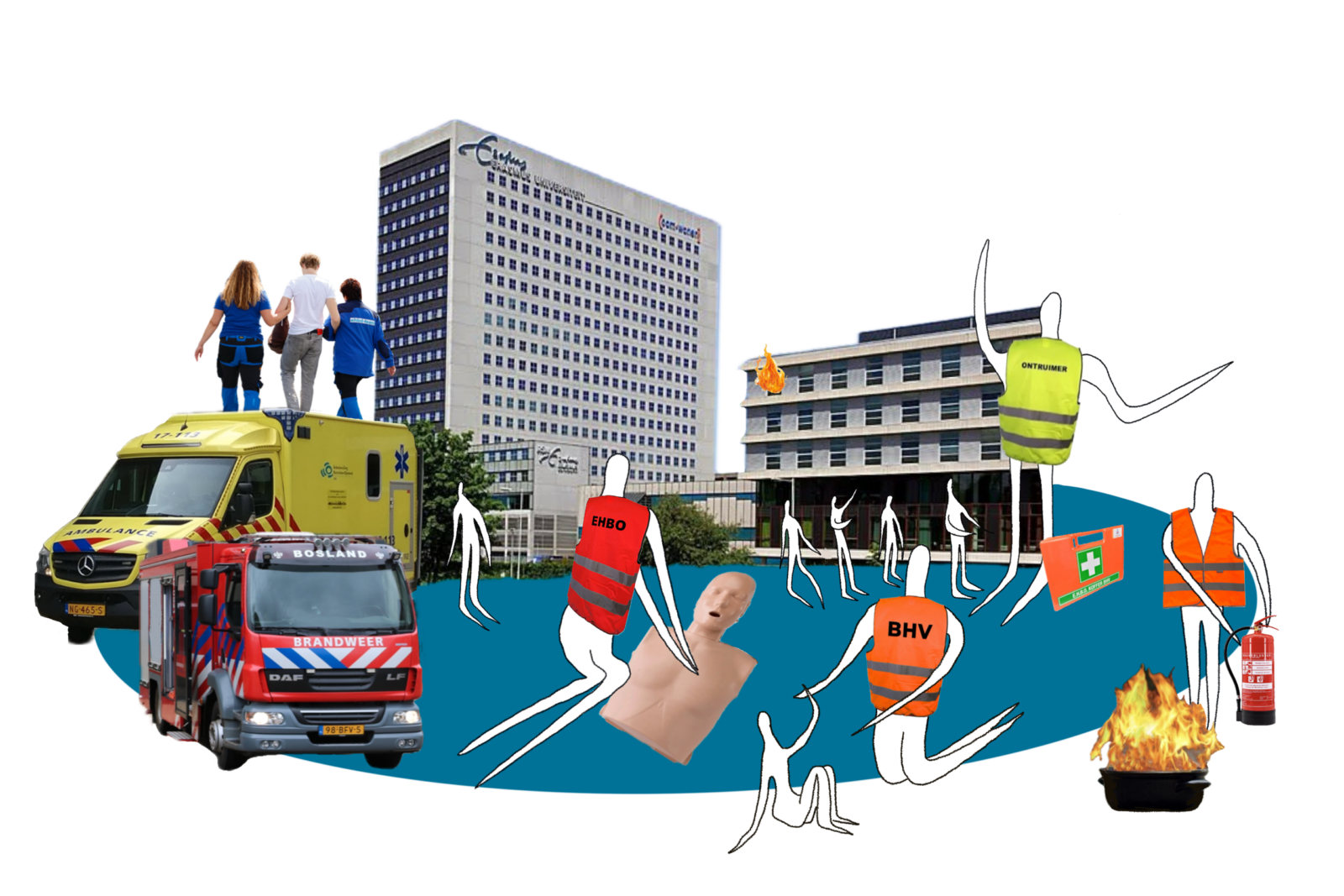
Image by: Sonja Schravesande
“But I don’t know what to do at all, do I?” Tutor Myrthe Fransen sat on her knees next to a first aid dummy. “That’s why you’re here, isn’t it?”, instructor Edwin van Pelt replied. In room Langeveld 4.16, eighteen staff members attended the workshop ‘what to do in an emergency’. “Believe me: in an hour that will be completely different. And the nice thing is: this dummy has never breathed, so we can practise perfectly on it”, said Van Pelt.
Step one is to check whether you yourself are safe. Fransen looked around the lecture hall to check. She was safe. Step two is to elicit a response. “In the past we applied a pain stimulus”, said Van Pelt. “But really, if we start resuscitating like this and compress the chest 5 to 6 centimetres, that is painful enough. We’re not going to waste time now.”
What do you actually do in the event of an emergency on campus? That’s what this workshop was all about. What if someone collapses, who do you call? And how do you evacuate from your office floor? Because in September, a pilot has started: ‘Everyone is an evacuator’. That’s not the same as ‘everyone is a emergency response officer’, emphasises coordinator Emma van Amstel. The message that all staff received at the start of this academic year – ‘everyone is an evacuator’ – didn’t immediately make this clear to everyone. Because what exactly is expected of staff now?
What to do in an emergency?
“If you see something happen, always first call the EUR emergency number 010 408 1100”, says Van Amstel. “Security can call in the emergency response officers and can meet an ambulance at one of the many entrances to the campus. Then call 112 if necessary. They will stay on the line to help you.” The EUR emergency number is on the back of your staff card. More information can be found on this page on MyEUR.
Evacuator, not an emergency response officer
In an emergency there is no time to lose and all support is welcome, that is the idea behind the pilot. Where each floor of every building previously had a designated evacuator, this is no longer feasible with the increase in hybrid working. Anyone can now take a yellow evacuator vest and act as an evacuator in an emergency. “As an evacuator you check whether everyone has left your floor”, states the description on MyEUR.
“My predecessor came up with this idea”, says Van Amstel. She has been involved in emergency response for two years and has been coordinator since November. “My predecessor rightly noted that many staff have no idea what to do in an emergency. This pilot is intended to encourage people to look into it. For example, do you know where the emergency exits are? Because lifts do not work during a fire. No one is obliged to put on the vest. Do you know that you panic in such situations? Then please don’t do it. It is really for support, and the emergency response team will still check a department.”
'My predecessor rightly noted that many staff have no idea what to do in an emergency'
Actual emergency response officers follow annual training and are called out when incidents occur on campus, such as a student fainting. They wear red or orange vests. “But together we make the campus safer”, says Van Amstel. “So in an evacuation it is up to everyone to get outside calmly and safely.”
Confusion
That ‘Everyone is an evacuator’ is intended to be so limited was not immediately clear to everyone, Van Amstel noticed when she explained the pilot to departments. Staff feel put under pressure by it, but after the explanation they are mostly reassured, says Van Amstel.
The University Council had similar concerns, because what exactly was expected of staff? “The pilot was not discussed with the Executive Board or the participation bodies”, says council member Sebastiaan Kamp. “At the start of this academic year, several related issues were also raising questions for us. We were told that it was often the same emergency response officers who showed up to incidents, so we wondered: are there enough emergency response officers? Inspections had previously shown that fire safety was not at the desired level. And around that same time all staff were asked to help with evacuations.” Although ‘Everyone an evacuator’ and the report on fire safety reached the University Council at the same time, there is no link between the two. The shortcomings in fire safety were addressed and the University Council sees that work is still ongoing. Due to the handover from the previous to the new emergency response coordinator, the other question remained unanswered for a short while.
Een lijst met artikelen
-
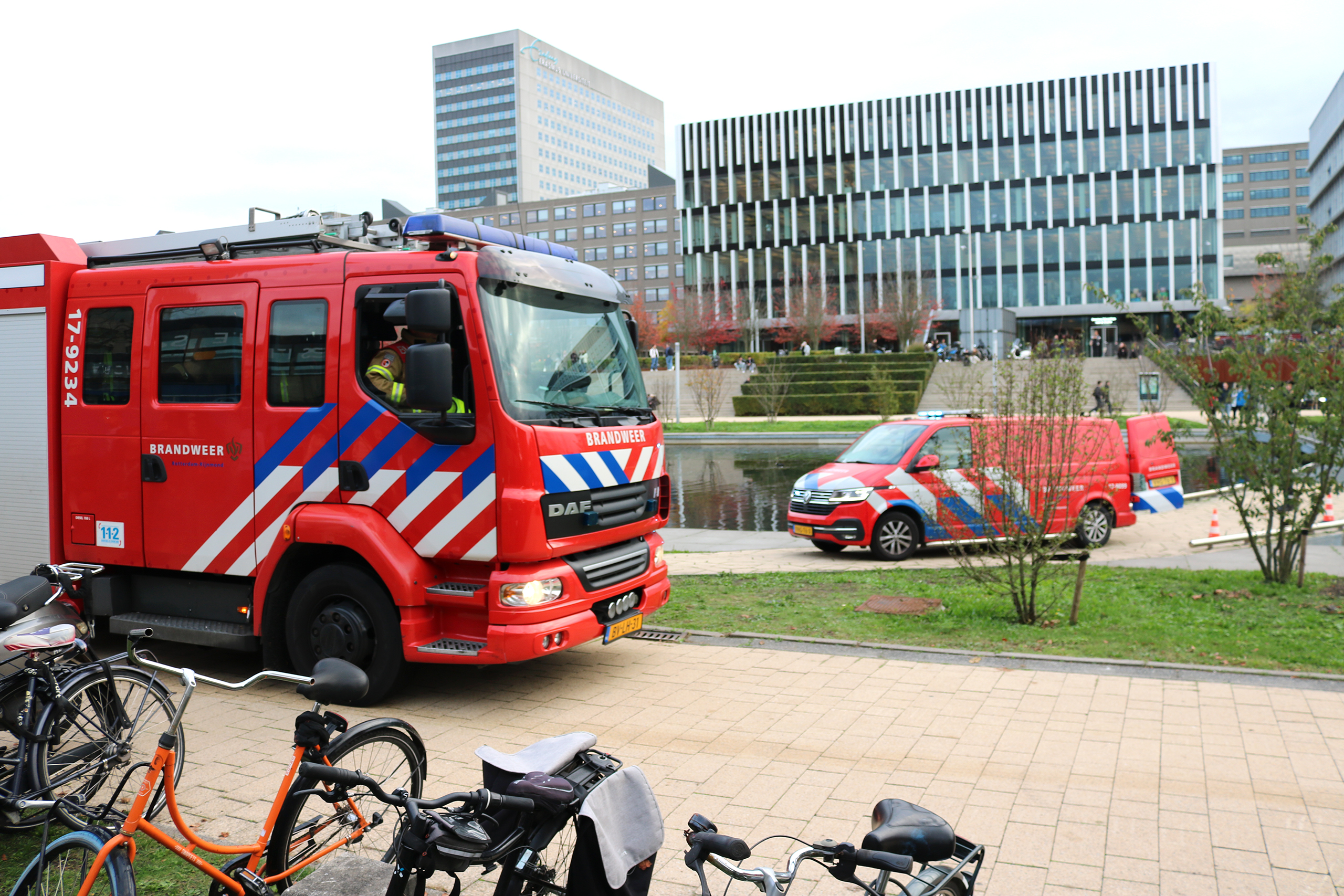
Fire safety on Woudestein campus was not up to standard for months in 2024
Gepubliceerd op:-
Campus
-
Communication around ‘Everyone is an evacuator’ could be improved, Van Amstel admits, and she’s working hard on this. Contact has been made with the University Council. “We are very pleased that there’s a contact person once again”, says Kamp. “And that work is being done on more information about this pilot. Before it becomes official policy, it should go through the Executive Board and the University Council.” The pilot runs until December this year.
Risk inventory
Van Amstel can quickly answer the question about the number of emergency response officers: there is no shortage. “People can still sign up as an emergency response officer, but there really is no shortage”, says Van Amstel. “We have 137 of them, and according to our calculations we need at least 104. That calculation is based on a risk inventory: what are possible disaster scenarios and how many people do we need at that moment? That turns out to be twenty.” Because it’s never entirely clear how many staff and students will be present on campus at any given time, the minimum number of emergency response officers has been set at 104.
“Oh no, oh no, this completely unknown person has just collapsed. Who can help?”, Van Pelt asks the group. It’s near the end of the workshop and the winning resuscitation group is allowed to demonstrate the AED to the others. Fransen is the first to sit next to the dummy. She shakes the shoulders, calling for a response. When there is none, she asks a bystander to call the university emergency number, another to call 112 and place the phone next to her for resuscitation guidance, and sends a third person to get the AED. Then she begins resuscitation. Afterwards, Van Pelt is very satisfied. As far as he is concerned, everyone signs up as an emergency response officer, he says, smiling to Van Amstel.
De redactie
-
 Tessa Hofland
Editor
Comments
Comments are closed.
Ad
Read more in Campus
-

Signing up for a Dutch course ‘feels like a race’, no more places available for now
Gepubliceerd op:-
Internationalisation
-
-

Ten years of the GDPR: access to your personal data is still not routine at EUR
Gepubliceerd op:-
Privacy
-
-

RTL: More than half of master’s theses contain AI-generated text
Gepubliceerd op:-
Artificial Intelligence
-
Education
-