Ad

345 million-year-old fossil found on Woudestein campus

A fossil around 345 million years old was brought to the surface during drilling activities on campus Woudestein. The drilling, which reached a depth of 250 metres, yielded a total of 558 samples containing ancient fossils.
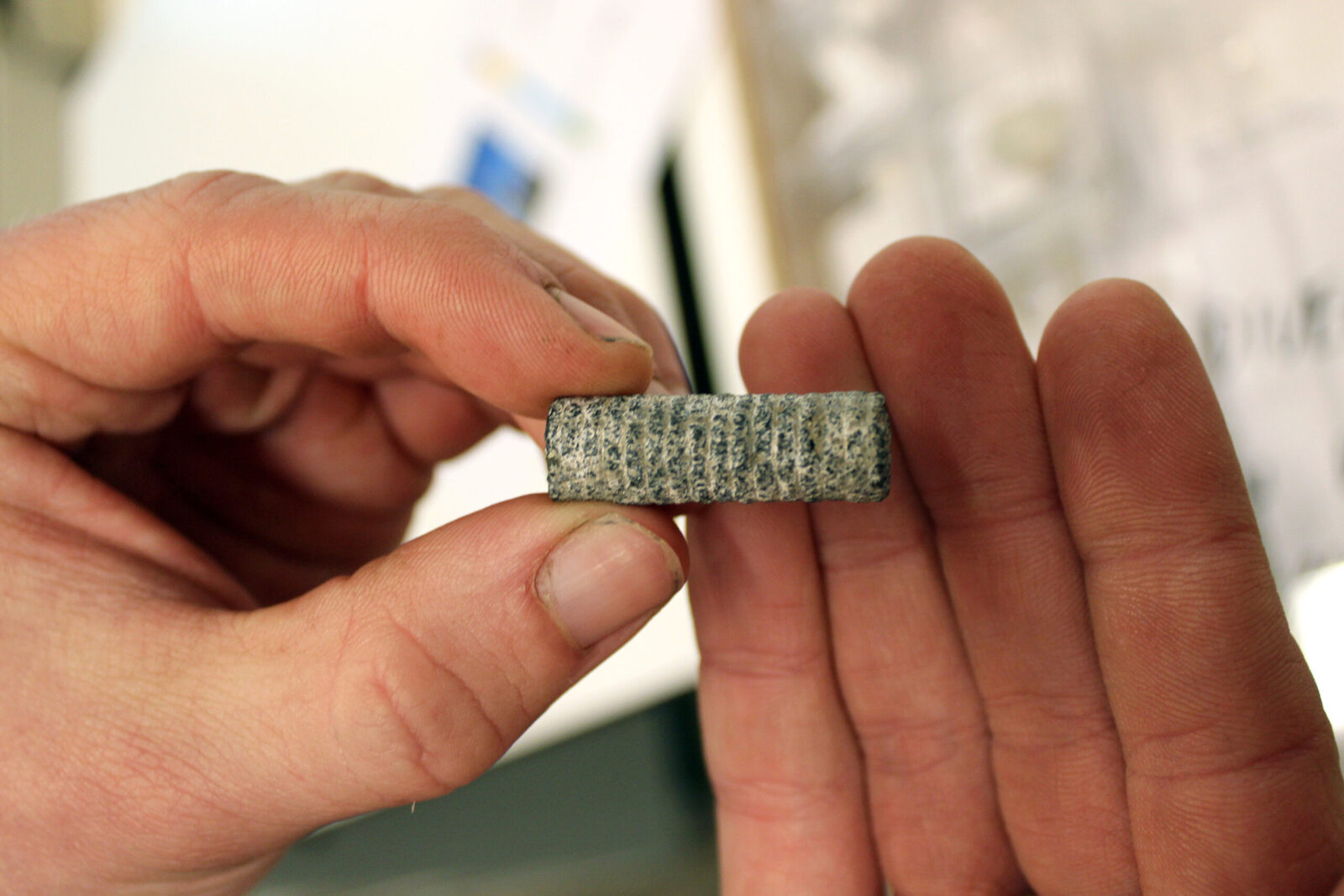
The fossilised stem of a sea lily is about 345 million years old.
The fossil, millions of years old, is grey, ribbed, cylindrical, hollow inside and around four centimetres long. This sea lily probably came from the Ardennes region, explains Bram Langeveld, curator at the Natural History Museum in Rotterdam. He found the fossil himself. The stem was probably washed loose by the ancient Maas river, ‘carried along like a pebble’ and eventually deposited in what is now Rotterdam. “And then, by sheer chance, brought to the surface by the drilling”, Langeveld says with a smile.
A sea lily is not a plant but an animal belonging to the starfish group. The animals grow a stem upwards from the seabed and look a little like flowers. Similar ‘drift fossils’ are found more often, but not at such depth. “That’s what makes this so special”, Langeveld explains. “We’ve never seen a piece of drift fossil that was deposited in a river so long ago.”
558 samples
It is one of many fossils Langeveld found deep beneath the campus in June. He sifted through the mud brought up during a drilling to a depth of 250 metres, which was needed for the renovation of the Tinbergen Building. The finest finds are now stored in the shell collection in the attic of the Natural History Museum in Rotterdam.
As well as the sea lily, hundreds of ‘younger’ fossils were found, dating from around two million years ago. Langeveld is holding a small transparent container filled with tiny black, ribbed fossils. “When I found these, I was really shouting”, he says with a grin. They are dozens of vole molars, around two million years old. Voles evolve very quickly. A species exists for a few hundred thousand years before a new species emerges. “So you can date things using vole molars.”
Langeveld collected 558 samples in total. They fill a lunchbox-sized container to the brim with grit, stones and fossils. It takes him around two to three hours to go through one sample, as he examines everything under a microscope, one handful at a time. “So I’ll have plenty to do well beyond my retirement”, Langeveld laughs.
Exhibition?
Langeveld hopes to put on an exhibition in the future featuring all the fossils found during drilling in Rotterdam. “To show that life has existed for more than two million years in what is now Rotterdam. I hope that if we know where all life and nature came from, we’ll also take good care of what we still have here in the city right now.”
Een lijst met artikelen
-

Two-million-year-old fossils found during drilling on campus: ‘This proves there was once a sea at Woudestein’
Gepubliceerd op:Article type: Video-
EM TV
-
Comments
Ad
Read more in Campus
-
Appeal commences: Fouad L. believes he was ‘destroyed by lecturers’
Gepubliceerd op:-
In court
-
-
Rector takes a stand for independent research at Dies celebration
Gepubliceerd op:-
Campus
-
-

Universities admit more international students than agreed
Gepubliceerd op:-
Education
-
Internationalisation
-
Leave a comment