Ad

Rector takes a stand for independent research at Dies celebration
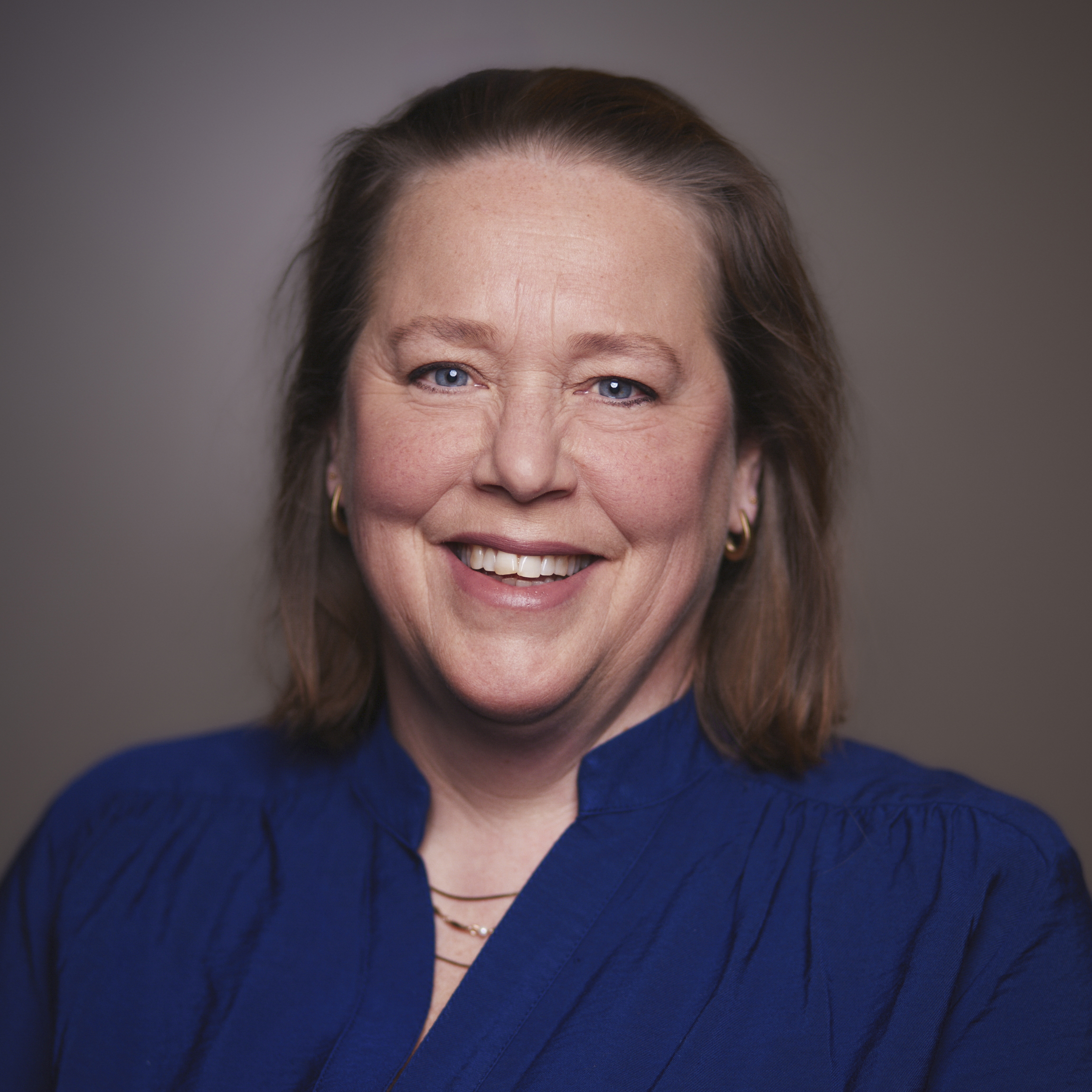
In a lively show, the university celebrated its 113th anniversary. The theme was Knowledge in motion. And whoever has a birthday hands out treats, so a number of people also received prizes.
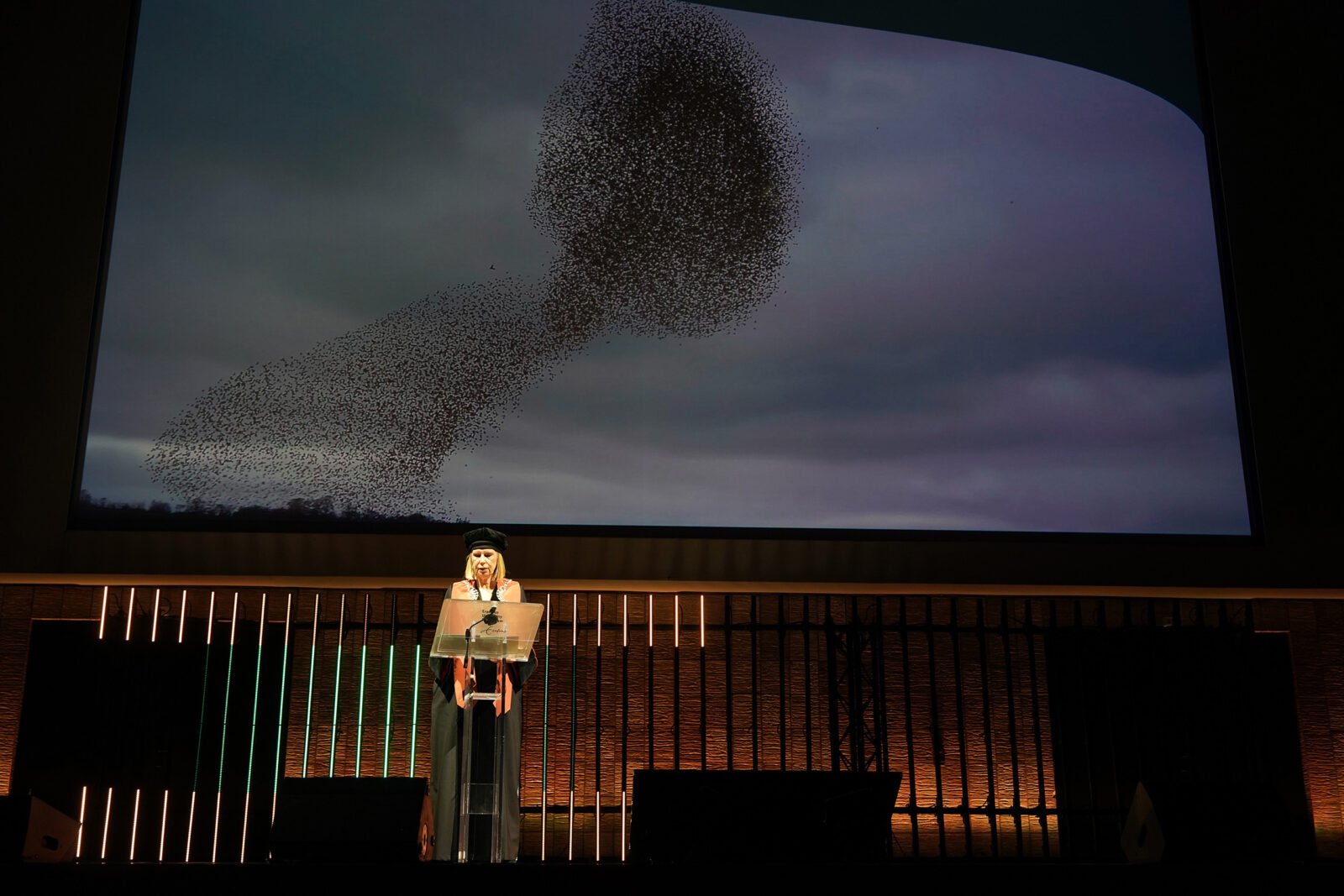
Rector magnificus Jantine Schuit with the swarming starlings in the background, which symbolise change and cooperation.
Image by: Arie Kers
If only humanity could be like a flock of starlings, able to follow one another flawlessly in the air in their hundreds or thousands and move along whenever the direction changes. Without colliding. That was the message visitors to the Dies Natalis 2026 – the university’s 113th anniversary – were meant to take away from the celebration on Monday 9 November.
The large screen repeatedly showed the hypnotic phenomenon of starlings in a large cloud, seamlessly following one another in an undulating movement, always at the end of the day. It fitted the theme of the Dies, ‘Knowledge in motion’. Rector magnificus Jantine Schuit called it: “The flock of starlings represents that movement, making connections and responding to change. I hope you take home with you that only by bringing different disciplines together can we strengthen resilience.”
Room for independent research
In her Dies speech, Schuit addressed concerns among some academics that the emphasis by executives on collaboration and interdisciplinarity means there is no longer room for curiosity-driven research. “Is it all just about impact?”, she is regularly asked. “For me, science that matters starts one step earlier, with asking questions. How does this work? Why does this happen? What do we not yet know?”, Schuit said.
The rector then announced that there is, and will remain, room for this fundamental research at Erasmus University. “We are committing additional resources to independent research. And we are actively helping researchers obtain personal grants, through guidance and mentoring. These grants in particular give researchers the freedom to decide for themselves what they want to investigate.”
According to Schuit, the call for greater collaboration is not about less specialisation, but about ‘the willingness to connect specialist knowledge. Knowledge gains meaning when it is set in motion’.
She also called in her speech for collaboration in education, so that students too learn at an early stage to work together across disciplines. “We are renewing existing programmes and developing new programmes, minors and tracks. Students who start with us in the coming years will learn through these programmes to work together across subject areas and to look at today’s and tomorrow’s problems with an open mind.”
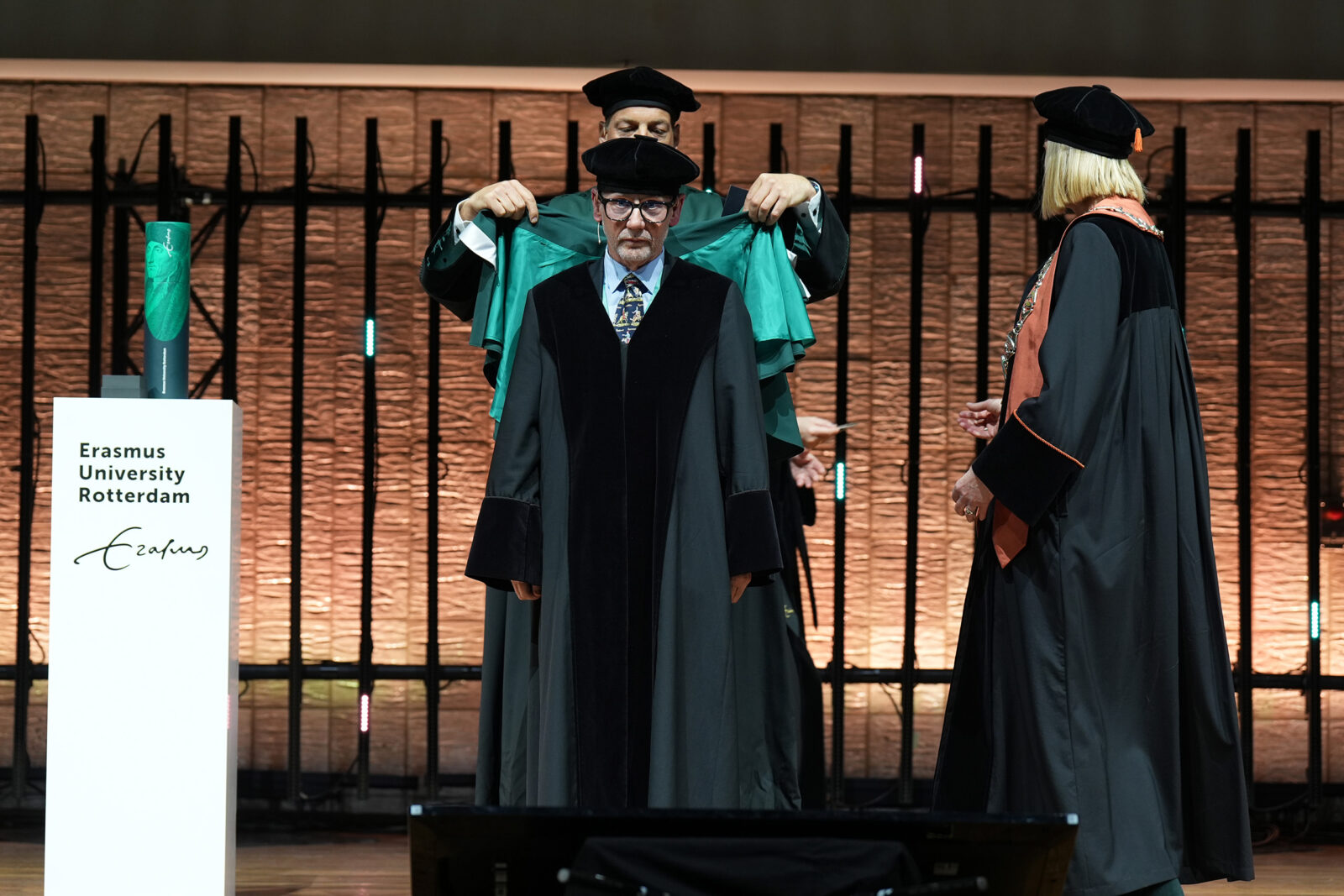
Professor Jeffrey Braithwaite is presented with the kappa associated with receiving an honorary doctorate.
Image by: Arie Kers
Honorary doctorates in the medical field
During the Dies, two scholars from the medical field received honorary doctorates, this year awarded by Erasmus MC and the Erasmus School of Health Policy & Management (ESHPM). The honorary doctorate from ESHPM went to Jeffrey Braithwaite, professor of Health Systems Research. The Australian conducts extensive research into healthcare systems and hospitals. In his speech, he too stressed the power of collaboration: “One H2O molecule does not make something wet, but a great many together do. Healthcare works in the same way, problems are interconnected. So, you need engineers, ethicists, doctors and the community to find solutions. The future depends on the collective.”
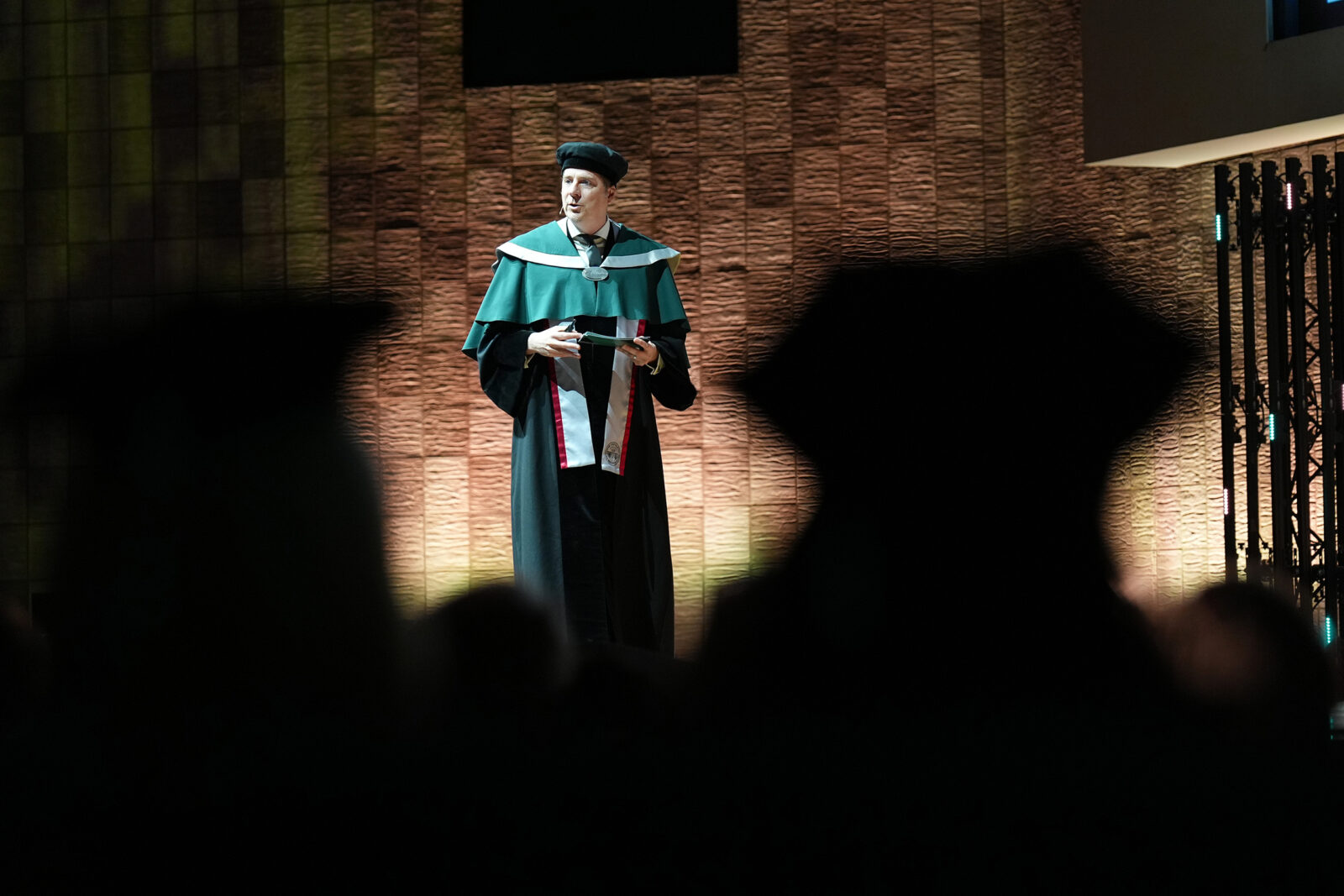
Eredoctor David Abbink, professor at TU Delft, listed in detail everyone to whom he owed his honorary title.
Image by: Arie Kers
Honorary doctor David Abbink, professor of Haptic Human-Robot Interaction at Delft University of Technology and mainly involved in developing robots that can support nurses in their physical work, paid tribute in his acceptance speech to all the people he had worked with and who had been important to him. The large screen filled with photographs of colleagues, collaboration groups, his friends, his wife, his parents and his son.
Three prizes
Three further prizes were awarded. The Erasmus Research Prize 2026 went to Sadaf Soloukey, a neurosurgeon in training at Erasmus MC, neuroscientist and philosopher. She researches ultrafast ultrasound that makes extremely small blood vessels in the brain visible. The prize consists of a certificate and 7,000 euros.
The Lambers Student Excellence Award 2026 went to Maxime Noordermeer. She received the prize for research in which she combines knowledge from her studies in Medicine, Law and Technology. She is now pursuing a PhD at Erasmus MC and received a certificate and 4,000 euros.
This year’s annual FAME Athena Award, for staff members who have worked to improve the position of women within the university, went to Ana Uribe Sandoval and Katarina Putnik for their work on the Advancing Inclusive Academia programme. This programme supports female academics in their careers.
Een lijst met artikelen
-
‘Academic powerhouses’ to launch by end of 2027
Gepubliceerd op:-
Governance
-
De redactie
-
 Wieneke Gunneweg
Editor-in-chief
Comments
Ad
Read more in Campus
-
Universities admit more international students than agreed
Gepubliceerd op:-
Education
-
Internationalisation
-
-
Letschert says it is sad that meeting of Jewish students could not go ahead in Maastricht
Gepubliceerd op:-
Politics
-
-
House of Representatives wants to put civil servants laid off by cuts in front of classes
Gepubliceerd op:-
Education
-
Politics
-
Leave a comment