Ad

Nobel Prize for research into ‘stabilisation’ of the economy

Two Americans have won the Nobel Prize in Economic Sciences for their research into the foundations of a stable economy.

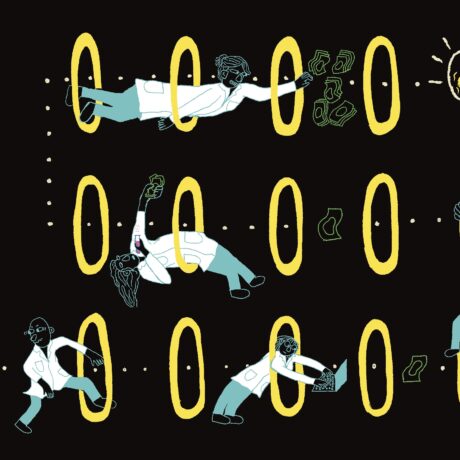
Image by: Pauline Wiersema
High unemployment, high inflation… what can the government do about it? How can it intervene in the market to prevent or remedy an economic recession?
Researchers Robert E. Hall and Michael Woodford did not look for the answer at the level of inflation, production and consumption (macroeconomics), but in the choices made by households and businesses (microeconomics).
Oil crisis
Their work builds on that of John Maynard Keynes, the famous economist who wrote about stabilising the economy. In times of recession, the government should spend money to soften the impact, while in times of economic prosperity it should cut spending, he argued in the 1930s.
But during the oil crisis of the 1970s, this did not seem to work, the Nobel committee writes in its explanation. Inflation spiralled out of control and unemployment remained high.
Clouds on the horizon
Hall came up with a new insight in 1978. Household spending is linked to people’s expectations about the future: if they anticipate better times, they spend more. If they see clouds on the horizon, they tighten their belts. This makes household spending fundamentally unpredictable. The same applies to the decisions businesses make.
In 2003, Woodford published a book that built on these insights. He incorporated them into new economic models, laying the foundations for central banks to intervene more effectively by influencing optimism or pessimism.
The Nobel Prize winners thereby laid the foundations for a new Keynesian macroeconomics. In this approach, for example, inflation is not a force of nature, but the result of decisions made by thousands of businesses. Overall demand for goods and services (consumption) is also determined at household level.
Social science
Economics is a social science, but thanks to the Nobel Prize it is grouped with the exact sciences. Critics of the prize say this leaves less room for criticism of the dominant economic perspective. There are occasional calls to abolish the prize.
Officially, there is no Nobel Prize for economics. The Swedish central bank’s prize is awarded ‘in memory of’ Alfred Nobel. It has been awarded since 1969.
The Dutchman Jan Tinbergen was the first to win it, jointly with a Norwegian colleague. In 1975, Tjalling Koopmans shared it with a Russian economist. Four years ago, a third Dutchman won: Guido Imbens, jointly with a Canadian and an American. Last year, an economist with Dutch parents won: Joel Mokyr.
This year, the Nobel Prize is worth 12 million Swedish kronor, equivalent to more than one million euros.
Een lijst met artikelen
-

Dutchman wins Ig Noble Prize for burying tighty whities
Gepubliceerd op:-
Science
-
De redactie
Comments
Ad
Read more in Science
-

Porn in the Pavilion: vanilla sex is the favourite among viewers
Gepubliceerd op:-
Lecture
-
Science
-
-

The emotions of science (and scientists) are palpable during theatre performance DOPE
Gepubliceerd op:-
Culture
-
Science
-



Leave a comment