Ad

AI in thesis is not always fraud, rules highest education court

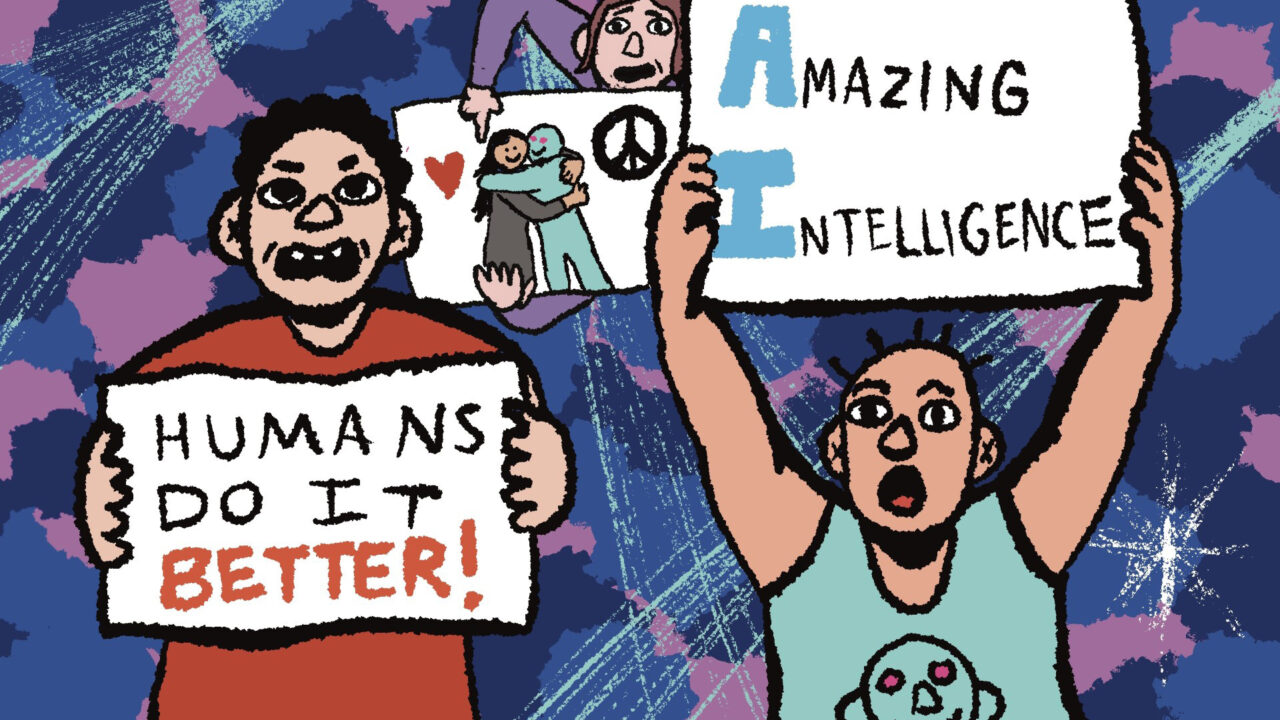
A student whose thesis contained AI hallucinations was cleared of fraud this summer. A student from Rotterdam has found no such leniency from the Council of State. What is the difference?

Image by: Migle Alonderyte
This summer, the highest education court laid down a number of ground rules for AI cases. In three extensive judgments, the Council of State explains when the use of AI is and is not acceptable.
When it comes to AI fraud, the court makes clear, there must be solid evidence. One striking detail: in one case, the education judge himself started googling to check a student’s thesis. That rarely happens. Normally, the judge mainly examines whether the rules have been followed correctly.
‘Carelessness’
In this first case, the student is a marketing student at the University of Groningen who submitted a thesis containing AI-generated rubbish in its bibliography. The student immediately admitted this to the Examination Board. He had an explanation: afterwards, he had asked ChatGPT to reorganise his bibliography. That was when the errors crept in.
But was this fraud? The student himself said it was a matter of ‘carelessness’. He sent in a corrected bibliography. And he could show that an earlier version of the reference list contained no hallucinations, meaning he had not relied on AI for the content.
The Examination Board and, later, the Board of Appeal for Examinations nevertheless found fraud. The thesis’s main text contained three references to sources that were missing from the bibliography. The conclusion was that these too were AI fabrications.
Do your own research!
The judge decided to check this for himself. With the thesis in hand, he sat down at a computer to track down the three sources. He succeeded. The judge writes that, ‘after a simple search’, he was able to find a suitable academic source for all the references, by the named author and from the correct year.
The three references in the main text were therefore not AI hallucinations. According to the judge, the student did indeed have a plausible explanation: ChatGPT had made a mess of his bibliography.
Not every AI hallucination amounts to fraud, the judge therefore ruled in this case. Sometimes it is simply a mistake. And that is not a matter for punishment by the Examination Board, but for a lower mark from the assessing lecturer, the Council of State told the programme.
Examination Boards and Boards of Appeal for Examinations spend a great deal of time checking suspected cases of fraud, as Maastricht committees told university newspaper Observant, for example. But in this case, the judge found that the Examination Board and the Board of Appeal for Examinations at the University of Groningen had not done enough. The student’s explanation ‘should have prompted’ them to do a quick Google search.
Forgotten AI declaration
Was the student even allowed to use AI to organise her bibliography? That question does not arise in the Groningen case. In the Rotterdam case, it is precisely the central issue. The master’s programme in media & business at Erasmus University has very specific rules on this, as the second judgment makes clear.
For example, students were only allowed to use AI if they also submitted an AI declaration. This had to state what students asked ChatGPT (the ‘prompts’) and what they had incorporated into their work. With the AI declaration, the lecturer could still assess the students’ own knowledge and skills.
The student who brought the case had not submitted an AI declaration for the first assignment and an incomplete one for the second. It was clear that she had used AI to compile her bibliographies. Chat had let its imagination run rather wild in them. She had done so because she was short of time. According to her, the main text of her papers was accurate.
And that is the crux: this Rotterdam student had AI compile the entire bibliography, while the Groningen student had only asked it to reorganise his. To the judge, that was an important difference. The bibliography is a ‘fully-fledged part’ of the submitted student work, the judge explained. She lost her case.
Sufficient evidence?
A student from Maastricht denied to the judge that she had used AI at all. For her European Law programme, she had to submit a short literature review every week, and the Examination Board claimed that she had used AI in three of her four assignments. There were conspicuous errors in years, titles, page numbers and journal titles.
Before the judge, she offered an alternative explanation: she had been short of time and her internet connection was poor, forcing her to rely on her memory and incomplete notes. This had led to mistakes. She also has conditions including dyslexia, which make reading, writing and spelling difficult.
To support her case, she submitted her old notes, so that the Council of State could see for itself how the errors had ended up in her assignment. The judge, however, could not find those errors in her notes. There was no conclusive evidence, but to the judge, ‘fraud’ was simply the best explanation. She therefore lost the case.
The same applies to AI as to other fraud cases: it comes down to weighing the evidence and examining any alternative explanations. AI fraud must be established ‘beyond reasonable doubt’, the Council of State ruled in these three cases. That criterion, ‘beyond reasonable doubt’, may explain why relatively few AI cases have so far come before the courts.
Read more
-

The impact of AI on entry-level jobs: no reason to panic, but much to think about
Gepubliceerd op:-
Artificial Intelligence
-
Student life
-
De redactie
Comments
Comments are closed.
Ad
Read more in Education
-
TU Delft may not favour women in admissions to courses
Gepubliceerd op:-
Education
-
-

RTL: More than half of master’s theses contain AI-generated text
Gepubliceerd op:-
Artificial Intelligence
-
Education
-
-

Education pioneer Etienne Augé: ‘Technology should give us more time for people’
Gepubliceerd op:-
Education
-