Ad

Would you want to live forever?
Transience gives meaning to our lives. That is what professor of Philosophy Ronald van Raak learned while reading Oneindigheid (Infinity).
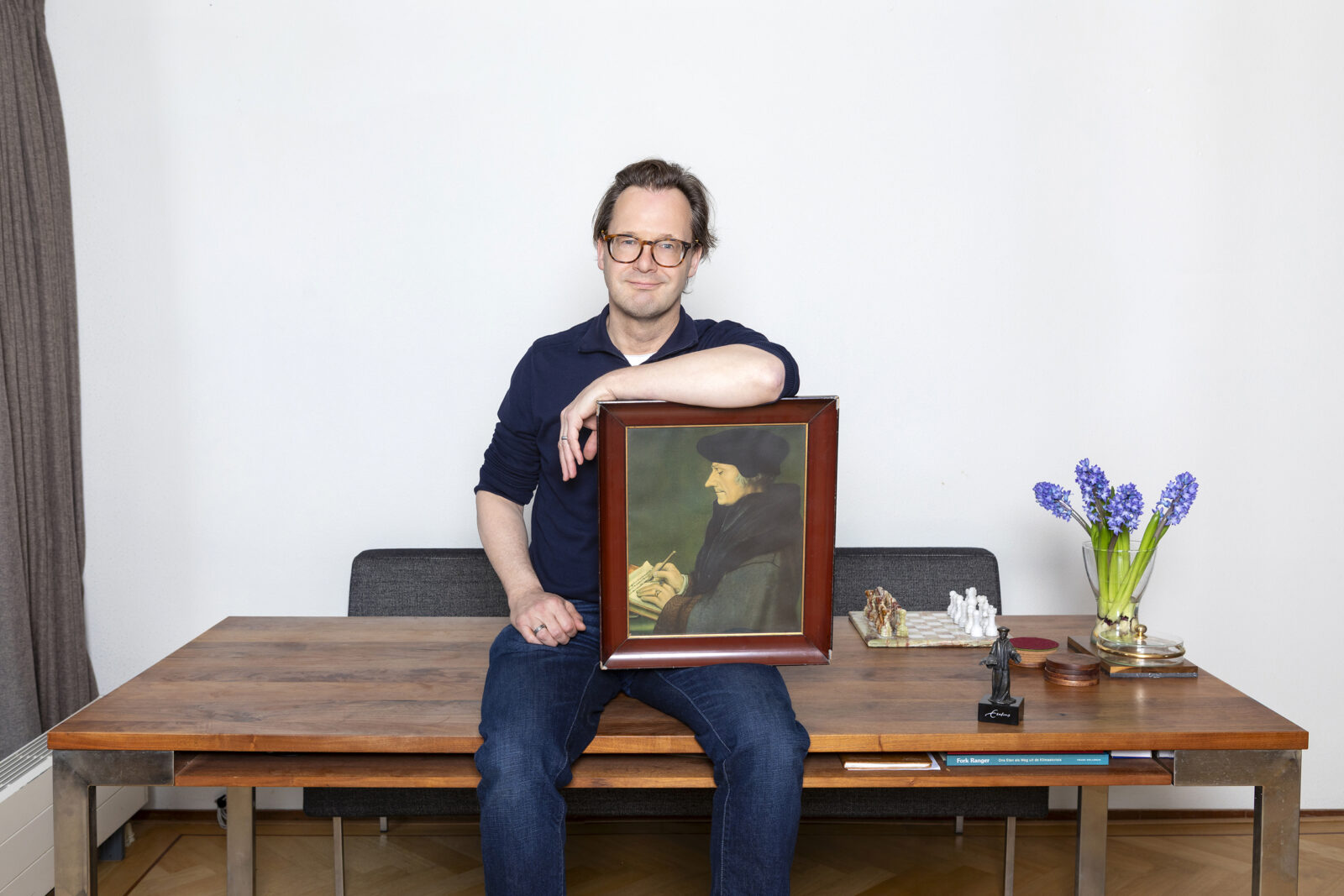
Image by: Geisje van der Linden
Would you want to live forever? I sometimes ask this question when I give a lecture somewhere in the country. For many people, this seems an appealing idea, judging by the number of hands that go up. When I asked the question during a philosophy class, however, every hand stayed down. One student pulled a face and said: “But then everything becomes meaningless?”
Count with me for a moment. 1, 2, 3, 4, 5… and so on. We can keep counting, ever further – into eternity, or infinity. We are probably the only animal species capable of counting on like this. It gives human beings an awareness of the existence of infinity. We are born and we will die; human beings are finite creatures. But we also know that the Big Bang was not a beginning and that this is probably not the only universe. That is one of the insights explored in Oneindigheid by Leiden philosopher Victor Gijsbers.
Human beings have a sense of infinity, but we do not really know what we mean by it. Infinity is not simply a very long time, or a very great distance. A thousand years, or a million years, or a billion years, is still nothing when viewed from the perspective of infinity; after all, infinity plus a billion is still infinity. A billion light-years is nothing at all – and neither is a thousand billion. From the perspective of the infinite, every possible world must exist again and again, including the one in which we are living now. The situation in which a person like me, on an Earth like this one, writes this very column again – and does so infinitely often.
'It is transience that gives meaning to our lives'
I do not know whether some readers will have stopped reading by now because they think it is nonsense to concern themselves with a subject that is so vague and uncertain. For the philosopher Cusanus, this was precisely why all his readers should reflect on ‘infinity’. He was a fifteenth-century thinker who also features in Victor Gijsbers’ book. Cusanus engaged his readers in all kinds of thought experiments to encourage them to think from the perspective of infinity; in doing so, he showed how the circle, line, triangle and square would coincide in an infinite point. A strange idea and, to us, an incomprehensible thought – but no less true in his view. According to Cusanus, looking through the lens of infinity allows human beings to gain a better understanding of their own ignorance. A ‘learned ignorance’, or an acceptance that we are finite beings with limited knowledge and insight.
Oneindigheid is ‘a philosophical guide’. In this accessible book, Victor Gijsbers takes the reader on an intellectual adventure through the philosophy and mathematics of infinity; from great thinkers such as Aristotle and Kant to highly illuminating reflections on concepts such as actual and potential infinity. It is an ideal book for the holiday period, which is also a time for intellectual reflection. Thinking about the meaninglessness of infinity teaches us to accept our finitude and shows how the fact that everything will one day end is precisely what gives life meaning. And that in this finite life we have so many possibilities – I might almost say ‘infinitely’ many. We should not fear death, but be grateful for our finite lives. At any rate, that is one lesson I took from this book. It is a comforting thought, even at times when everything seems to be going wrong and little appears to work out. It is transience that gives meaning to our lives.
Read more
-
Education is more than money in the bank
Gepubliceerd op:-
Column
-
De redactie
-
 Ronald van Raak
Columnist
Comments
Comments are closed.
Ad
Read more in Column
-
The sad anniversary of powerless staff and students
Gepubliceerd op:-
Column
-
-

Tea, theory and a healthy dose of procrastination
Gepubliceerd op:-
Column
-
-
The drama of Jason Arday
Gepubliceerd op:-
Column
-