Ad

Flower crowns and barbecue at Kralingse Plas Midsummer students celebration

Some came to keep a tradition alive, others to feel a little closer to home. On a warm Sunday, dozens of students gathered at the Kralingse Plas for the fourth annual and biggest event of the Nordic Student Association, Midsummer.
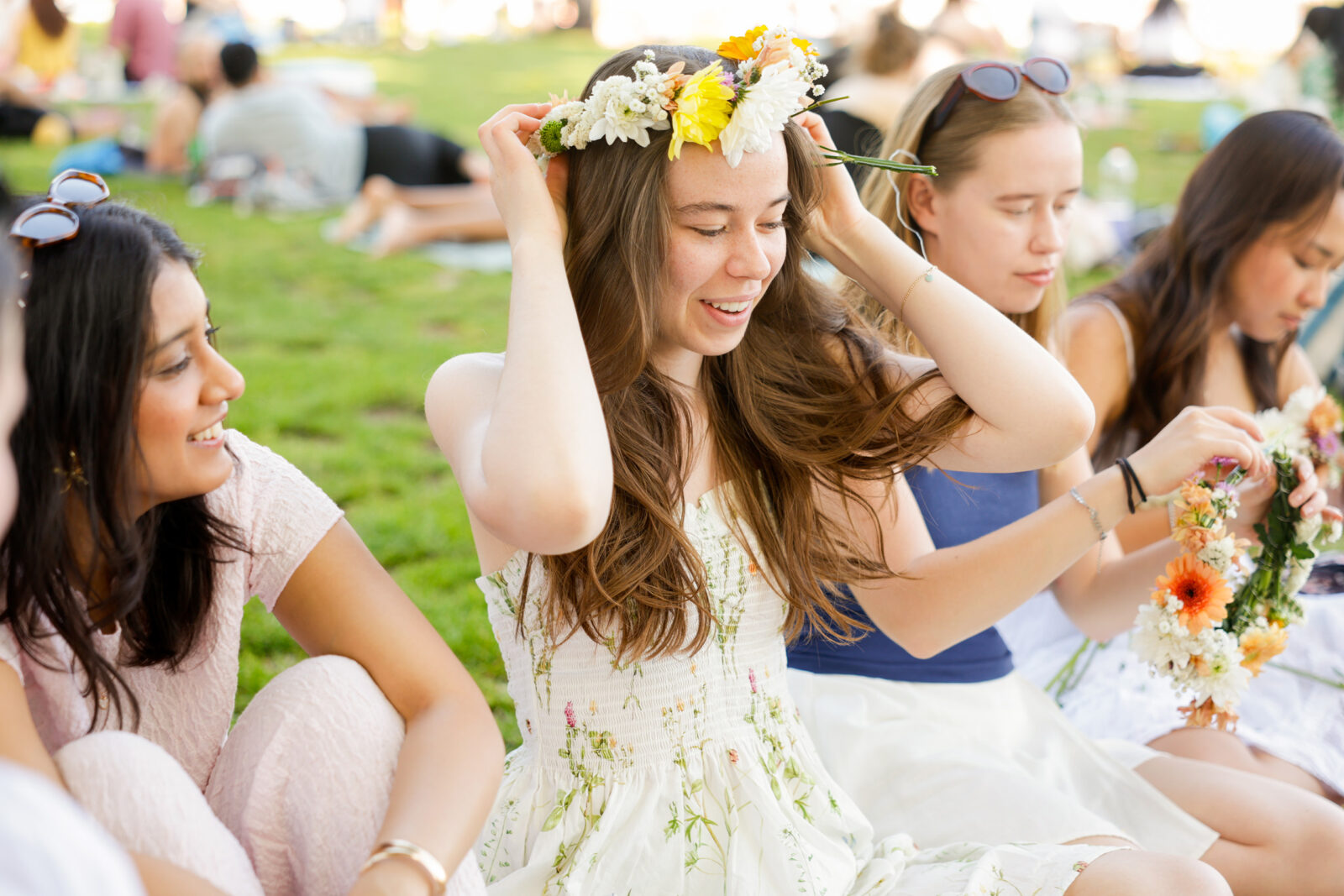
Students learned how to make flower crowns in a workshop.
Image by: Daan Stam
Blankets are spread across the grass as girls sit in a circle, carefully wrapping colorful flowers onto metal strings. Excited with their new look, some take selfies with flower crowns tucked into their hair. At the barbecue nearby, burgers and hot dogs are already in the grill. Loud pop music plays from a speaker, while a few students gather around a table for a game of beer pong.
Midsummer is a Scandinavian celebration of the summer solstice, the longest day of the year, which falls around the third week of June.
The association celebrates the holiday in May rather than June, as students return home after exams.
‘Everyone is welcome’
Midsummer is celebrated differently depending on where students come from. In Sweden, it is a national holiday in which the whole day is dedicated to the celebration. “You go out on the street, everybody is well dressed, people party and eat with their family”, says Timio Lemmerlijn Gummesson, the president of the Nordic Student Association. Originally rooted in religious tradition, it has since become a mainstream, something everybody does to drink and eat. Families gather around a big pole, the maypole, and sing traditional songs together, each followed by a small glass of schnapps.
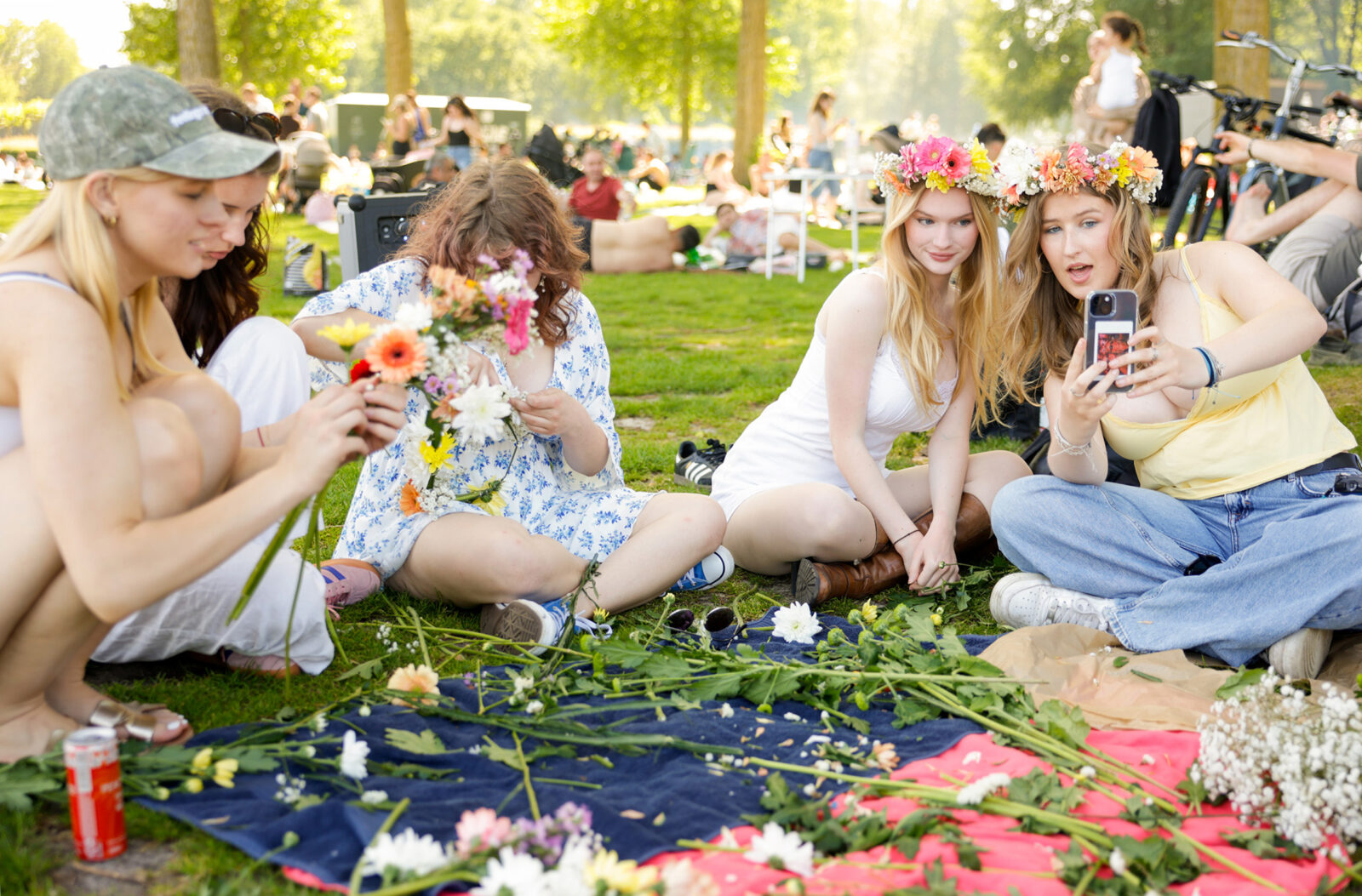
Taking selfies with your new flower crown felt like an almost mandatory part of the celebration.
Image by: Daan Stam
The association he runs follows the same spirit, bringing together students from across all Nordic countries and anyone else curious about their culture. As an English-speaking association, it is open to everybody. Now in its fourth year, the event has become a tradition of its own, a way to mark the end of the academic year in Midsummer style before everyone returns home. “Even if you’re not in Sweden, it feels like home”, adds Timio.
A different celebration
In Denmark, the celebration looks quite distinct. There is no maypole and no flower crowns. Instead, the whole neighbourhood gathers around a large bonfire in the evening on Sankthansaften (Saint John’s Eve). According to Emilia Bech, a bachelor’s student in Psychology, a ‘witch’ (usually a stick) is burnt in the fire, after which the witch flees to Germany. “As a kid, you were given a small torch to throw into the bonfire. You felt like such a grown-up”, she says.
Norway has a version of Midsummer similar to the Danes, also called Sankthansaften. In fact, Trym Braathen, a bachelor’s student in IBEB and Philosophy considers the Swedish way ‘weird’. “I’ve heard that they dress in white clothing and dance around a giant stick that’s supposed to represent fertility”, he adds.
Norwegians hold a bonfire evening when the days begin to shorten again after midsummer. “Everybody comes out, watches the bonfire, and listens to Norwegian music”, Trym says.
Making the flower crowns
Meanwhile at the Kralingse Plas, the flower crowns are the highlight of the afternoon. They take around ten to forty minutes to make, according to the students. Valentina Elm, marketing manager of the association, sees them as connected to the spirit of the day, nature, growth and the start of summer. “Making a flower crown is open to everyone”, she says. “It depends if they want to make one for themselves or others.”
Thea Norgren, a first-year MISOC student, made her own flower crown for the first time. Back home in Sweden, she explained, it was usually mothers who made the crowns for smaller children. “I’m proud of it”, she says. “It turned out really nice.”
For Amelie Egger, events manager of the association, they serve a different purpose. “When everyone was wearing them, it made us look like a group”, she says. “It was easy to see who part of us was.”
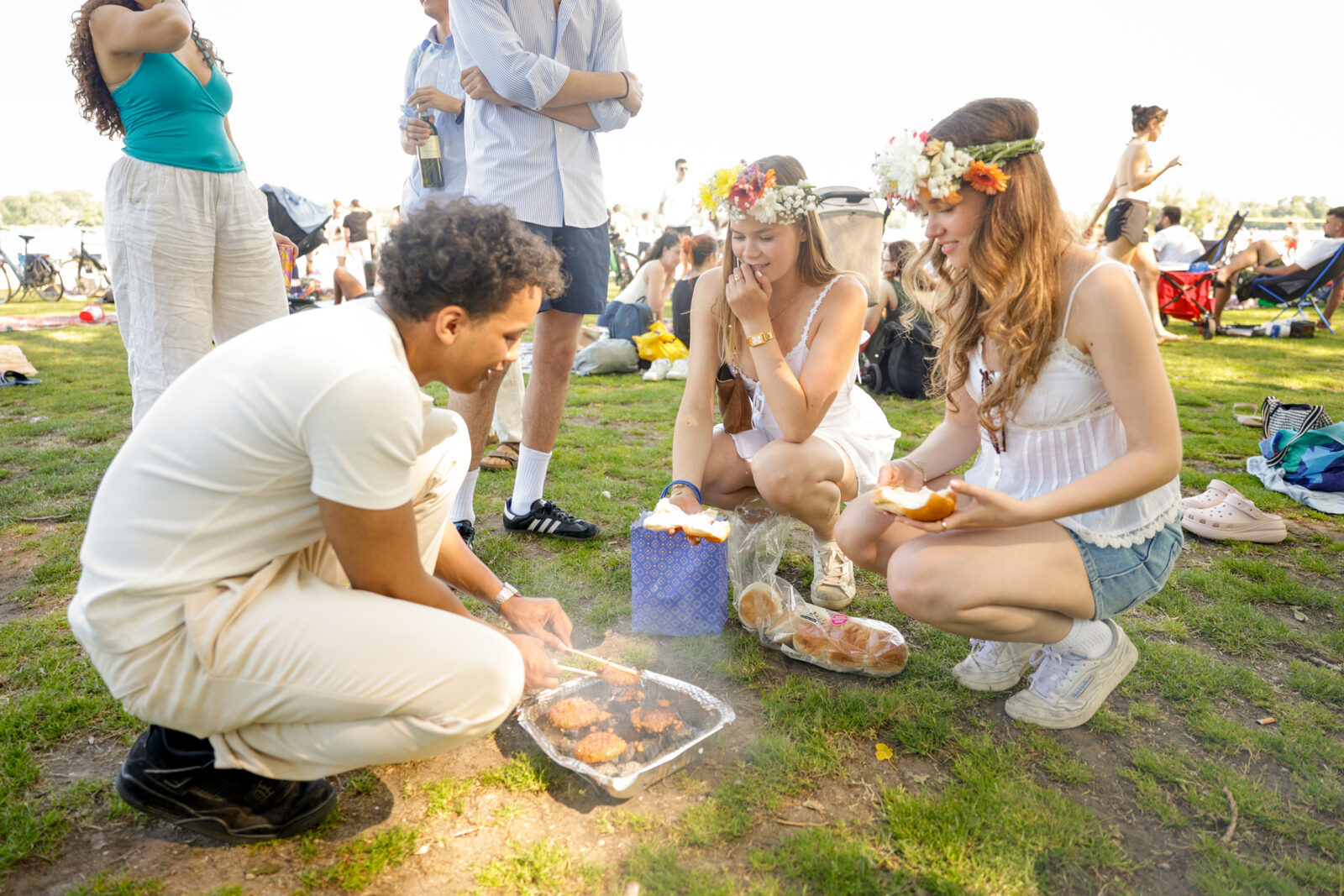
Board members Miko, Amelie and Valentina baked hamburgers for the participants.
Image by: Daan Stam
Not everyone making crowns today grew up with the tradition. Emilia made her first one at this very event two years ago, spending nearly an hour picking the right flowers with friends. “Maybe we should adopt it in Denmark”, she adds. Imogen Desmedt, who came to support her friends as a non-Nordic, was one of the first to finish her crown. “Everyone asked me how I did this”, she laughs. “I just kept wrapping.”
Closer to home
For many students, Midsummer in Rotterdam is simply connecting with fellow Nordic students. “For young people it’s mostly an excuse to drink and have fun”, Thea admits. “But it’s very much a family tradition too. It sounds like childhood.” Her favourite memory is going to her grandmother’s place outside the city as a child.
Emilia has come every year she has studied in Rotterdam, never having made it home for the actual date in June. Growing up, Midsummer meant the whole neighborhood gathering at her grandmother’s place. “I haven’t been able to go home and celebrate”, she says. “So, it’s always a bit nice to connect again”. For her, what makes it worth celebrating anywhere is simple. “You’re just supposed to come, relax, and have conversation with people you enjoy”, Emilia adds.
Read more
-

RSC/RVSV members step into the ring during kickboxing gala: ‘Everyone has a plan until you get hit properly on the nose’
Gepubliceerd op:-
Sport
-
Student life
-
De redactie
-
 Togzhan Kanapina
Student Editor
Comments
Comments are closed.
Ad
Read more in Culture
-
The emotions of science (and scientists) are palpable during theatre performance DOPE
Gepubliceerd op:-
Culture
-
Science
-
-
With this theatre show, cybersecurity expert Bernold Nieuwesteeg hopes to finally wake everyone up
Gepubliceerd op:-
Artificial Intelligence
-
Culture
-
-

Art workshops and dance performances play important role during inaugural lecture The art of healing
Gepubliceerd op:-
Culture
-
Science
-