Ad

‘Don’t blame international students for Anglicisation’
“I want to be served by someone who is Dutch”, spat the lady when I asked for her ticket to retrieve her jacket. When I responded by telling her that no one working in the wardrobe section spoke Dutch, she reacted aggressively. “I live in Amsterdam and no one speaks Dutch anymore. I want to see your manager.” I refused and remarked how the word ‘international’ was even included in the name of the event. This action prompted a rant from her part that might even make Geert Wilders blush. But, it’s a party after all, and I blamed the alcohol for her words. My co-workers looked shaken up.

I thought it was a one-in-a-million case until last month, when I was faced with an article by Law student Eline Burgman. She claimed that Anglicisation at the university has overshot the mark and described that she doesn’t want to be served in English at the Erasmus Pavilion. To my horror, her article prompted multiple reactions and comments that fully supported her. Reading her reaction with the staff of the Erasmus Pavilion brought a chill down my spine as it was almost the same situation.
Lees meer
-

‘Anglicisation at university has overshot the mark’
Gepubliceerd op:-
Opinion
-
A sentiment widely shared
It seems it was not a case that happens once in a blue moon, but a sentiment shared widely by the Dutch-speaking population and which had prompted public debate, made political groups unsuccessfully sue Dutch universities who declared English their official language and even brought forward the so-called Language and Accessibility Bill promoted by the actual Education Minister, Ingrid van Engelshoven, which proposed higher fees for non-EU students, cut the funding of Nuffic, and limited admission in English programmes. Of course this debate was in their native language, making us, English speakers, ignorant of its existence and unable to defend ourselves.
We live in the Netherlands and Dutch is the official language, so I totally understand the demand to speak Dutch. However, Erasmus University is a self-described international ambience where speaking English is accepted and multiculturalism is motivated. The university prides itself of its international focus and constantly mentions it through their official pages. Creating ‘world citizens’ is one of the ‘Erasmian Values’ that the university wants to achieve for the year 2024.
Through this international aspect, the university has placed itself high in international rankings. This attracts not only students but staff, too, and gives the opportunity to have high-quality staff working for the university. The same goes for multiple Dutch universities. However, international students are still a minority and it sounds a bit silly to say that this 20 percent are dominating the public spaces of the university.
Lees meer
-
Dutch rectors: ‘Internationalisation is necessary for quality and relevance’
Gepubliceerd op:-
Internationalisation
-
The Dutch dream
So why should we accommodate to a minority? International students suffer discrimination in the housing market, pay 10 times more than the EU fee, have low employability chances and show high rates of depression and anxiety. Loneliness and exclusion are daily battles and a lot of time their support system consists solely of the friends they made in university. They can’t even get a hug from their mum if things get rough, as they are located literally at the other side of the world. University is a safe space where internationals won’t be judged by their nationality and language (or lack of). You might say it’s their own choice to go study abroad, but would it really be that difficult to speak two words of English to order your coffee at Eramus Pavilion? A minor act of empathy that helps others in immeasurable ways.
‘The ‘Dutch dream’ bursts when students finish their studies and are thrown into a highly competitive market’
The ‘Dutch dream’ is something real for a lot of internationals who graduate and try to find a job in the Dutch market. But the competition is fierce and some of them have no other choice than to return to their home countries after their visa expires. It feels sometimes that international students (especially the ones who come from outside the EU) are the cash cows of the university and the strategy is to sell this idea of a paradisaical hyper-friendly country and make Rotterdam their home for 3 years. But the bubble bursts when students finish their studies and are thrown into a highly competitive market in which most don’t arise as successful competitors.
Second home
Erasmus University doesn’t give the necessary tools to internationals to enter the Dutch job market or even adapt to Dutch society. And of course knowing the Dutch language is a fundamental step to achieve this. Universities such as Delft and Groningen offer the opportunity for students to attend Dutch classes for free; some of these classes form part of the curriculum and are mandatory for students to graduate. Erasmus University offers a discount to students who decide to attend the Erasmus Language Training Center. However, if you want to reach a working proficiency level (B1), you would have to invest more than 1500 euros in classes.
‘Most international students have made the Netherlands their second home and are desperately trying to enter society’
After all, do not get me wrong. I firmly believe that Dutch should not disappear as a language of instruction in universities. I am not advocating to make all programmes English and christen it as the official language of academia, but proposing an approach to education as a bilingual project. Let’s not fall into this narrative of ‘them vs us’: internationals are not here to erase your Dutch identity, invade your hallways, attack your economy and degrade the quality of your course. Completely the opposite! Most international students have made the Netherlands their second home and are desperately trying to enter society while paying excessive fees compared to Dutch citizens. They would love to learn Dutch. In this age of increasing individualisation when it comes to Anglicisation, I believe that the defenders of the Dutch language should stop asking for the manager and causing a scene, and start approaching those international friends (or maybe try to make international friends) and offer them help to learn Dutch.
De redactie
Latest news
-
Desperate medical students are offering each other money to start their internships earlier
Gepubliceerd op:-
Education
-
-
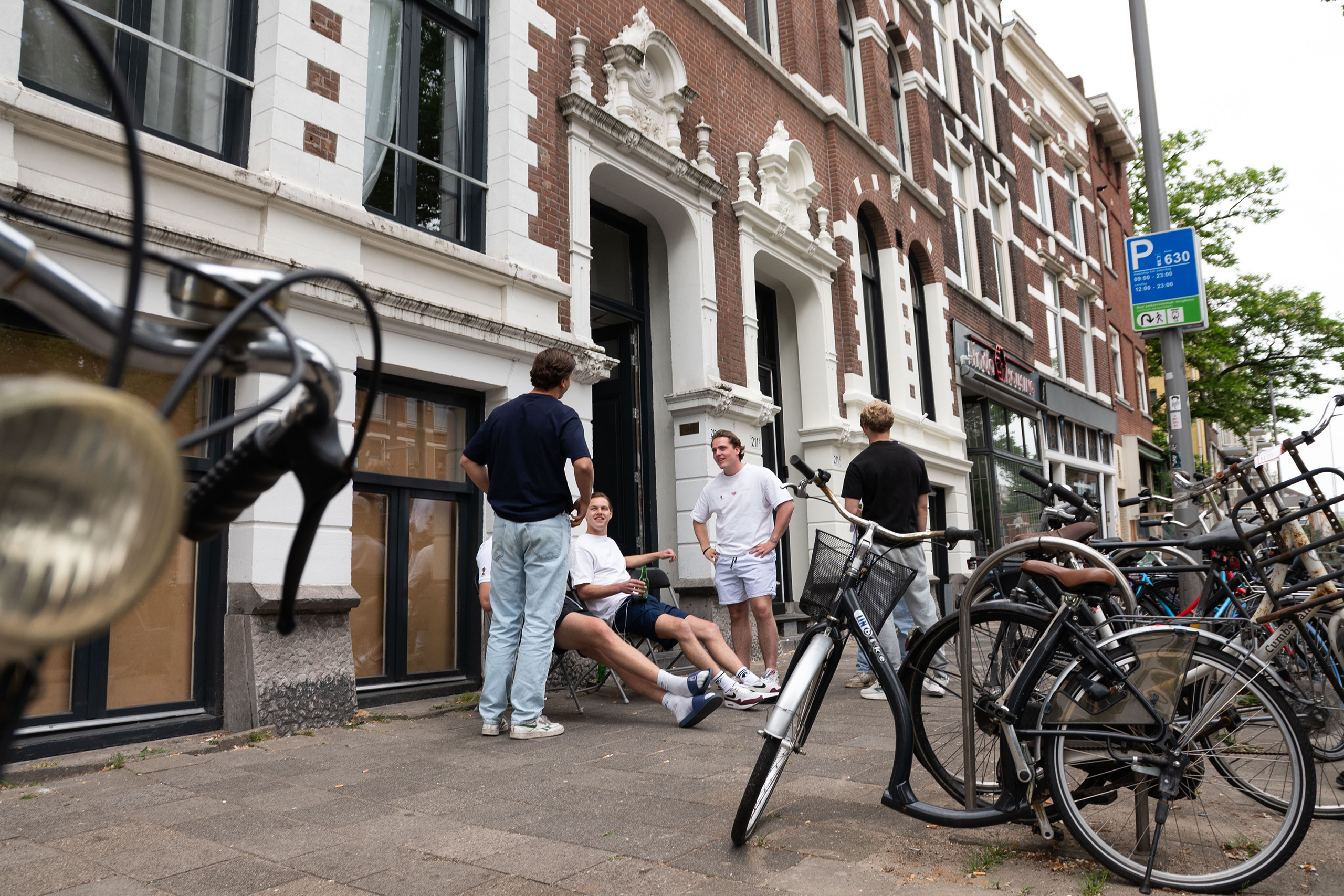
Still a shortage of 20,000 student homes
Gepubliceerd op:-
Housing
-
-

‘With gadgets like Meta Glasses, we pay to be surveilled’
Gepubliceerd op:-
The Issue
-

Comments
10 reacties
-
Sofia op 5 March 2020 om 14:12
Brilliant
-
Freddy Reyes vasquez op 5 March 2020 om 15:04
Excelente artículo, felicitaciones
-
Anon op 5 March 2020 om 15:30
Well said! 🙂
-
Elena op 5 March 2020 om 15:38
I agree – thank you for writing this!
-
Anonymous op 5 March 2020 om 19:02
You’re asking if would really be that difficult to use two words of English to order your coffee in English, but why not the other way around? An english speaker learning two words of Dutch?
And why would the political debate be in english? It’s a debate in the Dutch house of representatives.
-
Patrick op 6 March 2020 om 10:21
I blame Erasmus University for letting in so many students that are university unworthy. You really can see in many ways that Erasmus has not let go of its ‘hogeschool’ personality. For example even many Law (which is not even an high-end study to begin with) students themselves are shocked at how low the level of education is and other students are compared to those in other universities.
So naturally you get many students that are like Eline that do not understand that, by allowing English to be integrated more and more into the university, you get the best education possible (since all sources can now be drawn out of a larger pool). And the main purpose of university is still knowledge gathering and spreading.
Which students with a ‘hogeschool’ mentality do not understand. They just want it to be as applied as possible, get a degree as fast as possible and pretend that they are of a certain level as fast as possible, just like Eline.-
Mark op 7 March 2020 om 13:39
You, of all people, are not here to decided who is or isn’t “worthy” of university.
Learning English isn’t some form of “enlightenment”, instead of wasting your time complaining, pick up a Dutch book and start learning the language of the country you move to
-
Patrick op 10 March 2020 om 17:44
@Mark,
You are definitely not university material. A real researcher would never jump to conclusions based on assumptions.
You assumed without any lead that I am a foreigner. Wrong, I am Dutch.Even worse, you seemingly don’t know how to read comprehensively. Since I never claimed that English is a form of enlightenment. The task of a university and its students it to obtain knowledge. You increase this pool of knowledge by adopting the world language.
Furthermore, if you can’t learn to speak English like a native speaker (arguably the easiest language) than you are not worthy of being a university student to begin with, unless you compensate this with some badass STEM skills (ergo real hard sciences and mathematics).
-
-
fiver op 6 March 2020 om 13:34
Thank you for this well written article which perfectly emphasizes the international student position, so often forgotten about
Comments are closed.
Ad
Read more in Opinion
-

Academics allow themselves to be used by politicians
Gepubliceerd op:-
Column
-
-

Are you an EUR student gifted with writing talent? Take part in our columnist competition!
Gepubliceerd op:-
From the editors
-
-
The academic boycott of Israel is creating a culture of fear
Gepubliceerd op:-
Column
-

Anel op 4 March 2020 om 17:50
as an international student, I feel really identified with this. Thank you