Ad

Education pioneer Etienne Augé: ‘Technology should give us more time for people’

EM speaks to lecturers about what they think the education of the future should look like and how they put that into practice in the lecture hall. Etienne Augé is experimenting extensively with technology, with the aim of freeing up more time for personal contact with his students.
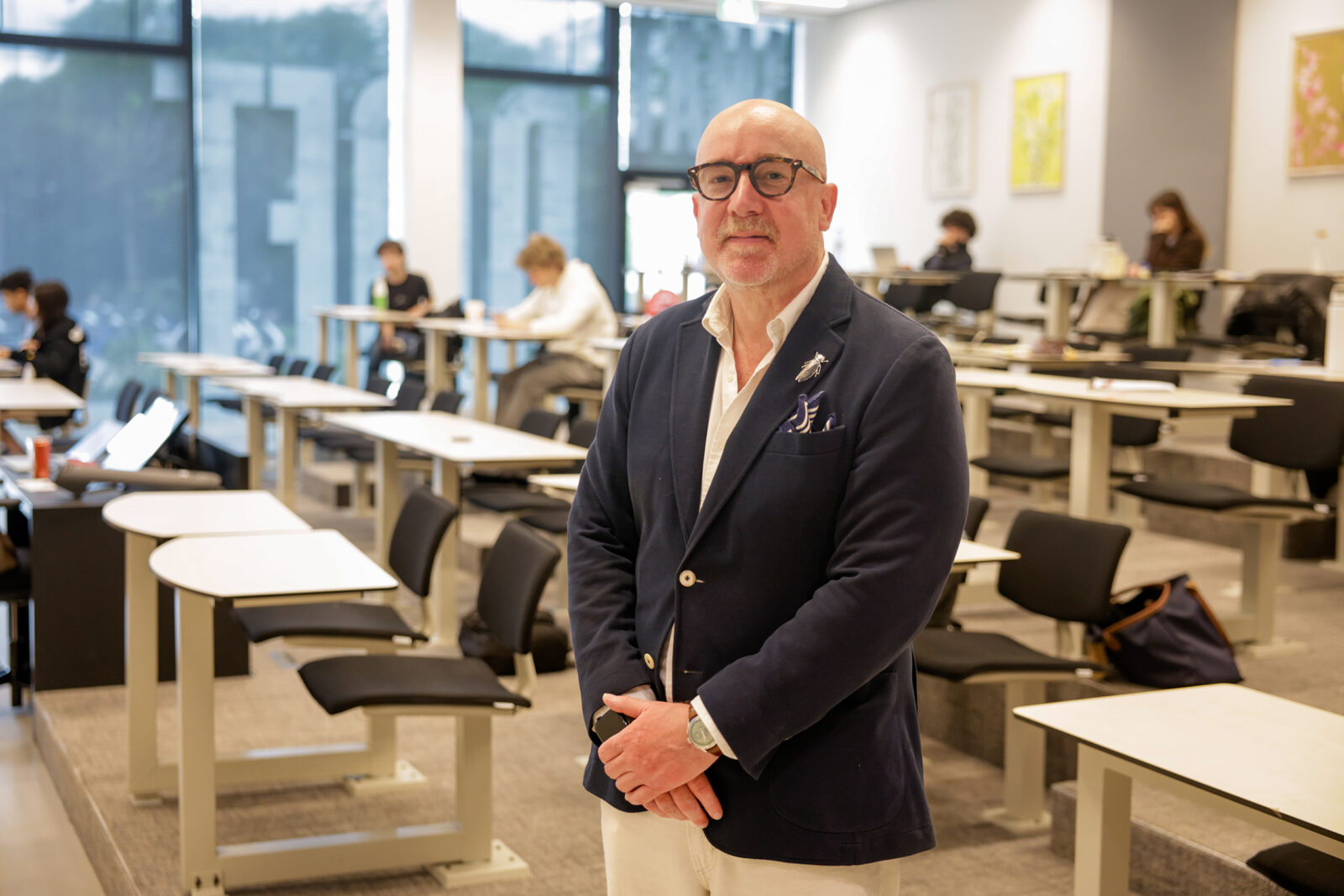
Image by: Daan Stam
There’s only one Etienne Augé. Or well, actually two. That’s why he prefers to go by Etienne F. Augé. He wears suits the way only French men can, is obsessed with science fiction, and immediately thinks of Melania Trump when he hears the word ‘vision’.
In the first twenty minutes of his lecture on science fiction, Augé has already shown a hundred slides. His presentations can contain almost 250 slides for a single lecture. Usually, his screen shows no more than a photograph or a quote. He thinks bullet points on slides are inappropriate for a lecture and calls such presentations ‘PowerPoint karaoke’.
His lectures feel more like a cinematic experience – he regularly plays film clips lasting several minutes – or sometimes like a theatre show. “One of the nicest compliments I ever received”, he says, “was from a student who said my lecture felt like listening to a podcast.”
Melania’s egg
Don’t bother him with questions about his vision on education. The word ‘vision’ reminds him of Melania Trump. “Have you seen the film Melania?” he asks. In the documentary about US first lady Melania Trump, there is a scene in which she focuses on the details of the pre-inauguration dinner.
A luxurious appetiser of caviar was served in a gold-coloured egg, placed in an egg cup on a plate. According to Augé, the golden eggs symbolise Trump’s entire inauguration: an over-the-top visual presentation, superficially polished, but lacking class or substance.
That is how he also experiences the word ‘vision’. In his view, it sounds impressive and polished, but often says little. “Since then, whenever I hear the word ‘vision’, I always think of Melania’s eggs”, he laughs. “It sounds wonderful, but what is it actually good for?”
Science fiction as a window on reality
Augé teaches courses at the university on science fiction, future studies, propaganda and film studies. The common thread is not a pre-designed teaching programme, but his own curiosity. “I teach about things that I find genuinely interesting. That’s why I can talk about them for hours.”
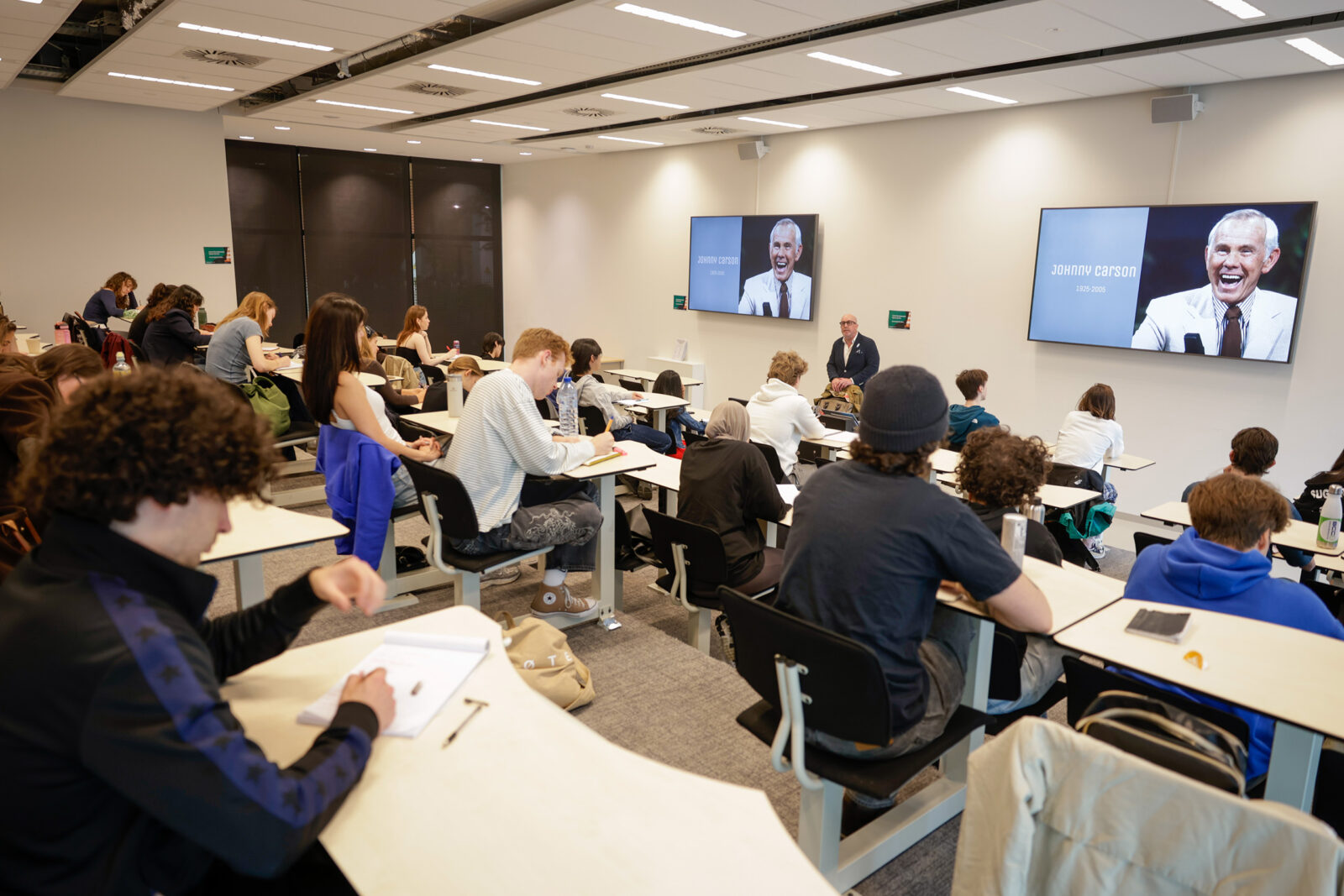
Image by: Daan Stam
In his lectures, Augé uses films, series and books to discuss developments in society. For him, science fiction is not just entertainment, but also a way of understanding society and thinking about possible futures. “You can’t build the future without first imagining it.”
'De Amerikaanse en Franse legers gebruiken sciencefiction. De CIA gebruikt sciencefiction. Verbeelding is een serieus instrument'
Science fiction, he says, makes it possible to explore scenarios that once seemed impossible but are becoming increasingly realistic. Governments, armies and international organisations have understood this for some time, he says. “The French and US armed forces use science fiction. The CIA uses science fiction. Imagination is a serious tool.”
He wants to convey the same idea to his students. Students need to understand, he believes, that ideas from films and books can eventually become reality. Those who view technology and social developments only as abstract theory may miss important changes, he says.
Technology as a tool, not an end in itself
That conviction also underpins his experiments with new technology. For example, Augé used AI to develop a metaverse – a virtual learning environment – in which students could navigate the teaching material independently. Students can walk around the metaverse with their avatars and receive explanations about the teaching material from a digital mentor. After a semester-long trial, most students still preferred his physical lectures.
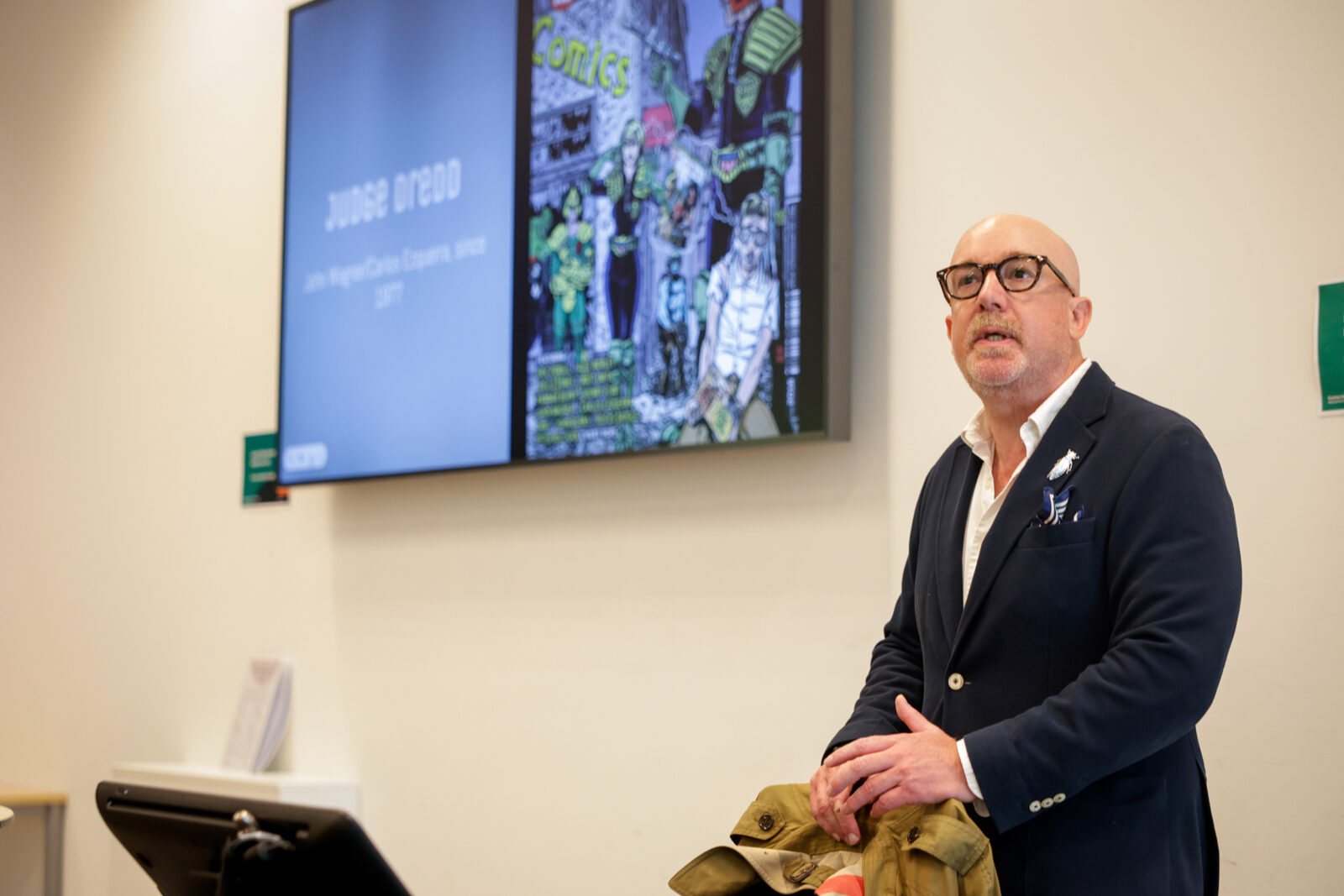
Image by: Daan Stam
“Some thought the metaverse looked like a bad version of Fortnite”, he laughs. “Actually, that was a good outcome for me. If they had thought the technology was fantastic, that would have been interesting. But if they say: we’d rather have your lectures, then I also know that the human element is important.”
More time for personal contact
Augé does not want to use technology to make lecturers redundant, but to give them more time for students: what if AI and technology could take over some of the transfer of knowledge, leaving a lecturer with more time for conversations with students? He is thinking of the system used at Oxford and Cambridge, where students receive intensive and sometimes one-to-one guidance from a lecturer.
Soon, he will continue experimenting with the Community for Learning and Innovation to integrate a virtual learning environment into education. “We want to offer students a better experience online, without losing sight of the human factor.”
The arrogance of academia
Augé is popular with students, yet he is strikingly sceptical about the influence a lecturer can have. “It’s arrogant for academics to think they can change the lives of an entire generation”, he says. “The only thing you can do is spark students’ curiosity.” Of the 36 students in his lecture today, many will undoubtedly be there mainly for the credits, he thinks. He does not see this as a problem. “But if four or five students genuinely take something away from what I tell them, that’s already fantastic.”
Etienne F. Augé is an associate professor at the Erasmus School of History, Culture and Communication. His main areas of expertise are propaganda, public diplomacy, film studies and science fiction. Augé writes books about propaganda and future studies. His latest book is Superheroes, a popular science discussion of the superhero genre. He is popular with students: he was nominated for the IBCoM Awards almost every year and regularly voted best lecturer. He has also twice been shortlisted for Erasmus University’s Education Award.
Een lijst met artikelen
De redactie
-
 Feba Sukmana
Editor
Comments
Ad
Read more in Education
-

Talent strategy takes shape: plenty of ‘self-management’, freedom of choice of study remains intact
Gepubliceerd op:-
Education
-
-

Extra funding for higher education does not keep pace with inflation
Gepubliceerd op:-
Education
-
Politics
-
-
Cuts to education after all? It could happen, according to secret coalition plan
Gepubliceerd op:-
Education
-
Politics
-

Leave a comment