Ad

Indirect discrimination? Five medical degree programmes know the criticism but continue to select at the gate
Three medical degree programmes have switched entirely to lottery admission because certain groups otherwise systematically have less chance. The other programmes are aware of the problem but are not acting on it. “A lawsuit is certainly not without prospects.”
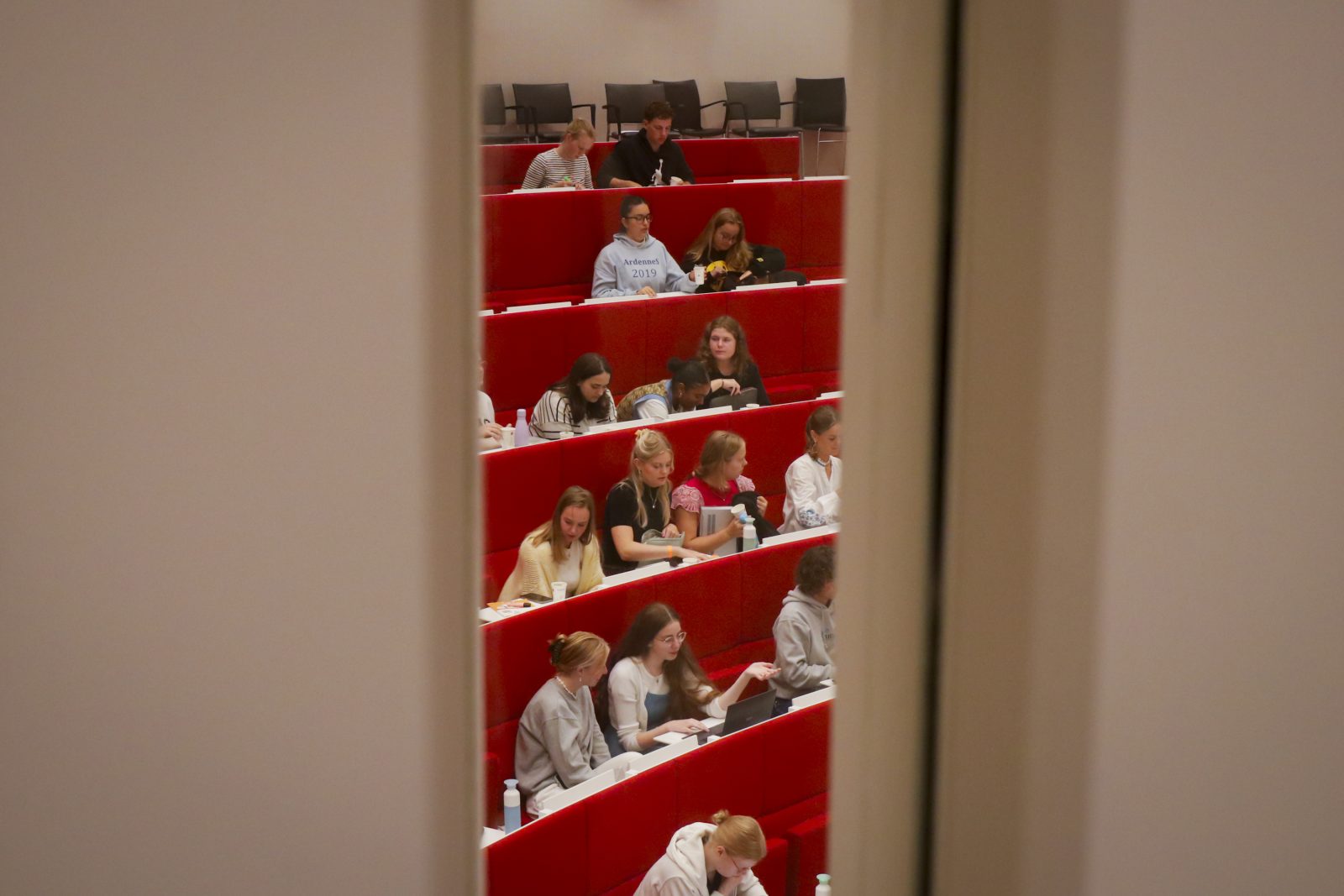
Image by: Daan Stam
Hundreds of 17-year-old pupils applying for medical school must demonstrate that they have what it takes to become a doctor and answer a range of multiple-choice questions. For example: “Together with a number of students you are working on an assignment and each of you writes part of the report. You are not satisfied with the quality of what the others have written and feel it could be improved. What do you do?”
This article in one minute
– Five medical degree programmes select students; four of them use a personality test.
– Experts strongly criticise this approach. The programmes do not substantiate their selection methods.
– Selection at the gate of degree programmes harms equal opportunity.
– This amounts to indirect discrimination.
– Lawyers and the Netherlands Institute for Human Rights suspect this is prohibited.
– The Education Inspectorate does not intervene.
Candidates can choose from four answers: A) You offer to do the final edit and spend a lot of time improving the others’ sections. B) You say nothing. You are all assessed individually for this assignment anyway. C) You discuss it with your fellow students and explain where you think it could be improved. D) You complain about it and make sure that next time you are placed in a group with other students.
Which answer does the programme want? With which answer do you become a better doctor in about seven years’ time? Should future doctors be allowed to complain or not?
Admission
Selection at the gate in higher education has come under increasing scrutiny in recent years. The Education Inspectorate has issued strong criticism: selection procedures lead to inequality of opportunity and the criteria are often poorly substantiated.
Medical degrees are also familiar with this criticism. Three of the eight programmes have now switched to lottery admission instead of selection. At the University of Groningen and the University of Amsterdam, applicants can enrol and it then comes down to luck whether they are allowed to start. At Radboud University Nijmegen, candidates must first read some information about the medical profession and the programme. Anyone who has done so may enter the lottery. Whether you are a student with average grades or top marks, everyone with the right subject combination has an equal chance.
Utrecht University uses a hybrid model. There, the medical programme admits 238 first-year students via lottery – 80 per cent of the total. The remaining 59 are selected on the basis of knowledge, motivation and a personality test (a so-called ‘non-cognitive’ test).
The other four programmes therefore do not use a lottery. All four test candidates’ cognitive abilities, for example by offering study material and lectures on which candidates then sit an exam. Erasmus University Rotterdam stops there. Vrije Universiteit Amsterdam, Maastricht University and Leiden University also aim (like Utrecht) to assess candidates’ personality.
Personality
What are the selective programmes looking for? Vrije Universiteit wants to know what makes a candidate stand out: do you do voluntary work, play the violin well, build your own robot, or have a part-time job at a GP practice scheduling appointments? Delivering pizzas does not count, it explicitly states. A job as a team leader in a supermarket also does not help. On top of this comes a test of ‘social insight’, in other words a personality test. The multiple-choice question at the start of this article, about teamwork, comes from VU.
Maastricht also wants to know candidates’ ‘distinctive qualities’. The Limburg programme not only wants to know whether candidates are sufficiently capable, but also whether they have ‘adequate (inter)personal qualities’. Maastricht does not, when asked, refer to it as a personality test, because: “In our view, there is no unambiguous answer to the question of what the ideal personality for a doctor is.”
In Utrecht, motivation plays a role in selection. The programme also wants prospective students to have an aptitude for competences ‘relevant to the professional attitude of a future doctor’.
Finally, Leiden looks for students who are ‘capable, caring and curious’. In the first round, candidates take a ‘study skills test’, previously referred to as a personality test, which, according to the information provided, cannot be prepared for: “It is about who you are and how you respond to certain study situations.”
Mapping character?
But is it actually possible? Can the personality of 17-year-old pupils be measured through a test in such a way that you can say who will become a good doctor and who will not?
The Leiden medical programme has little to say about it. “Many candidates ask questions about the reliability of the personality test,” reads a standard email sent to rejected applicants, seen by the HOP press agency. “We can be brief about this: it is reliably sound. It is not possible to give socially desirable answers or to present yourself as better than you are.”
Not everyone finds this convincing. Doctors and psychologists consulted on the matter raise their eyebrows when hearing about personality tests. They have immediate doubts.
The Handbook for selection in higher education, referenced by the association of universities UNL, is also not enthusiastic: “The reliability and validity of personality questionnaires is not favourable in the context of a selection procedure.” Moreover, they may undermine the ‘diversity of different types of students’.
History
In the past, medicine used a weighted lottery system: higher exam grades gave you a better chance, but otherwise admission was a matter of luck. Later, pupils with an average grade of eight or higher were automatically admitted, but a national lottery still applied for the rest.
That lottery sometimes felt unfair. Should motivation and aptitude not play a role? Who would you want at your bedside: someone who always wanted to become a doctor, or someone who simply happened to be selected by chance? It is also a waste if a weaker student drops out after a year, while a more suitable candidate never even gets the chance to start.
That is why programmes were given the opportunity to select students themselves. First this was allowed for half of all students (2000/2001), later the lottery was abolished entirely and they had to select all prospective students (2017/2018). They were, in principle, free to decide how, as long as they used at least two criteria.
Pudding
But can you meaningfully select on personality? Klaas Visser doubts it. He was for many years an expert on study success at the Faculty of Psychology of the University of Amsterdam.
'The prospective student only thinks one thing: what do they want to hear?'
As an external expert, Visser once commented on a personality test used by Vrije Universiteit. It included a question about a (fictional) lecturer who says something unpleasant to students: how would you respond? Visser: “The ‘correct’ answer sounded socially appropriate, but there was also an answer that was quite assertive. At the time, VU advertised that it wanted to recruit assertive students, but the test designer apparently felt they should not be too assertive. I said: this is all pudding.”
Visser considers such selection tests a waste of time and money, he says. And you do not get honest answers. “The prospective student is not thinking: this is what I would do. They are thinking only one thing: what do they want to hear from me?”
He is not only critical of personality tests, but also of knowledge and reasoning tests. The main problem is that you can prepare for them, he says. And some candidates therefore have a greater chance than others.
People from more privileged backgrounds, in his view, always have an advantage. “A colleague professor once told me that he and his wife, who is also a professor, drilled their granddaughter for a week to prepare her for such a selection test. Then I thought: not everyone has grandparents who know this material inside out.”
Do you end up with better doctors? Visser thinks not: “You select a lot of high achievers, people who try extremely hard to get in. I have heard doctors say this leads to students who are more prone to burnout. Do we want that? Shouldn’t we have a more diverse population? And that is not only about background, but also about interests. Imagine if all medical students wanted to become paediatricians, while we actually need more geriatric specialists.”
Visser: “I once went to the Ministry of Education and gave a passionate plea that they should at least ask these programmes: what is your method based on?” But institutions are not required to account for this.
Een lijst met artikelen
-
Unequal opportunities for Dutch-Caribbean students in medical programmes, despite shortage
Gepubliceerd op:-
Diversity
-
Groningen
The medical programme in Groningen was the first in 2025 to return to lottery admissions. It is an unweighted lottery: high exam grades give no advantage. With the right diploma, everyone has an equal chance.
“We know there is an unconscious bias in the selection system,” says Marieke Schuurmans, vice dean for education and training at UMC Groningen since November 2023. “We saw that our student population was becoming more and more similar. We also knew we were missing out on many pupils.”
Schuurmans: “We were mainly getting candidates who played it safe. Their parents could afford expensive courses to prepare for selection tests. We all understand that this does not work. It does not give a good representation of Dutch society.”
'Does the motivation of a 17-year-old pupil tell you anything about the motivation of an adult doctor?'
If one of your parents is a doctor, she emphasises, you are far more likely to pass selection. But in principle, many candidates are suitable to become doctors, she says. There are more than can be accommodated. You would like to select ‘promising’ candidates, but what exactly counts as promising?
“You can look at study success: which students are most likely to graduate? But is study success the most important outcome of the programme? You are training for the medical field,” she says. “How do we know someone will ultimately become a successful doctor?” Schuurmans also points to burnout among students and young doctors. “A good doctor is also someone who feels well in their work,” she says.
Of course, you can invent all kinds of criteria for selection, she says, but no matter how well intended, you simply do not really know whether you are doing something meaningful. “Take motivation. Even if you could measure it, how do you know that the motivation of a 17-year-old pupil says anything about the motivation of an adult doctor? You have no idea what that motivation is based on.”
It is clear, however, that selection leads to inequality of opportunity. That is why Groningen decided to stop and return to lottery admission. It met little to no resistance, she says. “Of course someone sometimes asked: are we getting the dummies in Groningen then? On the other hand, doctors of my generation say: I am so glad we are doing this, I would never have made it through selection myself.”
Pure lottery is not her preferred option, however. Schuurmans: “Ideally, I would reserve study places specifically for regional candidates. We struggle to retain enough healthcare professionals here. A large proportion of medical students leave for the Randstad, while students from this region are more likely to stay and work here. I would also like to reserve places for students from underrepresented backgrounds. For example, we have very few students with a non-Western background or students without highly educated parents.”
Going it alone
The Education Inspectorate warns against overconfidence among selective programmes. “We have seen that, with the best of intentions, they design and implement their selection procedures themselves,” said then Inspector General Alida Oppers in 2023. “But everyone essentially devises these procedures independently and according to their own insight, and without consensus on what fair and effective selection looks like.”
The selective medical programmes do not want to disclose their reasoning. Leiden refers to the company that develops the personality test: NOA, part of Vrije Universiteit.
No judgement
This organisation develops such tests for a wide range of institutions. When asked, NOA explains how carefully the tests are designed, but refers responsibility back to the programmes. The personality test produces a profile, but not a judgement.
The personality tests can be criticised. But even if you believe they are accurate, the question remains what you should do with the results in a selection procedure. This is not about identifying candidates with, for example, psychological disorders that would clearly make them unsuitable for the profession. It is about assessing and ranking hundreds of often underage candidates who are, in fact, largely capable. Sometimes they are admitted a year later after a second attempt.
Multilingualism
Meanwhile, the current selection process does in fact lead to inequality of opportunity, sociologist Lianne Mulder has shown. She obtained access to hard data on prospective students and enrolled students and wrote a PhD thesis at Vrije Universiteit Amsterdam on this topic, showing inequality of opportunity from primary school through secondary school and medical education to medical specialisation.
There are standard requirements for medicine: a pre-university diploma with specific science subjects. Inequality begins with the fact that some groups of young people (for example those with a non-European migration background or from rural areas) receive lower secondary school recommendations and therefore never reach pre-university education, Mulder says.
Once you have that diploma and want to study medicine, selection comes into play. Selection programmes then look at characteristics that are already sufficiently demonstrated by the diploma (cognitive ability), or at softer personality traits.
And this increases inequality. Wealthier parents, Mulder also says, can easily pay for expensive courses that prepare their children for selection. Children from certain social circles, for example with doctors as parents, therefore gain entry more easily.
She is not necessarily against selection, but believes it could be done much better. “In selection, I miss characteristics that demonstrably contribute to inclusivity and accessibility in healthcare.”
She mentions multilingualism. There are many patients who struggle to speak Dutch or English. For them, it would be very helpful if a doctor happens to speak their language. Mulder: “Sometimes their children are used as interpreters, which can of course be very harmful to those children and is therefore not allowed at all. Imagine having to tell your mother she has cancer.” Multilingual medical students are also regularly asked to interpret.
Multilingualism among doctors therefore improves care. It could easily be included in selection. “Multilingualism does not depend on your country of birth or where your parents come from. Regional languages such as Frisian, Limburgish, Zeelandic and Twents are also languages, as is sign language. Candidates can also learn an extra language if they wish.”
'In selection, I miss characteristics that contribute to inclusivity and accessibility'
To tackle inequality, lottery admission alone is not enough, she says. There has been a long-term imbalance in medical education. “Even if all medical programmes switched to lottery admissions, the eventual population of doctors and medical specialists would never reflect society.”
Greater diversity among doctors would also help improve their geographical distribution, she explains. “Candidates from lower socioeconomic backgrounds are more likely to work in regions where patients have similar backgrounds. GP shortages are greatest in areas where, for 25 years, the fewest medical students have come from.”
Mulder is not the only one who sees the problem: research in Rotterdam also shows inequality of opportunity. They looked at first-year student performance. Selection based on CV, reading tests or numeracy tests made little difference. Only a trial study test (where candidates receive study material and sit an exam) predicted study success, but this disadvantaged candidates with a migration background and those with a foreign diploma.
Background
Of course, students from less advantaged groups do get in. Aicha, for example. She challenged the selection procedure at her programme.
Aicha: “From fourth year of secondary school I was focused on my grades and my CV. I had help from a Moroccan girl I knew who was also studying medicine. That really helped. Do you know how important that is? She could tell me what to put in my motivation, what to include on my CV and more. You need a lot of inside information to get through selection properly. I also worked extremely hard to get an 8-plus average. I could not afford exam preparation courses.”
Once at university, she tried to raise concerns about selection. “That met huge resistance.” Those designing the selection, she says, have little understanding of equality of opportunity. “They are mainly focused on medicine and do selection on the side. They barely realise that quality can be defined in many ways. For example, they think it is unfair to take someone’s background into account.”
'I am a woman of colour, why would they listen to me?'
Multilingualism as a selection criterion, which Lianne Mulder advocates, was also suggested by Aicha at one point. “That was laughed off. They said: who is going to test all those people, we do not have the money… It is very strange. In medicine you are supposed to work evidence-based, but in selection they abandon that principle.”
You have to imagine, she says, who she is speaking to: white, privileged people. She feels that white fragility plays a role, the defensiveness of white people who do not want to receive criticism from people of colour. “Nobody knows the best way to select, but they do not want to hear that from me. I am a woman of colour, why would they listen to me? They present themselves as being reasonable. Then they say: we will adjust something and evaluate in a few years whether it worked. But you can already see it will not help much, and then we are years further down the line.”
Discrimination
To summarise: student selection disadvantages certain groups, and the programmes cannot demonstrate that this selection leads to better doctors. Yet they continue. Is that actually allowed? Is it not discrimination?
No selection committee explicitly opposes children of migrants or children of less educated parents. But selection procedures can involve ‘indirect’ discrimination, says professor of education law Paul Zoontjens. “Even without specifically targeting a minority, you can still exclude certain groups.” This must be demonstrated statistically, he adds.
Lawyer and education expert Peter Kwikkers agrees. “Universities are allowed to select,” he stresses. “But they are not allowed to discriminate in doing so. I actually find all additional selection criteria dubious, because the risk of discriminatory effects is always present.”
A legal process would be required to prove such (indirect) discrimination, Kwikkers says. “There are significant barriers. You first need someone who is rejected and who will likely have to take the case all the way to the European Court in Luxembourg.”
Netherlands Institute for Human Rights
We put the issue to the Netherlands Institute for Human Rights, where people can report discrimination. Programmes are in principle allowed to select, stresses senior policy adviser Guido Terpstra, and sometimes indirect distinction may be justified. “For example, if you require a certain level of Dutch for a language degree, you exclude people without that level.”
But selection is not easy, he adds. “Because there is a risk of discrimination, programmes have a responsibility to monitor the effects of selection. Are we attracting more men or more women compared to a blind lottery? More or fewer students with a migration background?”
If distortion occurs, they must be able to justify it, Terpstra says. “And we assess that very strictly.” Programmes are required to properly substantiate their selection, but he suspects this often does not happen.
'The education institution must prove that it is not discriminating'
A rejected candidate can therefore approach the Netherlands Institute for Human Rights. Terpstra: “You can do that if you think: I am being wrongly disadvantaged by the selection process. You can also file a lawsuit.” (Unlike a court, the institute can only issue opinions.)
In such a procedure, the burden of proof can be reversed, Terpstra says. “If a candidate can make it plausible that a selection method disadvantages people at group level, for example those with a specific ethnic background, then it is up to the institution to prove that it is not discriminating.” The university must then objectively demonstrate that the method truly leads to better students and doctors and does not exclude groups.
Such a case may become easier for rejected candidates now that some programmes use lotteries while others still select, Terpstra argues. This puts the remaining selective programmes in a position where they must defend their approach. “Such a case is certainly not without prospects.”
Terpstra: “You could also argue that the Education Inspectorate has a role here.”
Inspectorate
That is indeed the question: why is the Inspectorate not acting? Can inspectors not intervene against selection that undermines equality of opportunity and has limited predictive value? The short answer is no, because the Inspectorate receives no ‘signals’ that anything is going wrong.
“At the Education Inspectorate we do two things,” says inspector Susanne Rijken. “We supervise the system. We have, for example, written a report on selection. In it we said: equality of opportunity is often not taken into account when designing selection procedures. In addition, we work in a ‘signal-based’ way. So if a signal comes in that students are being selected unlawfully somewhere, we can investigate and form an opinion.”
In cases of directly discriminatory selection, the Inspectorate can intervene. For example, in 2024 there was a programme that wanted to prefer women because there were already so many men in the field. That was not allowed, the Inspectorate ruled, because it constituted prohibited discrimination on the basis of sex. But it is rarely that clear-cut, Rijken says. Programmes have considerable freedom in selection.
Does the Inspectorate not see the problem of indirect discrimination? “As long as it is not proven beyond doubt, we cannot enforce it,” says Rijken. And according to her, it has not yet been proven.
But students from non-Western backgrounds and from disadvantaged environments are less likely to get through. If that is not discrimination, what is it? Is it perhaps their own fault?
Rijken does not want to phrase it that way. She again points to the distinction: the Inspectorate can make strong statements about the system, while still not intervening in individual programmes. For that, a ‘signal’ is first needed that something is seriously wrong. Until then, programmes may continue.
Is something wrong with her personality?
Lisa is a grammar school pupil with high grades. In the past, she would have been warmly welcomed into medical school: anyone with an average grade of eight or higher was admitted.
Lisa took an aptitude test and a personality test. She did well on the aptitude test (a kind of intelligence test), but scored unexpectedly low on the personality test. Was there something wrong with her personality?
Lisa: “I thought about that for a long time. You start doubting yourself. You wonder what is wrong with you. I also sent an email asking whether I could see my results. But they do not disclose anything.”
It kept going round in her head. “Was I perhaps too modest? Maybe I am not confident enough yet, I am still quite young.” She was 17 at the time of the interview.
And yes, the rejection hurt. “I was in town with my mother when the email came. I immediately started crying, I was very upset.” In the conversation she keeps trying to find reasons for it. She kept telling herself she would be a good doctor: “I am a hard worker and good with people.”
A year later, Lisa was admitted after all, without having taken any training or tutoring.
Egyptian father, Dutch mother
Salma was rejected twice for medical programmes: once in Leiden and once at the University of Amsterdam. She has an Egyptian father and a Dutch mother. She lived outside the Netherlands until the age of 13. “When I came here, I could barely hold a conversation in Dutch.”
School, however, was not a problem. “I did well in pre-university education. In years three and four I spent hours every day on homework. In year five I had a dip, but otherwise I got good grades. I inherited a lot from my parents.” Both are highly educated.
Salma now speaks flawless Dutch. She scored highly on the personality test, because, she says, she could see through it. “I knew exactly what they wanted to hear.” Yet something went wrong in the selection process.
Also in Amsterdam, where there was still no lottery at the time. Applicants were asked questions about their knowledge of medical news, for example vaping and doping controls – apparently intended to measure their interest in the field. You could prepare for this. “Some people had folders with all the medical news from the past year,” Salma says.
She did not try a third time and instead started a different degree.
Response from the medical degree programmes
In a joint response, the programmes say nothing about the risk of indirect discrimination or the substantiation of their selection procedures. In their considerations, universities take into account ‘principles such as equality of opportunity and suitability for the programme profile’, they say. Below is the full text.
“The number of secondary school pupils who want to study medicine is much higher than the number of available places. The number of applications is at least three times higher than the number of places at each university, so many students are disappointed each year. To determine who is admitted, lottery admission or selection may be used. Each university has its own profile and makes decisions on how to design its admissions process based on that. Principles such as equality of opportunity and suitability for the programme profile play a role in this. Both lottery admission and selection have advantages and disadvantages, and these experiences are shared between programmes. Some universities have fully switched to unweighted lottery admission, others to a combination of lottery and selection, and some still use selection procedures. It is good that pupils can choose the programme that suits them best. Admissions methods are monitored annually, extensively evaluated and adjusted where necessary. Many students consciously choose selection because they prefer to have more control over their admission. And there are students who prefer lottery admission.
Through UMCNL, the medical faculties are working on an annually updated website where information about the eight programmes is clearly presented. Pupils can find a reliable and accessible overview of the medical degree, the differences between programmes and the admissions procedures in one place. Each faculty explains what characterises its programme and how the associated admissions procedure is structured. UMCNL facilitates the development of this portal, with faculties responsible for the content.”
The names Aicha, Salma and Lisa have been changed for privacy reasons.
This article was produced in part thanks to a journalism in education grant from the Stichting Onderwijsfonds COCMA.
De redactie
Comments
Comments are closed.
Ad
Read more in Education
-
TU Delft may not favour women in admissions to courses
Gepubliceerd op:-
Education
-
-
RTL: More than half of master’s theses contain AI-generated text
Gepubliceerd op:-
Artificial Intelligence
-
Education
-
-
Education pioneer Etienne Augé: ‘Technology should give us more time for people’
Gepubliceerd op:-
Education
-