Ad

Shivering or sweating in Sanders: staff sat in the office with electric blankets

The temperature in the Sanders building has been all over the place this month. It should be a stable 19 degrees, but due to a malfunction earlier this January, people sat at their desks with blankets, heaters and extra layers of warm jumpers.
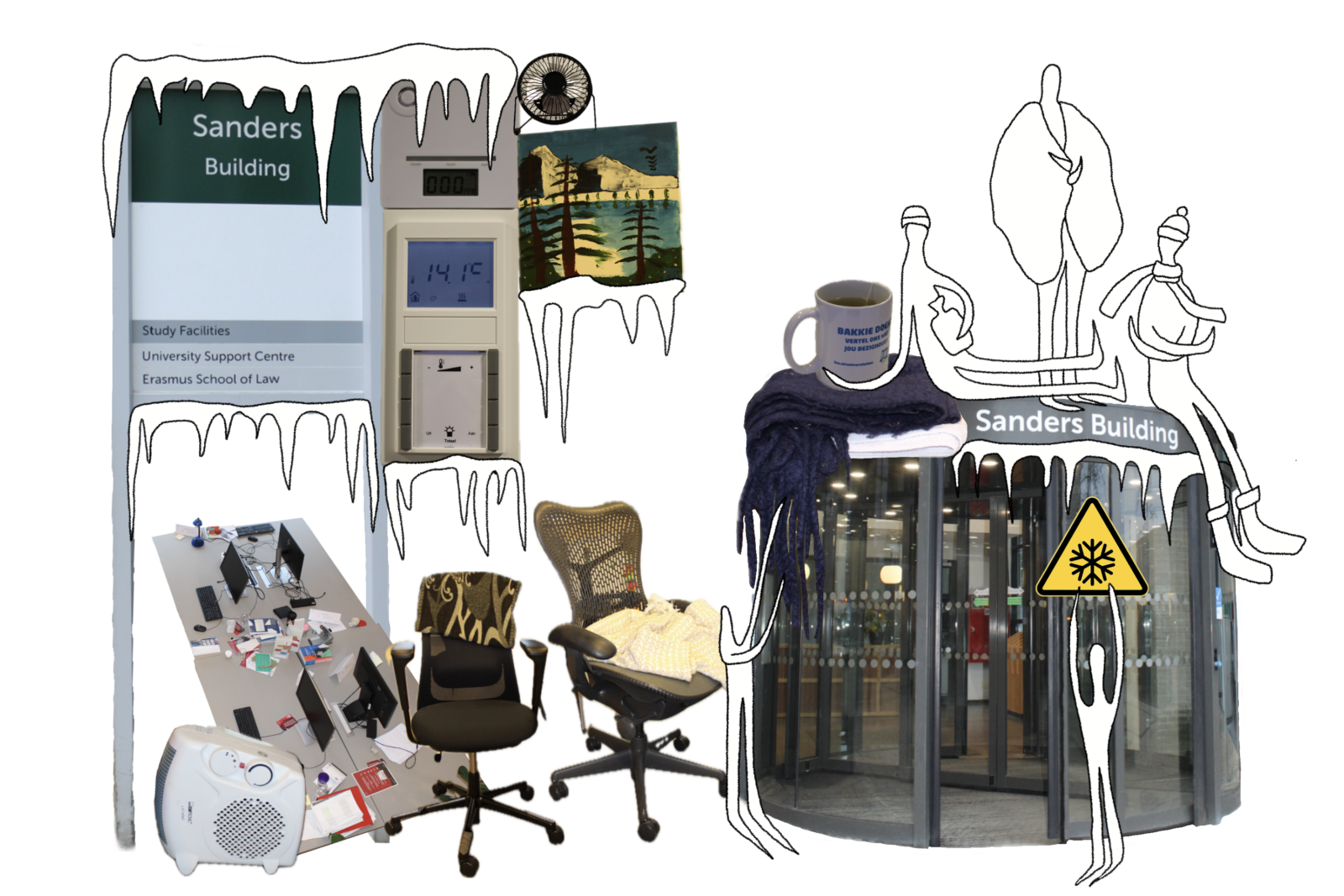
Image by: Sonja Schravesande
Monday morning, 9 am, and it is 18.8 degrees on the seventh floor of the Sanders building. At the left door just around the corner that is, on the right side of the building, it’s 19.1 degrees. Much more pleasant than the 14 degrees at the beginning of January, agrees an employee who has just stepped out of the lift. “Well, don’t get me started. It’s often been very cold since the renovation in 2017.” Another employee tells about the first weeks of January: “People brought blankets, heaters and warm jumpers to the office. It was unbearable.” Now she also finds the indoor temperature much more tolerable.
The malfunction that caused the cold workplaces in early January has now been fixed. That wasn’t the first malfunction this academic year, there was also one in November. “What a mess”, Marlies describes those first weeks of January. She works on the fifth floor. Although it was even colder for her colleagues: “Colleagues worked with their coats on, wore thermal underwear, sat on Stoov cushions they had brought from home or worked behind their computers with electric blankets.” Marlies sent several emails asking if something could please be done about the cold.
(Un)stable 19 degrees
After reports of overly cold workplaces, the temperature was turned up, with the result that it became too warm in some places. “What makes regulating the temperature difficult is that Erasmus University uses a building management system that automatically regulates the indoor climate in the Sanders Building”, says a spokesperson for the university.
When the building is empty, for example at weekends and between Christmas and New Year, the thermostat is turned down. “The lower the base temperature is set, the longer it takes for the building to warm up again when users return. As a result, the temperature was lower than the required 19 degrees, especially at the beginning of the working week.” The cause of the malfunction is unclear.
Traces of the cold
Traces of the cold days are still visible in various workplaces: blankets, extra jumpers or warm cardigans and the occasional electric heater can be found on or under desks. There are small fans on the fourth floor because it can be sweltering, especially in summer. There are thermostats everywhere in Sanders, but they don’t always work properly, says Marlies. When, according to her own measurement, it was 15 degrees and she was shivering from the cold, the thermometer at her desk read 18.9 degrees.
Until the beginning of March, various measurements will be taken in the building for new research. “Real Estate & Facilities is now looking for the right balance in adjusting the system”, says the spokesperson. “We are investigating the optimal base temperature that will keep the temperature in the building constantly comfortable. In the coming period, the department will be using temperature meters to objectively determine the temperature on the different floors of Sanders Building. The aim is to determine whether the temperature shown by the building management system corresponds to the actual temperature in the building. If there are any discrepancies, we can ensure that they are resolved, enabling us to better control the indoor climate.”
De redactie
-
 Tessa Hofland
Editor
Comments
Comments are closed.
Ad
Read more in Campus
-
Interest on student debt at highest level in 17 years
Gepubliceerd op:-
Money
-
-

Behind on repaying your student debt? DUO may soon pass the details on to your municipality
Gepubliceerd op:-
Politics
-
-

Extra funding for higher education does not keep pace with inflation
Gepubliceerd op:-
Education
-
Politics
-