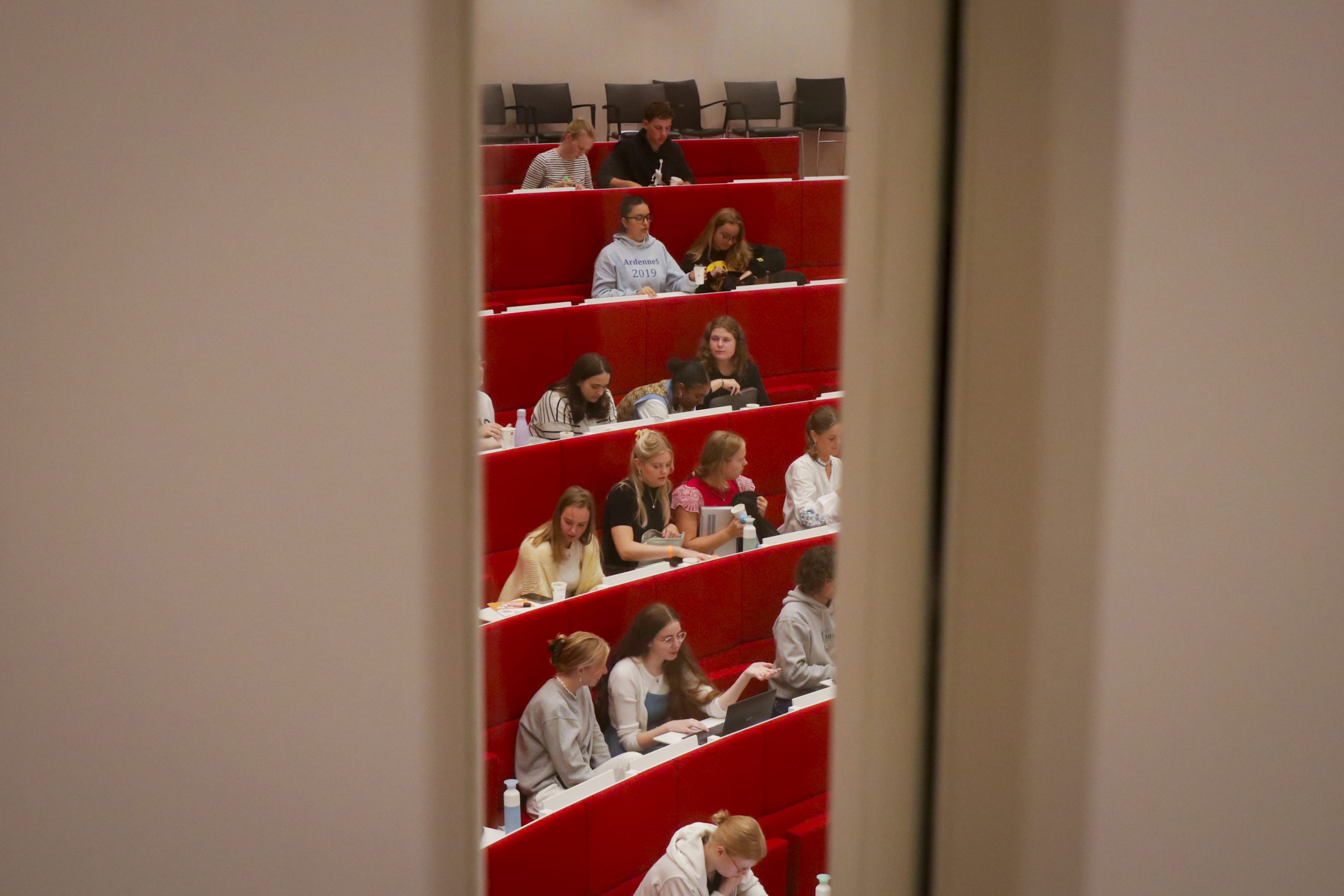
Study delay is often caused by illness or part-time job

Students can’t always prevent delays in their studies. A large number say they were simply ill, according to research agency ResearchNed. They also often mention their part-time job as a reason.

Image by: Pauline Wiersema
Many students take longer to complete their studies. In universities of applied sciences, only one in three gains their bachelor’s degree within four years. At universities, where a bachelor’s programme lasts three years, roughly the same proportion of students finish within the set period.
Politicians would like students to keep up the pace. Programmes may, for example, dismiss first-year students who fail to obtain enough credits. The Schoof-government even wanted to introduce a slow-progress penalty for students with more than one year of delay. That proposal was shelved after fierce protests.
Research
But where does this delay come from? Students must have good reasons, thought student organisation ISO, which asked research agency ResearchNed to look into the matter.
It first listed known factors: men are more likely to fall behind than women, as are, for example, students with a migration background and students with a part-time job. Parents’ income also plays a role.
The researchers also circulated a questionnaire, which more than 7,500 students completed. Of these, 37 per cent were behind schedule. What do they think is the cause?
Illness, part-time job, motivation
From a list of options, 22 per cent chose ‘illness’ and 19 per cent a ‘part-time job’. Almost as many students mentioned a lack of motivation. These answers can overlap, as they could tick three options.
The open answer (‘other’) is the most selected: 31 per cent. But these answers are not included in the study. Less frequently chosen options include, for example, ‘wanting to enjoy student life for longer’ or ‘too young to start working, so studying longer’, but also ‘made the wrong study choice’ or ‘the programme is too difficult’.
Sometimes students deliberately choose to delay their studies, for example if they become active in an association. Other students apparently chose a demanding programme in full awareness that it would cause delays. This applies to 20 per cent of the delayed students who said their programme was ‘too difficult’.
Strengthened
Student organisation ISO feels strengthened by the findings. According to chair Sarah Evink, the study confirms that students often have good reasons for taking longer to finish their studies. So it is not because they drink too much beer, she sneers. “If politicians think study delay is such a big problem, they should ask students how they can help them. Let’s stop with sham solutions such as sending students away after the first year because they have not obtained enough credits”, she said.
The ISO wants the study advice to no longer be ‘binding’, so that students may decide for themselves whether they remain on their programme or switch after all. In addition, the ISO is calling for a higher basic grant, so that they spend less time on a part-time job.
Read more
-

Money worries, study delays: are extracurricular activities out of reach for some students?
Gepubliceerd op:-
Money
-
De redactie
Latest news
-

Agreements on international students now officially formalised
Gepubliceerd op:-
Education
-
Internationalisation
-
-

Looking for Woudestein’s wildlife with nature expert Jacob Molenaar
Gepubliceerd op:Article type: Video-
EM TV
-
-

Student union starts petition against increase in tuition fees for international students
Gepubliceerd op:-
Money
-

Comments
Comments are closed.
Read more in Education
-
Agreements on international students now officially formalised
Gepubliceerd op:-
Education
-
Internationalisation
-
-

Provisional positive recommendation for Delft bachelor’s in Rotterdam
Gepubliceerd op:-
Education
-