Ad

Mathematics turned upside down by AI: ‘Perhaps we’ll need more mathematicians after all’

Mathematicians have been hit ‘amidships’ by the rise of AI. Should they fear for their field? Or is AI making mathematics more accessible? “We could see huge breakthroughs.”

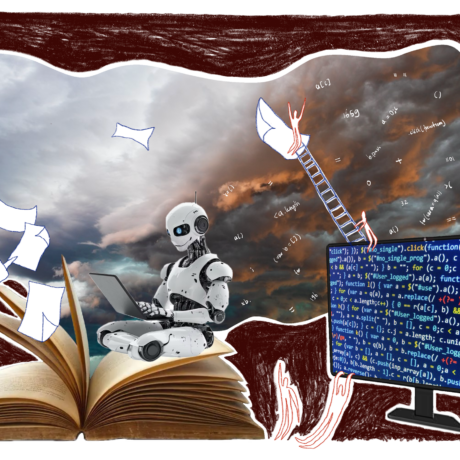
Image by: Femke Legué
In October, OpenAI (the maker of ChatGPT) posted the solutions to hundreds of mathematical problems online. With a vast amount of computing power (which probably cost millions of dollars), the AI company is creating an existential crisis in mathematics.
Researchers who have spent years working on a particular problem now have to watch as their expertise is hijacked by a Large Language Model from Silicon Valley. Mathematics has survived all kinds of technological innovations – calculators and computers became useful tools. But this?
‘No future?’
“I think mathematicians should fear for their future”, says Piet Lammers of Sorbonne University in Paris. “Their raison d’être has always been that they can prove new mathematical theorems, but that is going away.”
In October, Lammers wrote an alarming piece about it in NRC. “Almost all the problems I was working on have been solved”, says the mathematician.
His PhD candidates have been affected too, he writes in a follow-up. They had been looking forward to years of wrestling with mathematical puzzles, but now they have to focus on checking the solutions provided by OpenAI.
For the time being, Lammers is not taking on any new PhD candidates, even though he recently received a European research grant of 1.4 million euros: “I don’t know whether they have a future.”
Canary in the coal mine
Artificial intelligence has hit mathematics ‘amidships’ too, says theoretical physicist Robbert Dijkgraaf. But scientists in other fields should not think mathematics is the only one affected, warns the former education minister. They will be hit too.
“We are already seeing a flood of AI-generated scientific articles, grant applications and conference contributions”, says Dijkgraaf. “That affects how we share scientific insights with one another. Reports are being eaten away at by AI-generated data. No one has the time to check it all.”
Optimism
Dijkgraaf wonders whether mathematicians can retain control, now that it is mainly commercial AI models turning mathematics upside down. Scientists have little insight into how ChatGPT or Claude arrive at an answer. Does it steal the ideas you discuss with it? “AI can be a very unreliable partner”, Dijkgraaf warns.
Like Lammers, Dijkgraaf wonders what will happen to young people on the verge of becoming mathematicians. How do you train a new generation for a field that is changing so dramatically?
But he also sees a bright side. “We can now solve some very difficult problems. AI is already being used to design nuclear fusion reactors. It is being used in weather and climate models. We could see huge breakthroughs.”
Een lijst met artikelen
-
‘If anyone should be thinking about the effects of AI on society, it is scientists’
Gepubliceerd op:-
Artificial Intelligence
-
Science
-
‘More mathematicians’
Jeroen Zuiddam also sees many opportunities for mathematics. He is a mathematician at QuSoft, a collaboration between the University of Amsterdam and the Centrum Wiskunde & Informatica.
“The field is becoming more accessible”, he thinks. “Mathematics is so broad that most people know only a small part of it. Thanks to AI, they can use other areas of mathematics too. And we can focus more on how mathematics can be applied.”
Mathematics can therefore flourish, he says. “We can shift our ambitions and set ourselves bigger goals. If AI makes mathematics easier to apply, perhaps we’ll need many more mathematicians after all.”
Distrust
But many mathematicians are digging in their heels and say they want to avoid or banish AI. In a statement, 28 former winners of the prestigious Fields Medal called AI a ‘threat to the field’. What harm could it do? That will depend ‘on the people in charge of this new technology’.
The Association for Human Mathematics (AHM), founded in September, already has more than 1,100 members. They pledge not to use their expertise for commercial AI companies. One sub-group wants to avoid using AI altogether.
Distrust of OpenAI prevails at the AHM. Many accuse the company of not really caring about mathematics itself. It just wants to show how impressive its AI tool is, at the expense of mathematical careers.
Ideological
There are all sorts of reasons to steer clear of AI, says mathematician Jim Portegies of Eindhoven University of Technology. The energy-hungry data centres AI needs are not very sustainable, for a start. Portegies understands that some mathematicians will use AI, ‘but there must also be room in mathematics for people who don’t want to’.
He believes there is plenty of evidence that you learn better without using AI. Portegies muses aloud about a mathematics institute where students could be trained without AI. “I think graduates from an AI-free institution would be in great demand elsewhere in mathematics or in business.”
That is precisely the question that continues to occupy Dijkgraaf too. In theory, students or young researchers can set a bunch of AI agents to work on a task. But how do you learn to understand what those agents are actually doing? How do you learn to assess AI-generated answers?
You could say that AI gives students a private coach to talk things through with while they study. But why would you want to learn at all as a student if AI can give you the answer?
Changing
Jeroen Zuiddam of QuSoft is confident that students who want to go into the sciences are genuinely curious. “Ambitious students are certainly motivated to work hard at it.”
But will students still have that ambition? Piet Lammers of Sorbonne University is doubtful: “It isn’t motivating to spend a lot of time and effort on mathematical problems when you know they could be solved in a day as soon as OpenAI turns its attention to them.”
The work will change significantly, too, thinks Jim Portegies of Eindhoven University of Technology. “But people will remain important in this field. In the coming years, they will have to help shape the future of mathematics and the role AI plays in it.”
That is Dijkgraaf’s call too: get involved. He understands that young people are worried about AI’s impact on their careers. “AI is frightening, especially when you’re just starting out. But so much is changing that, in a sense, we are all at the beginning of our careers again.”
Een lijst met artikelen
-

AI leads to flood of research funding applications, NWO to revisit lottery system
Gepubliceerd op:-
Science
-
De redactie
Comments
Ad
Read more in Science
-
Student or scientist may soon pitch a groundbreaking idea to Defence
Gepubliceerd op:-
Science
-
-
Eleven countries launch their own platform to break the power of commercial scientific journals
Gepubliceerd op:-
Science
-
-
AI leads to flood of research funding applications, NWO to revisit lottery system
Gepubliceerd op:-
Science
-
Leave a comment