Ad

Deep budget cuts in Argentina: ‘We are putting the future of our universities at risk’

Empty classrooms, crumbling facilities and lecturers leaving. Since President Javier Milei came to power, Argentine universities have been under considerable financial pressure. During his exchange, IBCoM student Stef Straver set out to explore the impact of the cuts on university education.
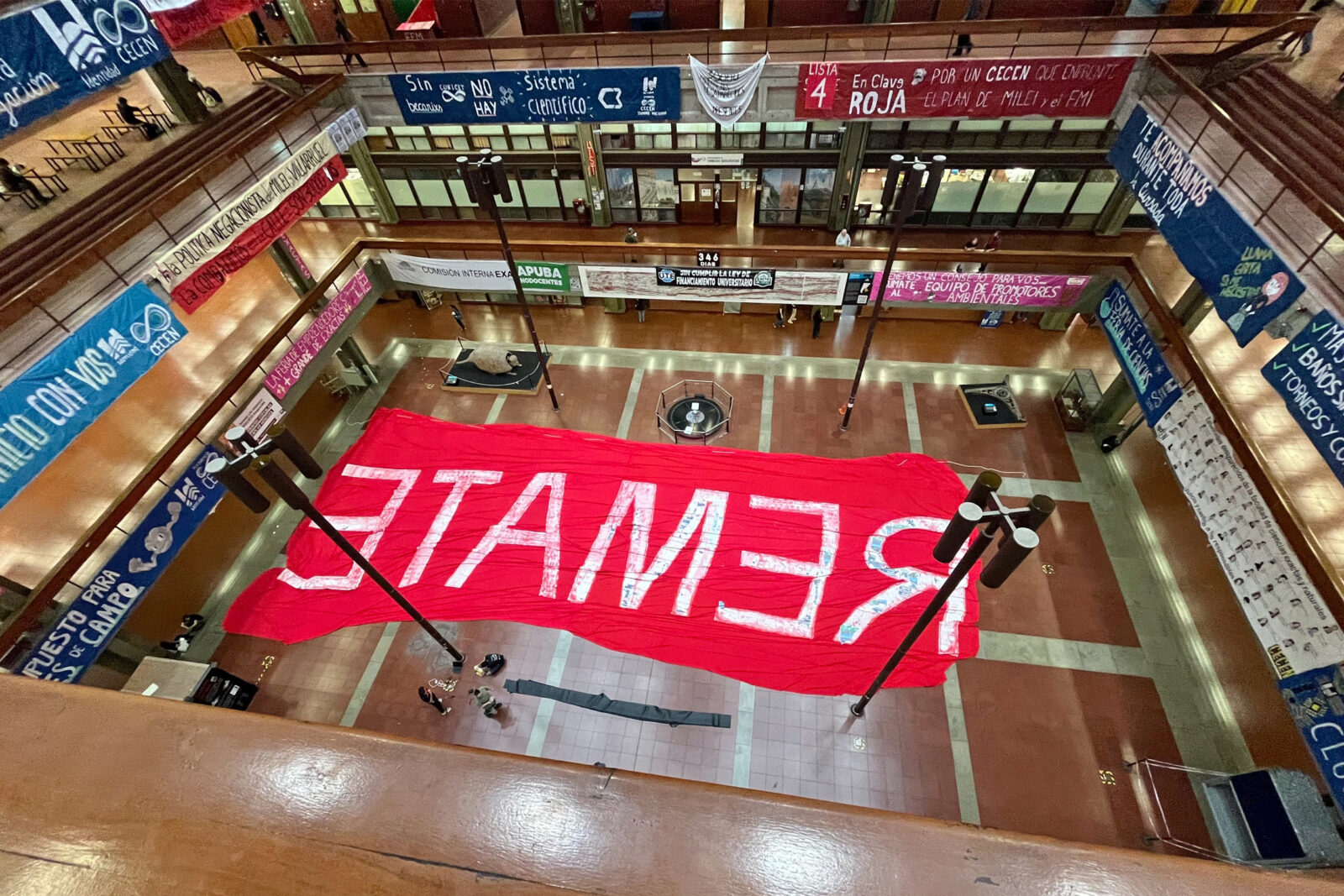
Banners in the University of Buenos Aires building. Remate means ‘sale’ and the word refers to a protest from the end of the last century.
Image by: Stef Straver
I am on an exchange in Buenos Aires, sitting with a group of fellow students in one of the city’s many cafés, talking about my experiences. So far, I have been pleasantly surprised by my university, Universidad Torcuato Di Tella. The campus is modern, the classes are good and the lecturers are capable.
That is far from the case everywhere, one Argentine fellow student points out. Many public universities have been in serious financial difficulty since Milei took office in 2023. You would hardly notice that at the private university where I study, but only a small group can afford to study here. My fellow student has a scholarship. Students without one pay thousands of euros in tuition fees each year.
Stef Straver is studying for a bachelor’s in International Bachelor Communication and Media in Rotterdam. He currently lives and studies in Buenos Aires. Before leaving for Argentina, he worked as an editorial intern at Erasmus Magazine.
The subject immediately piques my interest. In the Netherlands, too, the previous government wanted to make ‘unprecedentedly deep’ cuts to higher education. Although most of these plans were reversed, the financial future remains uncertain. I wonder: can the Netherlands learn anything from the situation in Argentina?
The university as a springboard
My search begins with an email to Marcelo Rabossi. He specialises in higher education policy and university funding. I hope he can tell me more about the current situation. A week later, we meet in his office at Di Tella University.
Rabossi explains that about 80 per cent of Argentine students attend a public university. Studying there is free, and there are no admission requirements or exams. The remaining 20 per cent go to a private university, where students do pay tuition fees. These universities often have entrance exams.
The combination of free education and freedom of choice made public universities a source of national pride. “These universities played a central role in Argentina’s development and are therefore highly regarded in society”, Rabossi says. “Studying at these universities is something to be proud of.”
“No one questioned this Argentine tradition”, he continues. Milei’s arrival changed that. “For example, he wanted students at public universities to pay for their education. The universities rejected the proposal.”
The fact that public universities do not charge tuition fees makes them vulnerable. “90 per cent of their income comes from the government”, Rabossi notes. “Milei significantly cut the budget after taking office. That’s where the problem began.”
Fire sale
In the meantime, I got in touch with Eugenia through a fellow student. She studies at the Universidad de Buenos Aires (UBA), Argentina’s largest public university, and is active in the protest movement against the cuts. She invites me to visit.
Een lijst met artikelen
-

University struggles to get a grip on social safety
Gepubliceerd op:-
Safety
-
Staff
-
As soon as I step inside the UBA’s university building, I feel as though I have travelled back in time. The building is old, steeped in history and covered with banners bearing protest slogans.
It is also eerily quiet. Most of the classrooms are empty and dark. In just a few, students are working intently on their project assignments.
In the large courtyard, students are working on an enormous banner bearing the word ‘remate‘, or ‘fire sale’. It refers to a protest at the end of the last century, when a similar banner covered almost the entire university building. Next week, students will take it to the fifth national march against cuts to the university system. “Students are furious”, Eugenia says.
No toilet paper or wifi
Eugenia feels the effects of the cuts every day. “There are fewer staff to keep the university clean, the toilets are poorly maintained and many computers no longer work. There is no toilet paper or wifi.”
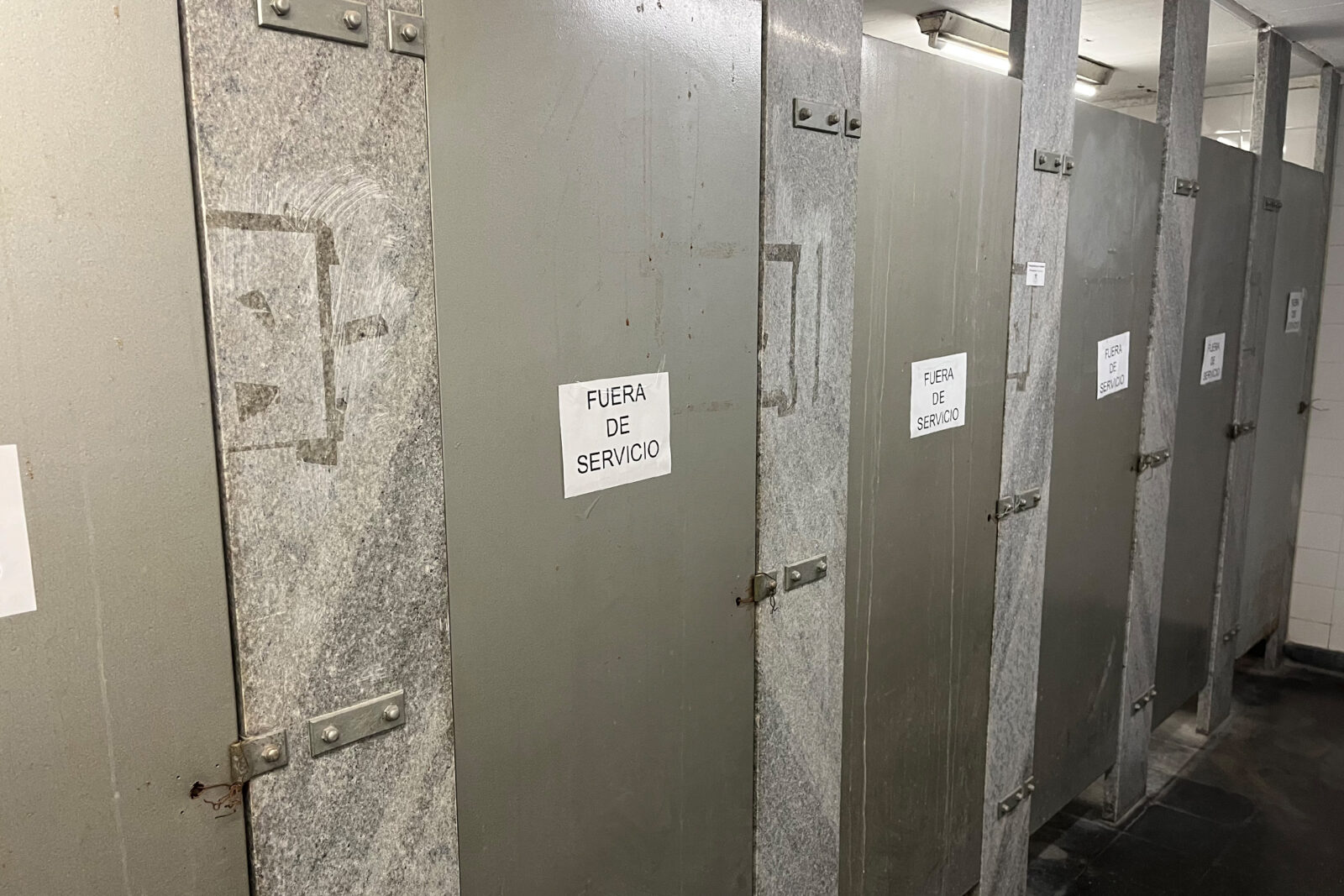
Toilets that are out of order.
Image by: Stef Straver
Later that afternoon, I see what she means. Almost every toilet has a sign saying ‘out of order’. There is no toilet paper to be found.
A budget that is falling behind
Universities have been facing financial problems for some time, but these have worsened since Milei took office. As he promised during his election campaign, he took a chainsaw to much of government spending in an effort to curb high inflation.
Rabossi estimates that the university budget has fallen by about 35 per cent. “For 2027, the universities jointly asked for 11 trillion Argentine pesos.” That is almost 6.5 billion euros. “The government was only prepared to make 7 trillion pesos available. According to the council representing all public universities, that amount is only enough to pay salaries.”
Lecturers are leaving
Lecturers have been hit particularly hard. According to CONADU, a national union of university lecturers, they have lost a quarter of their purchasing power. Rabossi arrives at the same figure. “Before Milei came to power, lecturers’ salaries in the public and private sectors were more or less equal. There is now a big difference”, he stresses. Many combine several jobs to make ends meet.
Een lijst met artikelen
-

How examination boards determine AI use: the consequences for students can be far-reaching
Gepubliceerd op:-
Artificial Intelligence
-
Eugenia illustrates this with an example from her own family. “Both my parents are chemists. My father works at the university, while my mother works for a commercial company. She earns as much from one job as my father does from four.”
Students pay the price
The departure of lecturers also affects students. Joel, a Data Science student, missed classes for an entire semester. “Many lecturers have left the university for jobs in the private sector. They earn more there. Since lecturers can barely make ends meet, I can’t blame them.”
Eugenia missed a month of classes, although for a different reason: “My lecturers went on strike against the cuts.” She fears that more people will leave if the cuts continue.
The situation reminds me of my own degree. Several lecturers left there, too, making my classes much larger.
Science under pressure
Not all lecturers leave. Those who stay try to make the best of things. Bruno Martin Aramburu, a research assistant and lecturer, returned to his home country at the end of 2023 after working abroad for several years.
'If you don't invest in science, the future is uncertain'
Shortly after he was appointed, he was allocated a research budget. But he never received the money. “The government decided to stop these budgets. The university now has to pay for everything itself.” He can barely carry out any new research.
Aramburu, too, fears that more colleagues will leave. In the long term, that could have serious consequences. “If the transfer of knowledge dries up, researchers have to reinvent the wheel every time. For researchers doing a PhD abroad, there is little incentive to return.”
Rabossi shares those concerns. “If you don’t invest in science, the future is uncertain. If we rely only on primary production, as Milei would like, the economy will grow, but we will not develop. There is no strategic plan behind it.”
Studying in uncertainty
The cuts not only affect the quality of education, they also make studying less accessible. Eugenia sees more and more students having to ‘prioritise work’. As a result, their studies take second place. “Access to university may be free, but everything around it isn’t.” Previously, the university could help students with little money, but it can no longer do so. “As a result, fewer people can afford to go to university.”
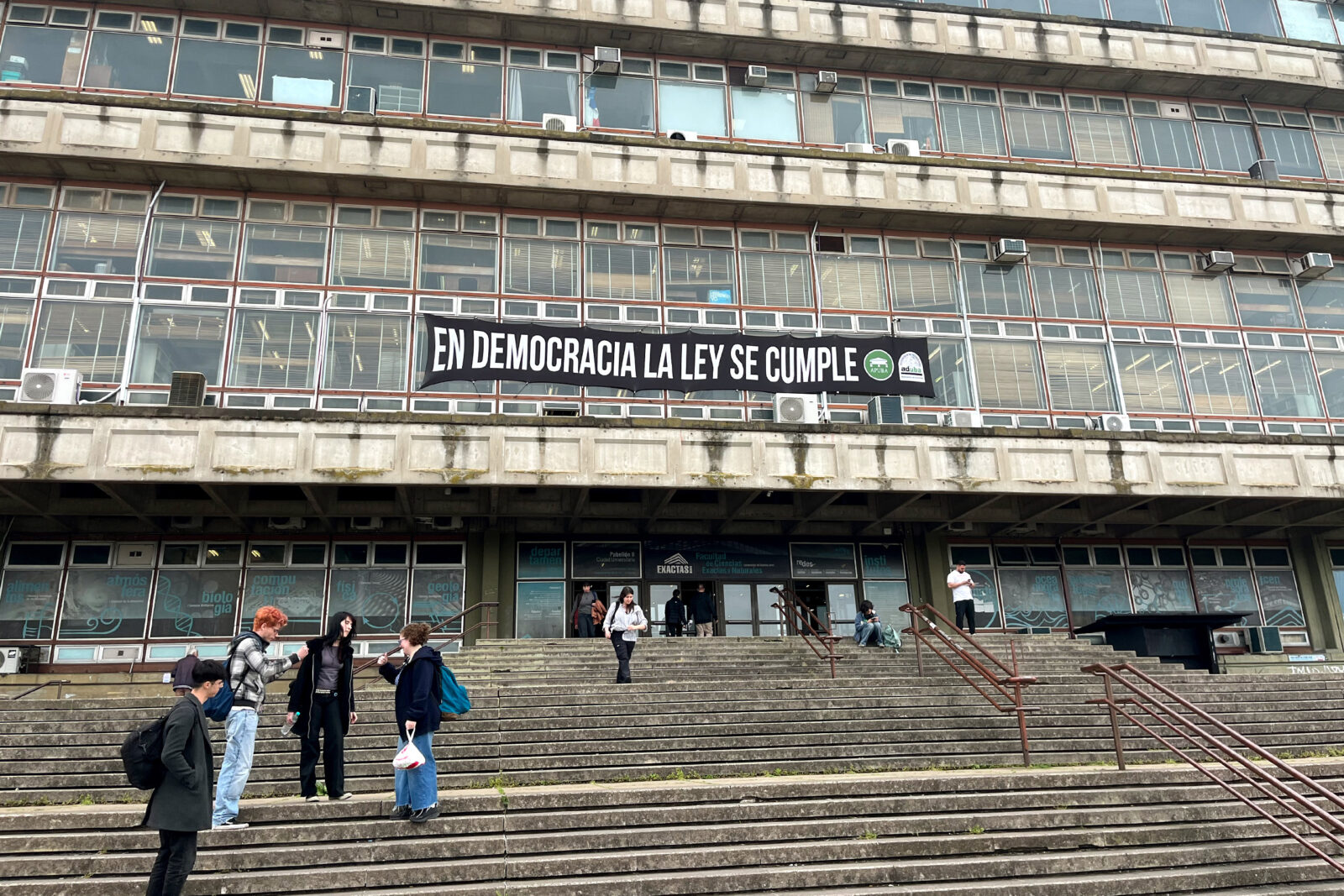
It says: ‘In a democracy, the law is obeyed’.
Image by: Stef Straver
Joel sees a growing divide. “Financial resources are increasingly determining our chances of studying. Students who can afford it move to a private university. Those who can’t are falling behind in their studies.”
Conflict
A small group of students do support Milei’s cuts. “They believe public universities spend government money inefficiently and oppose independent financial audits”, Rabossi says. These students also accuse universities of favouritism. “Many academic positions are said to go to political allies.”
Santino, an economics student at the private university where I study, puts support for Milei in a broader context. “Many Argentinians were fed up with the previous governments’ policies and voted for Milei. He is the result of years of frustration.” In his view, the debate is not about whether public education should exist, but rather about ‘the lack of transparency over how the money is spent’.
What the Netherlands can learn from Argentina
Before I go home, I ask what lessons the Netherlands should take away. Joel warns: “If someone says they are going to make cuts, you should assume they will actually do it. People here said: ‘We have a parliament, don’t we? It won’t let things go that far.’ But parliament was unable to stop Milei. It even passed new laws to give the universities extra money, but Milei is ignoring them.” The fight over the implementation of these laws is now being waged in court.
According to Eugenia, there is another danger: fewer people are supporting the universities. “If people start asking how worthwhile university is, or why they should pay taxes so that someone else can study, then things are clearly going in the wrong direction. We are putting the future of our universities at risk.”
Een lijst met artikelen
-
From extinct deer to sea slugs: these fossils lay hidden deep beneath Woudestein campus
Gepubliceerd op:Article type: Video-
EM TV
-
De redactie
-
 Stef Straver
Intern
Comments
Ad
Read more in Education
-
Complaint against university magazine SAM was unjustified, Press Council rules
Gepubliceerd op:-
Education
-
-
NVAO positive about Erasmus University’s education quality
Gepubliceerd op:-
Education
-
-
Universities admit more international students than agreed
Gepubliceerd op:-
Education
-
Internationalisation
-
Leave a comment