Ad

‘Should we all become vegetarians?’ Lecture on the cost of meat attracts over-70s to campus

The average age in professor Michael Faure’s lecture theatre was quite high on Wednesday afternoon, but the audience was far from finished learning. For three years, the university has been organising lectures for curious members of the public. ‘This lecture is a real eye-opener.’
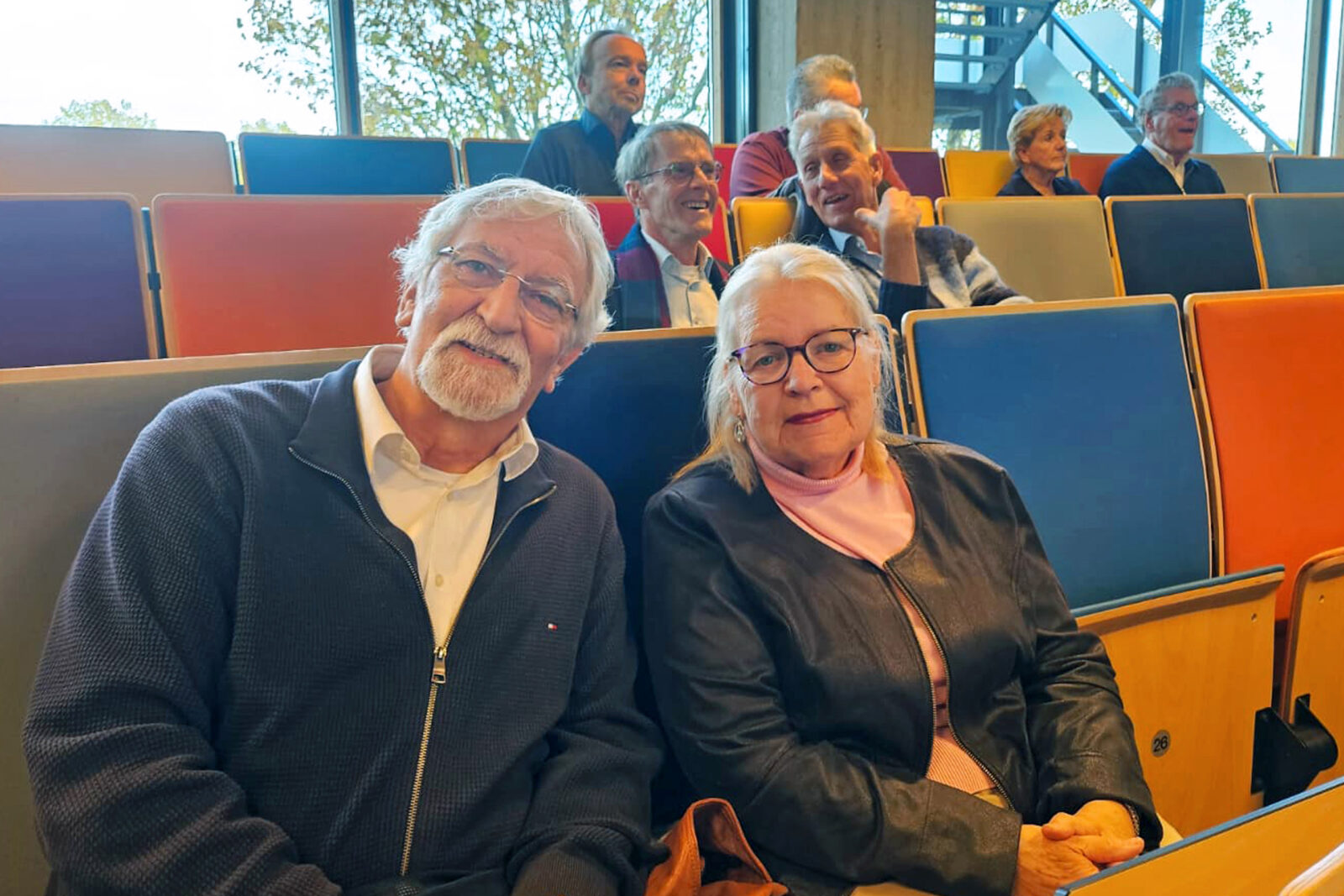
Ton and Annemieke van der Boom are regular attendees of the lecture series.
Image by: Feba Sukmana
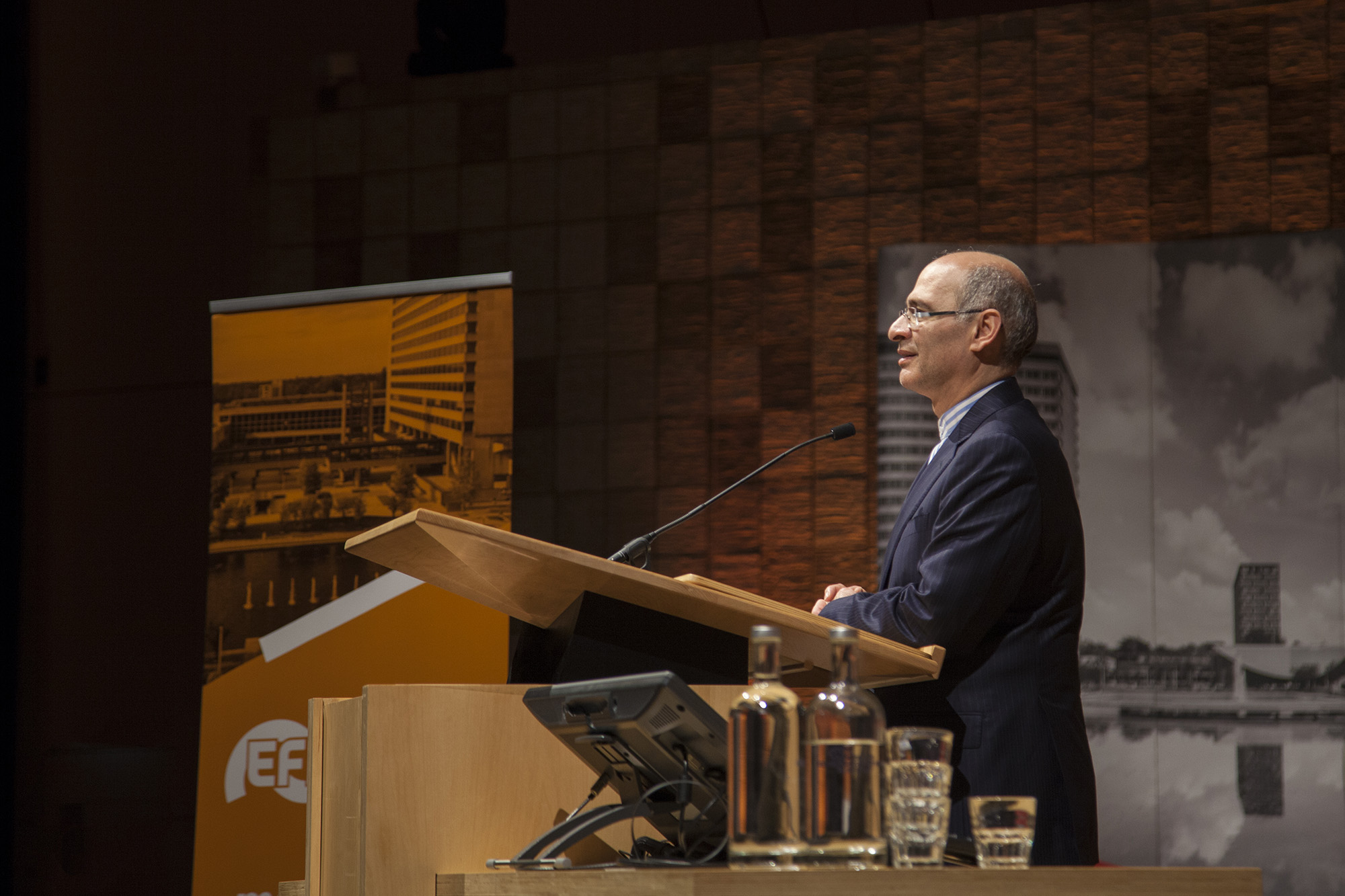
“Today I’m going to talk about my neighbour and my neighbour’s daughter”, says Michael Faure, pointing to the screen. It shows two cows grazing in a meadow. In his lecture, the emeritus professor of International climate law at Erasmus School of Law examines the impact of meat production on climate change from the perspective of environmental law and the economics of law.
His lecture is part of the Academic Horizons programme, an initiative of the Erasmus Centre for Values, Measurement & Leadership. The programme has now been running for three years, with eighteen lectures organised for people from outside the university. ‘Horizons’ because the lectures encourage us to look further into the future, explains organiser Philip Hans Franses. “You reflect on things and then look ahead from an academic perspective.”
Fanatical audience
The 25 people attending the lecture room in the Theil Building listen attentively to professor Faure. For most of them, this is not their first lecture. Married couple Annemieke and Ton van der Boom, both 75, are regular ‘students’. They have been attending the open lectures for almost three years. Until five years ago, Ton worked at Erasmus School of Economics for many years. This is why they’re on the programme’s mailing list. “We enjoy coming to the lectures”, says Annemieke. “The topics are always relevant and interesting.” Alumnus Jan Willem Koch also enjoys attending the sessions. “Sometimes I can’t make it. But as a rule, it’s in my diary.”
Ton Muhlheim and Emmy van Wijnen, also in their seventies, are neither alumni nor otherwise connected to the university. “But we heard through an acquaintance that some interesting lectures were being organised. So we signed up”, says Van Wijnen. They have now attended more than eight lectures. Muhlheim adds: “Our generation gets its information from newspapers, but here you have speakers who are right in the thick of things. So you get all the latest information and learn about all the different aspects of the subject. What’s not to like?”
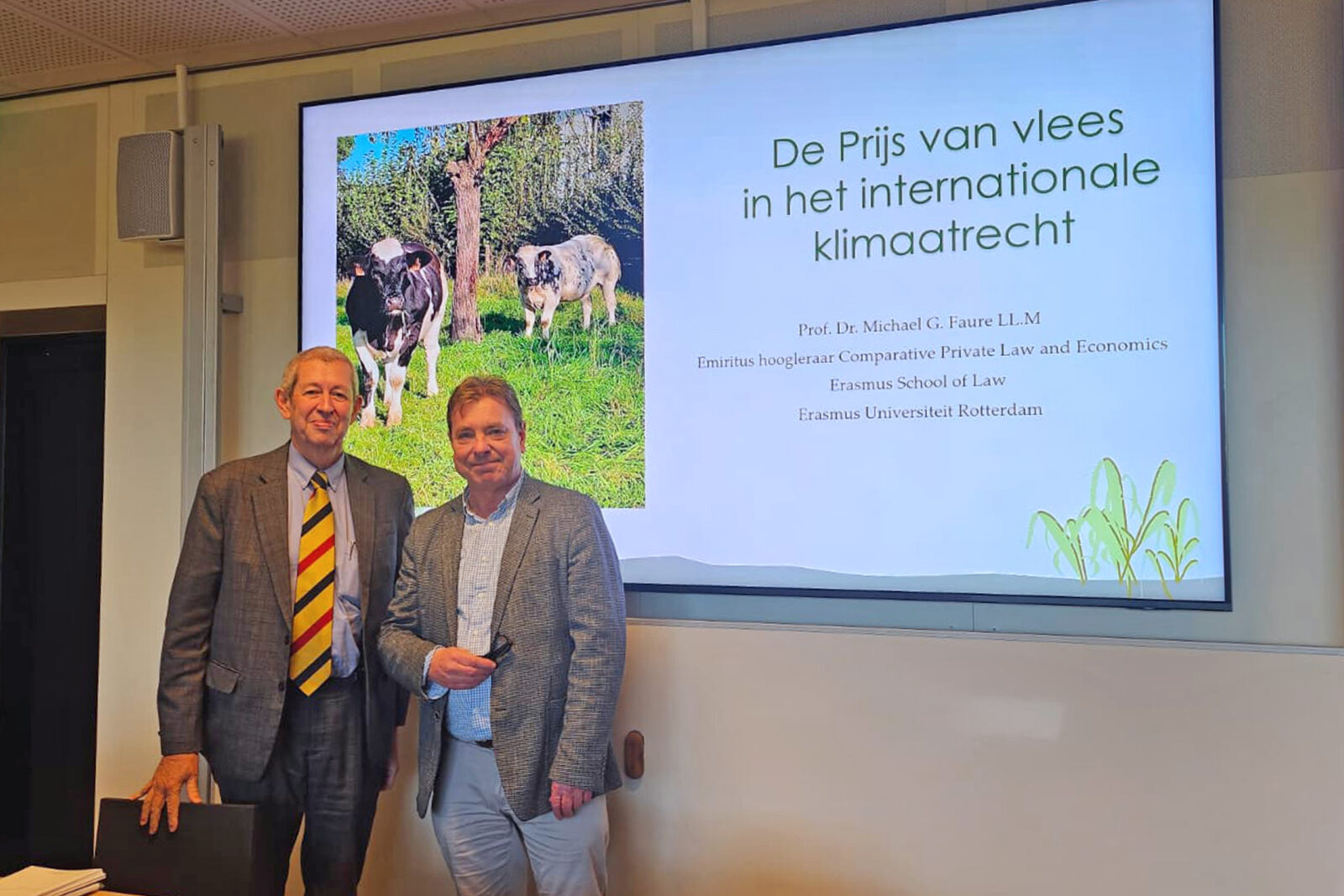
Speaker Michael Faure (left) with organiser Philip Hans Franses (right).
Image by: Feba Sukmana
Small-scale
Franses organises the programme in a personal capacity and pays for it himself. “It costs nothing, apart from a bottle of wine for the speaker and a few drinks for the informal gathering afterwards. That’s manageable”, he laughs. The lectures cover a range of subjects, from economics and law to philosophy and religion. He approaches the speakers himself. “I know a lot of academics who have conducted interesting research, and they are also happy to come and speak.”
He has no desire to see the programme grow. “No, then I’d have to book the Aula, and I don’t fancy that”, he jokes. “But seriously, I don’t think anyone would enjoy sitting in a room with hundreds of others. I think it’s important that the lectures remain small-scale and interactive, as they are now.”
Meat should become more expensive
In the lecture, professor Faure emphasises that livestock farming is responsible for 14.5 per cent of global greenhouse gas emissions. Food production as a whole accounts for an even larger share, causing as much as 26 per cent of all greenhouse gas emissions.
He goes on to argue that the current price of meat doesn’t reflect its true cost. By true cost, he means the environmental pollution caused by its production. He therefore believes there is a gap between the market price and the actual cost.
A tax on meat is one possible way to bridge that gap, he explains. It could also be an effective tool for reducing meat consumption and cutting emissions: various studies show that a meat tax could reduce greenhouse gas emissions from livestock farming by 29 to 70 per cent.
“So should we all become vegetarians?” Faure asks as he concludes his lecture. “No, that’s not what I said. My message is simple: meat should become more expensive.”
'The audience has a slightly different perspective on the subject than younger students'
Eye-opener
After the lecture, 71-year-old Lex Keijser is enthusiastic. “It’s a real eye-opener”, he says. “I knew meat production wasn’t environmentally friendly, but I had no idea that livestock farming was the biggest polluter on Earth.”
Faure is also pleased. “It was really enjoyable to give the lecture. The people attending are very engaged. They come out of their own interest, so they are highly motivated and ask some great questions.” His regular students are also engaged, he says. “But, of course, today’s audience has a slightly different perspective on the subject than younger students.”
Afterwards, a group of attendees enjoy a can of beer and chat among themselves. “Have you come from far away?”, one asks. “I came by bike”, another replies. “Now that’s good for the environment”, he laughs.
Comments
Ad
Read more in Lecture
-
Porn in the Pavilion: vanilla sex is the favourite among viewers
Gepubliceerd op:-
Lecture
-
Science
-
-
‘Do women need to appear masculine to emancipate?’ Students attend lecture on gender identity
Gepubliceerd op:-
Lecture
-
-
Iranian ambassador visits Erasmus University: ‘I want to be careful with what I say’
Gepubliceerd op:-
Lecture
-
Leave a comment