Ad

With this theatre show, cybersecurity expert Bernold Nieuwesteeg hopes to finally wake everyone up

Running, shouting, delivering a speech in a German or American accent. Bernold Nieuwesteeg gives it all to get his message across: we have entered a new era in which we need to be very careful about how we deal with technology. His try-out performance of a theatre lecture on cybersecurity attracted a full Pavilion theatre on Tuesday evening.
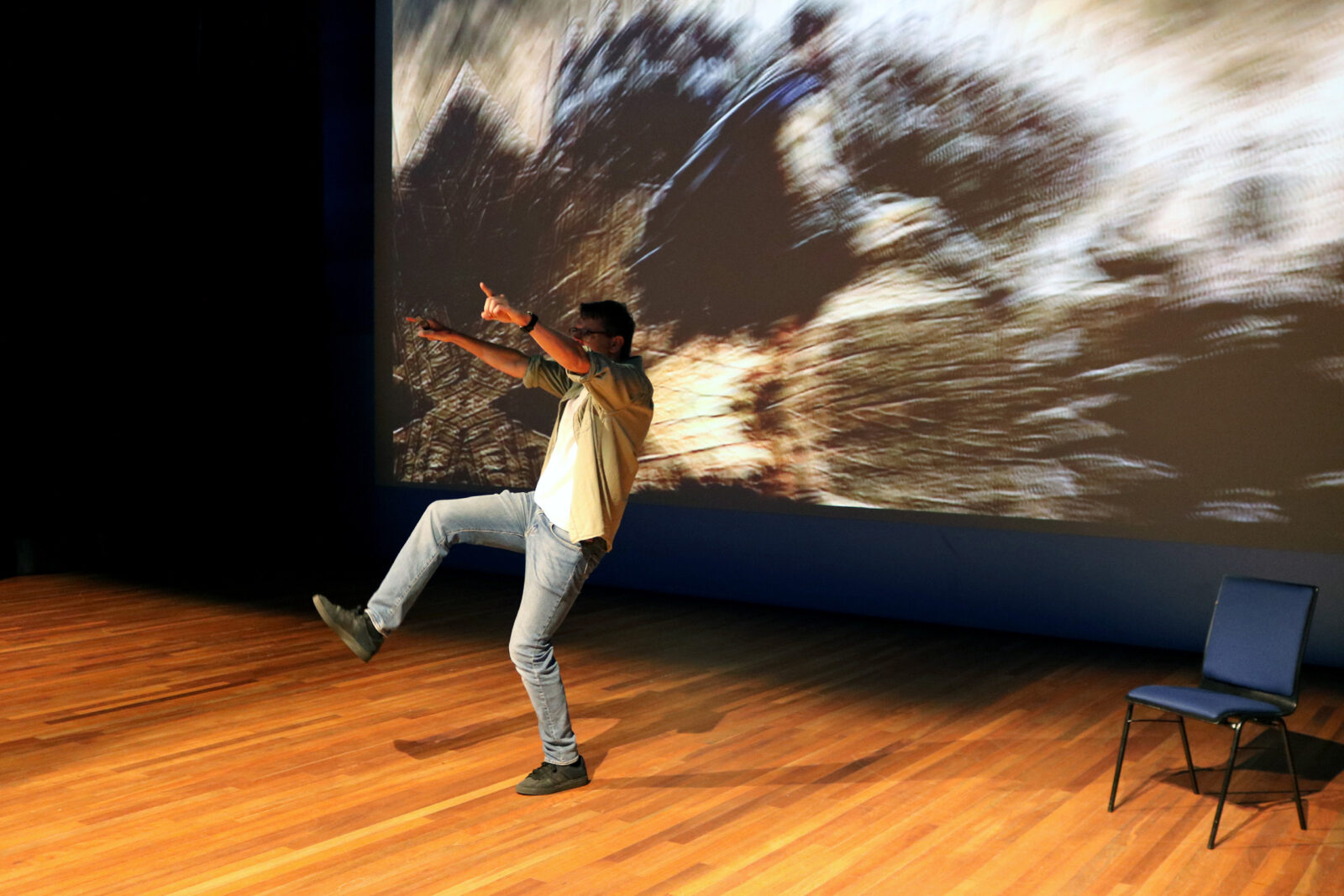
Nieuwesteeg jumps, runs and shouts to get his warning across to the audience.
Image by: Esther Dijkstra
How much data can actually fit on an old-fashioned floppy disk? The audience knows the answer very well: 1.44 megabytes, to be precise. “I can hear there aren’t many students here”, jokes Nieuwesteeg, founder of the Erasmus Centre for Law and Economics of Cyber Security. “Because they would think 2 gigabytes will fit on it.” His observation is correct: the audience mainly consists of his family, friends and a sizeable group who consciously witnessed the rise of the floppy disk.
No one responds
The show Cassandra.exe begins as a fairly regular lecture, in which Nieuwesteeg airs his frustrations as a cybersecurity expert. Although he felt that something major was happening, no one seemed to be taking notice. “First I wrote reports, but they disappeared into a drawer. Then I started writing for newspapers, but almost no one responded to my articles. Then I thought: I need to build a community, so I organised webinars and talk shows. Who here has actually attended one of my webinars?” To his surprise, quite a few hands go up. “The joke was that no one would respond”, he laughs, pretending to be indignant. So now he is trying to wake the world up with a theatre lecture.
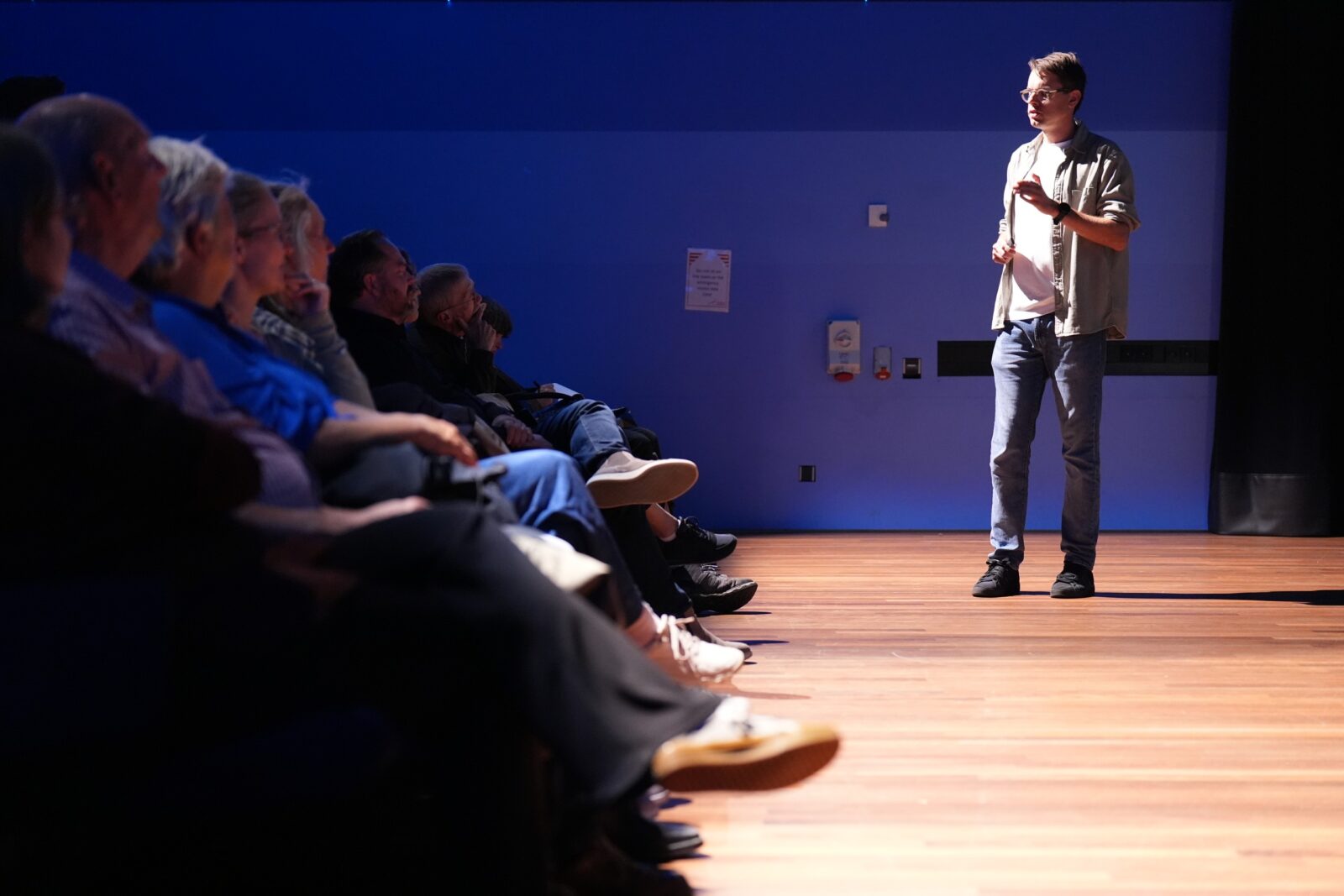
After completing his PhD, Nieuwesteeg wanted to step out of his ivory tower. But companies still did not heed his warnings.
Image by: Arie Kers
His own wake-up call was the hack on shipping company Maersk in 2017. Russian hackers managed to inject malware into the company’s accounting software, meaning that no containers could be unloaded in a large part of the Port of Rotterdam for five days. The moral of the story: if Maersk, like the Titanic, had compartmentalised its data, the Russian hack would have had far less dramatic consequences, but the board and the IT department did not understand each other. It is a technical story, but with slick AI-animated images and very loud music, Nieuwesteeg delivers it with flair.
Cybercriminal course
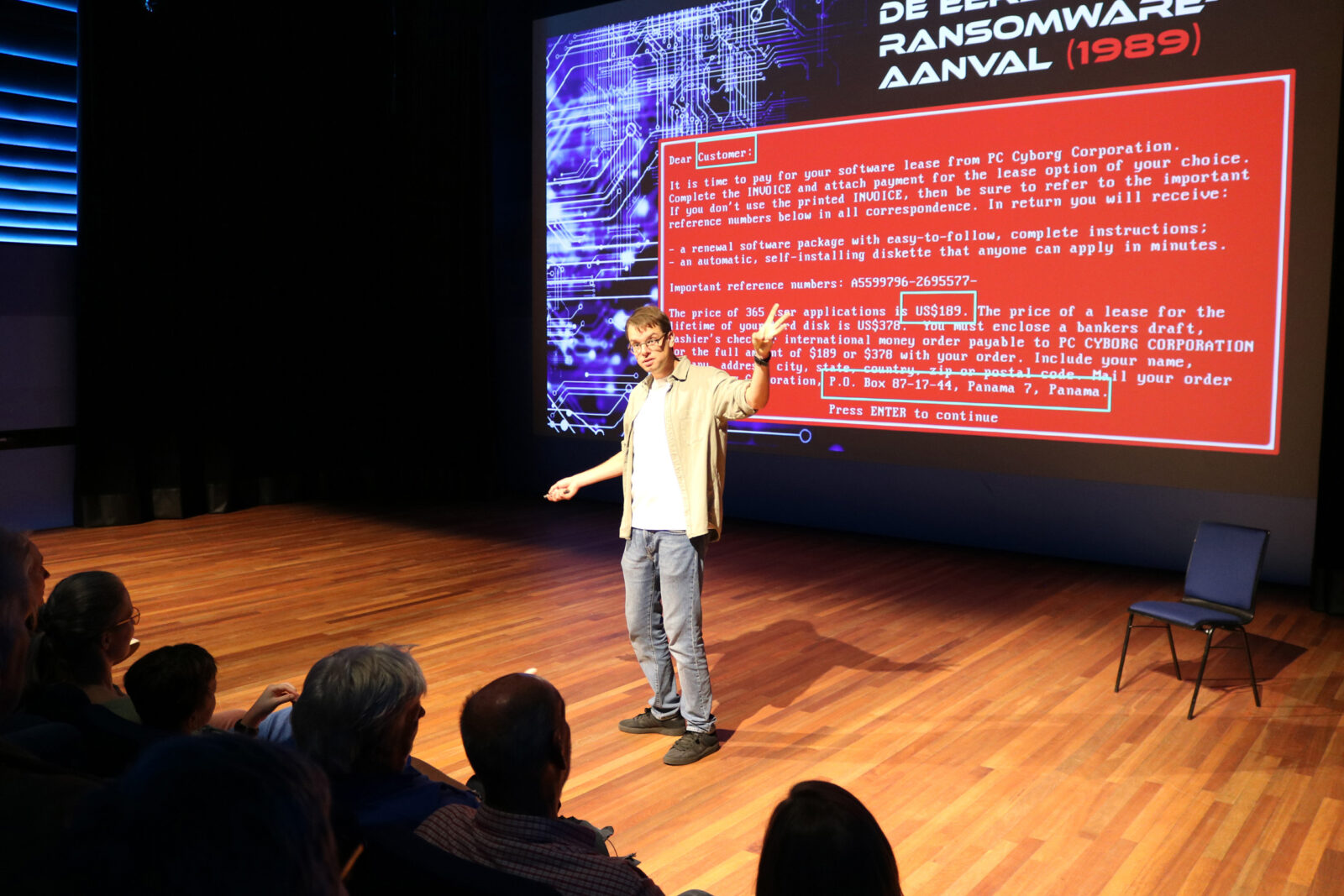
The first ransomware attack took place in 1989. Back then, you still had to send your money by post to a PO box in Panama.
Image by: Esther Dijkstra
Next, the cybersecurity expert invites the audience to take part in a light-hearted ‘cybercriminal training course’. First, he explains how two American charities each received 10,000 dollars from hackers out of the blue. But why? He explains how to do ransomware properly: treat your victims like customers, offer an early-bird discount, provide a simple payment method (bitcoin!) and good customer service. “Because of course you don’t want them to be unable to pay.” And: donate part of your proceeds to charity. At least then the ‘customer’ knows that part of the money will go to a good cause.
With an even bigger wink, he urges the audience to help the criminals: do not install a password manager, disable multifactor authentication and do not encrypt your data.
Hydration moment
Via Trump and his tech friends, the cloud solution of the municipality of Ommen, Pearl Harbor and a secret European tech meeting in the style of the film 300, accompanied by bombastic music, Nieuwesteeg takes his audience through the risks of AI and dependence on American tech at high speed. He also impersonates the Polygoon newsreel, president Franklin D. Roosevelt and his primary school teacher.
He literally runs himself ragged, trying to keep up with the AI rat race. It symbolises the labour productivity paradox: in recent years, we have all started working harder, but it has generated barely any additional value. He genuinely needs the ‘hydration moments for Bernold’ that are inserted from time to time to catch his breath. They also give the audience a chance to take in all the information.
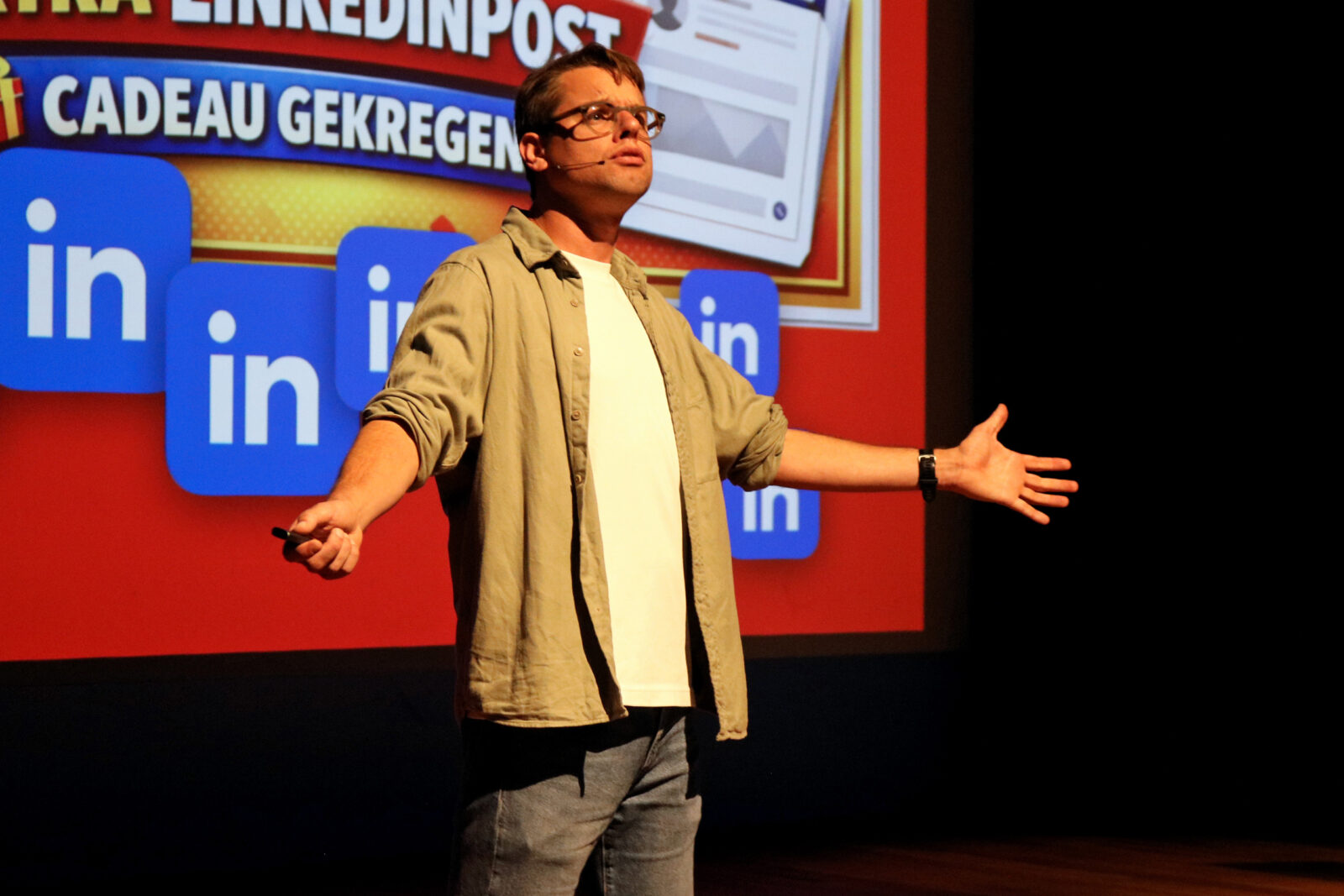
If everyone can write LinkedIn posts twice as fast thanks to AI, you also have to write twice as many to stand out as much as before, Nieuwesteeg explains the labour productivity paradox.
Image by: Esther Dijkstra
Afterwards, the audience gives the lecturer a thunderous round of applause. Once Nieuwesteeg has caught his breath, he says that he was ‘very nervous’ at the beginning of the show. “But after the first sentence I started to loosen up.” The story he tells in the show about no one responding to his alarming reports or opinion pieces is drawn from real life. “It simply doesn’t get through to the average Dutch person. Five years ago, I was already warning about digital autonomy, and independence from Big Tech is still not an important issue for many companies and institutions.”
Bernold Nieuwesteeg is a cybersecurity researcher working at the intersection of law, economics and cybersecurity, and founder of the Erasmus Centre for the Law and Economics of Cyber Security. Before his show Cassandra.exe premieres in Woerden on 17 November, he will give another twelve previews, some of them for companies.
Een lijst met artikelen
-

Rollercoaster for IT during Canvas crisis: ‘That is when all the alarm bells went off’
Gepubliceerd op:-
Campus
-
IT
-
De redactie
-
 Elmer Smaling
Deputy editor-in-chief
Comments
Ad
Read more in Culture
-

Art workshops and dance performances play important role during inaugural lecture The art of healing
Gepubliceerd op:-
Culture
-
Science
-
-

Flower crowns and barbecue at Kralingse Plas Midsummer students celebration
Gepubliceerd op:-
Culture
-
-
Lady Bits win EURvision 2026: ‘Big things are coming for us!’
Gepubliceerd op:-
Culture
-


Leave a comment