Ad

Manifest: House of Representatives must enforce ‘studying without barriers’

Students and pupils have handed over a manifesto to the House of Representatives on Tuesday about ‘studying without barriers’. They want politicians to enforce accessible education.
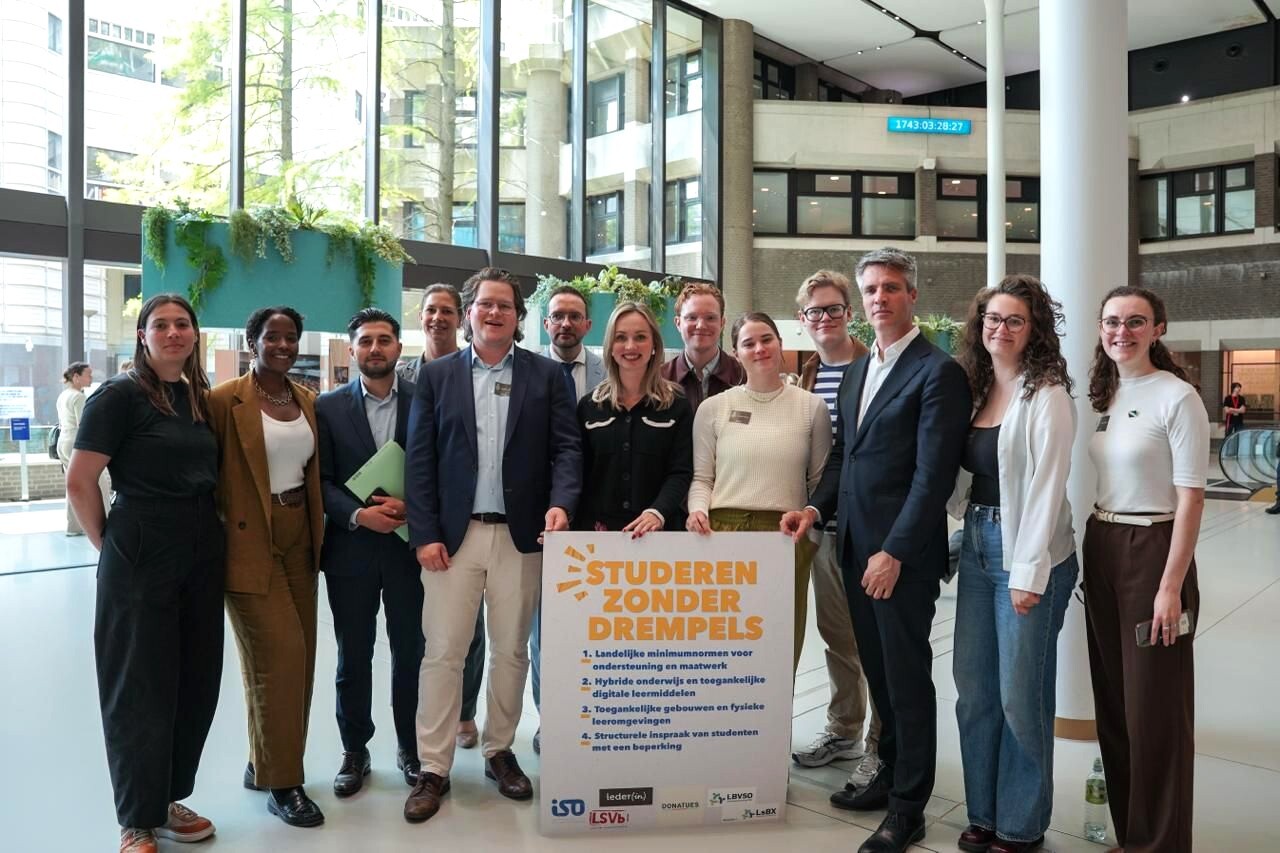
The student interest organisations presented the manifesto to the House of Representatives on Tuesday.
Image by: Ludian Harrijvan
The Interstedelijk Studenten Overleg and the National Student Union, together with other interest groups, have set out four points. They want accessible buildings, a voice for students with disabilities, education that can also be followed online and national minimum standards for support.
What do they expect from the House of Representatives? “The House can put pressure on the ministry of Education to monitor the accessibility of universities of applied sciences and universities”, said incoming ISO chair Allis Richardson.
Accessibility should be a fixed part of quality assurance within institutions, she suggested. “We argue that accessibility should not be an option, but a requirement. That way every student can study properly.”
Letschert
Education minister Letschert appears not to need encouragement. Last week she sent a letter to the House of Representatives about studying with an impairment. There can be differences between institutions in tailored support and financial provisions, ‘but that the differences are so large is inexplicable’.
Universities and universities of applied sciences have a great deal of administrative freedom, but Letschert finds it ‘worrying’ that students in similar circumstances are helped in very different ways. “It is the student who ultimately suffers from this.”
She wants to reduce the differences between institutions, she announced. She is discussing this with quality watchdog NVAO, among others: in the six-yearly reviews of programmes the accessibility of education should play a larger role.
One in five
About one in five students feels ‘hindered’ in their programme, reported expertise centre ECIO last autumn. Far from all of them inform their programme.
Often this involves concentration disorders, anxiety, stress or mental health conditions. A smaller proportion has problems with the physical accessibility of education or, for example, experiences hearing problems. Most of these students do receive understanding from their programme, but a sizeable group of 11 percent say they do not.
Human rights
In a press release accompanying the manifesto the students refer to the Netherlands Institute for Human Rights, which surveyed the experiences of people with disabilities in society. Most agreed with the statement ‘My school has made sufficient adjustments so that I can/could follow my education properly.’ A quarter, however, disagreed.
Een lijst met artikelen
-

Fewer students? Beware Japanese or Portuguese scenarios
Gepubliceerd op:-
Education
-
De redactie
Comments
Comments are closed.
Ad
Read more in Education
-

Solution for students who have to wait more than 50 weeks for medical internships
Gepubliceerd op:-
Education
-
-

National budget: extra money education and research, no unexpected cuts
Gepubliceerd op:-
Education
-
Politics
-
-
Long waiting times for medical internships also affect other cities
Gepubliceerd op:-
Education
-