Ad

Criticism of academic powerhouses: ‘A university is not a power station’

Imposed from above, too businesslike an approach, an organisation that is too large-scale and too little opportunity for input. The criticism from professors of the plan by the Executive Board and deans to cluster faculties into ‘academic powerhouses’ is scathing.
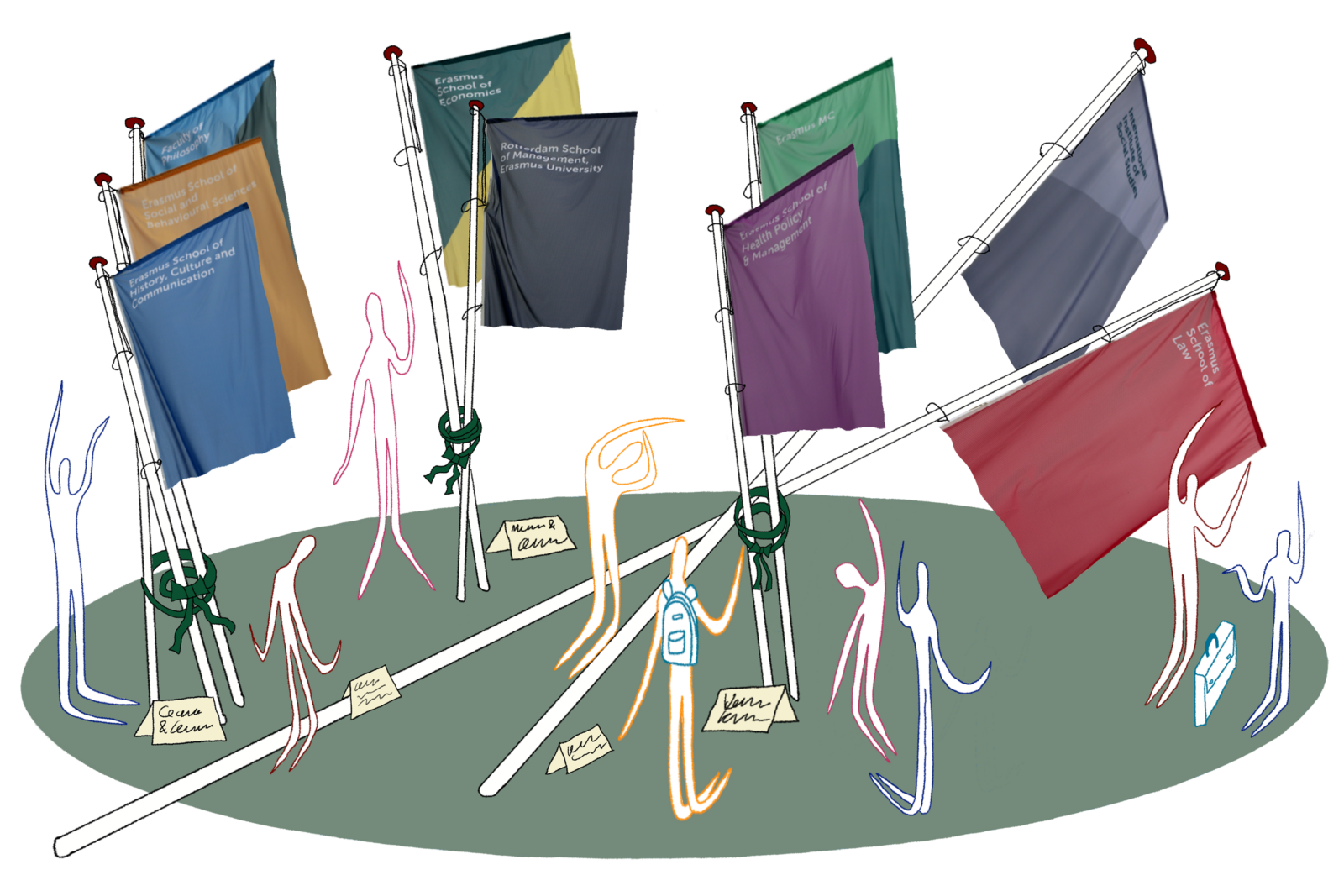
Image by: Sonja Schravesande
The Executive Board and the deans have announced plans to ‘cluster’ faculties into ‘academic powerhouses’. The RSM and the ESE will form the economics and management cluster, the ESSB, ESHCC and ESPhil will become social & humanities, and the Erasmus MC and the ESHPM medical & health sciences. The ESL and the ISS will be ‘connecting forces’ or perspectives ‘that run across the academic powerhouses’.
According to the Executive Board, this plan will provide ‘more financial resilience and space for innovation’. “By harmonising processes and collaborating more intelligently we free up significant capacity and/or resources for renewal”, reads the university’s narrative on the intranet MyEUR.
Association with dominance
The criticism starts already with the term the planners invented for a cluster: the academic powerhouse. “A university is not a power station. I find it quite grotesque and rather unfortunately chosen. It suggests that academic quality is mainly a matter of size, strength and concentration”, says Gerrit van Bruggen, professor of marketing. “If this is really a future scenario, I would prefer language that inspires substantive renewal rather than language that sounds as if the university is selling a corporate restructuring.”
Marise Born, professor of work and organisational psychology, also thinks the word powerhouse ‘evokes associations of energy, strength and dominance’. She says cooperation with other universities such as Tilburg and Delft is becoming increasingly relevant, ‘at a time of growing scarcity due to fewer students, less government funding and an even sharper decline in funding in the fields in which Erasmus University has traditionally been strong’.
Corporate
Bauke Visser, professor of economics, is similarly appalled by the rather ‘corporate’ approach. “We are not a company. You saw strong resistance at the universities of Twente and Groningen to this way of governing (there, the universities wanted to merge faculties). A university should not adopt a dirigiste attitude. Such compulsive centralisation raises many questions.”
Visser, for example, does not see how clustering will lead to better collaboration between scholars from different disciplines. “If that does not work now, why would it work if imposed from above?” Van Bruggen wonders what problem the powerhouses are supposed to solve exactly. “Is it about potentially declining student numbers, profiling, rankings, inefficiency or insufficient collaboration? Those are different problems. They do not automatically call for the same solution.”
Exercise
The professors are also critical about the participation of the academic community. “Formally we are only in the exploratory phase. But the powerhouses have already been named, the division of the clusters is on the table and the benefits are already being claimed quite assertively. It seems mainly an exercise of the Executive Board and the deans”, Van Bruggen thinks.
“The Executive Board says: this is not imposed from above, because we involved the deans”, Visser says. “I think most staff do not see it as if the whole community has been involved.” Visser also says the Executive Board contradicts itself. “They write that they want to ‘take everyone along in the process’ from the start”, he reads in the email from the university announcing the plan. “But a little later they write that the moment for consultation comes only ‘at a later stage’.”
Buried
As a marketing scholar, Van Bruggen does not see how this plan will make the university more attractive to prospective students or talented scholars. “Students, researchers and partners do not choose an internal administrative structure. They choose quality, reputation and distinctive propositions.” He is even concerned that the opposite could happen, particularly for smaller faculties. “Their own profile, culture and substantive distinctiveness can easily be buried by the dominant logic of the larger cluster.”
Born also fears that scaling up will reduce the attractiveness of the faculties. “The creation of large academic clusters carries the risk that these clusters become cumbersome structures in which substantive domains blur and are less distinctive. This can reduce the university’s appeal, while profiling is precisely important to attract scarce students and resources.”
Prefer to adjust
Van Bruggen thinks ‘adaptive organising’ is wiser than ‘revolutionary restructuring’, as the university leadership now plans. “Better to keep learning, experimenting and adjusting than to have the illusion that we can draw the perfect structure for the future now.” Born seeks the solution in cooperation and specialisation. “Rather than a competition between universities for future students about which is the most powerful institution, a strategy focused on specialisation, sharper differentiation and collaboration between institutions could be more effective”, the professor thinks.
Een lijst met artikelen
De redactie
-
 Elmer Smaling
Deputy editor-in-chief
Comments
Comments are closed.
Ad
Read more in Governance
-

‘Academic powerhouses’ to launch by end of 2027
Gepubliceerd op:-
Governance
-
-

Executive Board supports institutes ISS and IHS’s wish to merge
Gepubliceerd op:-
Governance
-