Ad

Number of international students falls for first time

For the first time in twenty years, the number of international students in the Netherlands has fallen slightly, reports internationalisation organisation Nuffic. Students from Germany and China in particular are staying away more often.

Image by: Bart Huijser
This academic year, a total of nearly 130,000 international students were enrolled in a full bachelor’s or master’s programme in the Netherlands. That is 133 fewer than in the previous academic year, shows new figures from Nuffic.
The growth in the number of international students slowed in recent years. Three years ago the growth was still 7 percent, two years ago 5.4 percent and last academic year 3 percent. It has now turned into a slight decline.
This is because fewer international students are starting programmes in the Netherlands. Applications for bachelor’s programmes at universities of applied sciences fell by 3 percent, and at universities by 4 percent. Nuffic expects that the total international student population will decline further in the coming years.
German students
Although they still form the largest group, the number of German students in the Netherlands has been shrinking for years. In 2021 there were 24,600 Germans studying in the Netherlands; this year there were only 18,200. It is the fifth consecutive year that German intake has fallen.
The first decline in 2021/2022 possibly came after Germany changed training requirements for psychotherapists, Nuffic says. Demographic shrinkage may also play a role. Yet that does not seem to be the whole story: in other countries, such as Portugal and France, the number of new German students is actually rising.
Ellen Tomesen, head of the science and education team at the Dutch embassy in Berlin, points out that, in addition to the rule changes and demographic decline, the persistent shortage of student housing in the Netherlands is a factor. The national halt to active recruitment of international students could also reinforce the downward trend.
Chinese students
The total number of students from the European Economic Area (EEA) remains stable for now, because there are more students coming from southern and eastern Europe. Applications from Spain, for example, rose by 28 percent. From outside the EEA, the number of Chinese students – the largest group from outside Europe – has fallen most sharply. New enrolments dropped by 28 percent.
According to Nuffic, this can be partly explained by Chinese universities increasingly performing better in international rankings, causing students to stay in their own country more often. There are also fewer young people in China. After China, Turkey and India are the largest groups of non-EEA students.
Engineering
At universities, the number of internationals still increased in technical subjects. The universities of Delft and Eindhoven are therefore the only ones showing growth this academic year, with 8 and 19 percent respectively. All other universities saw a decline, with the exception of Erasmus University, where the number remained roughly the same.
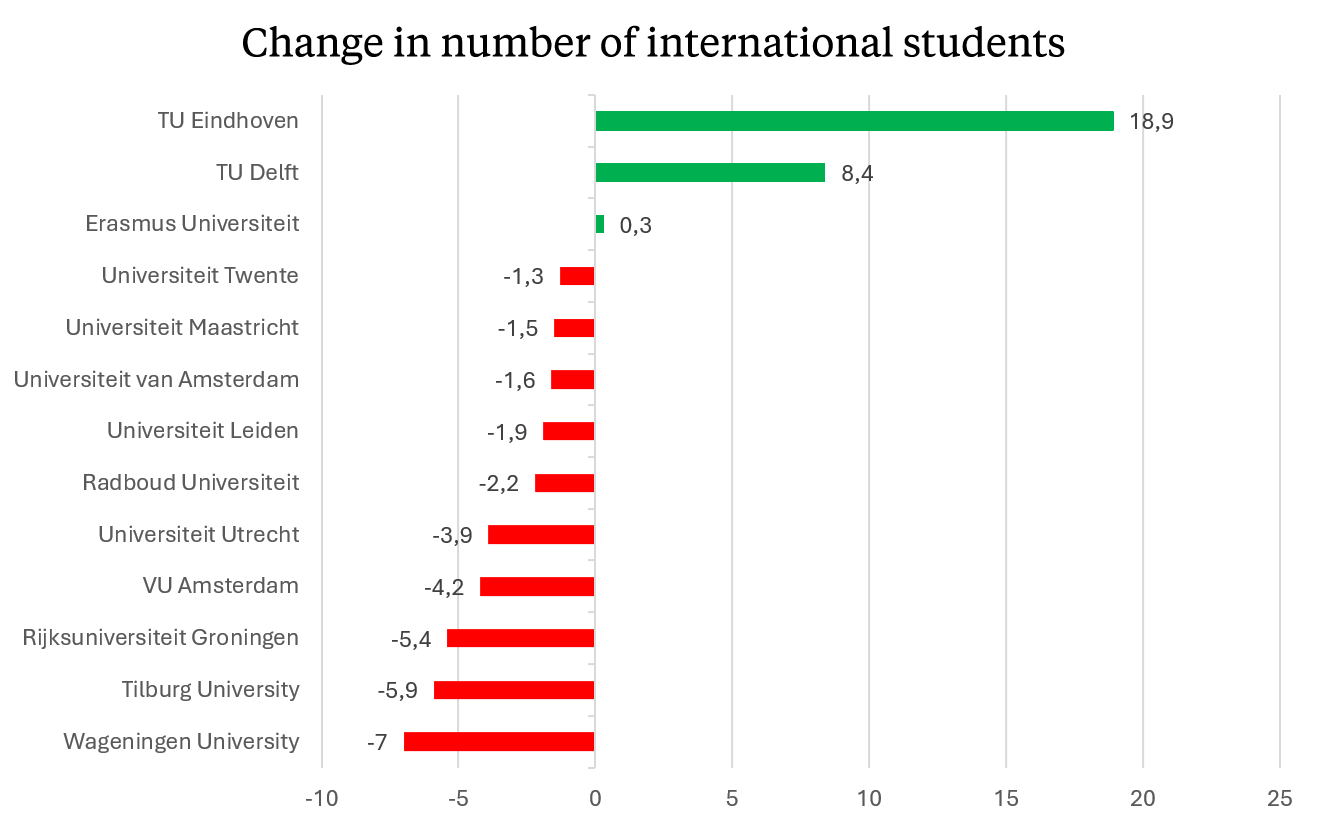
Image by: HOP / Nuffic
At the universities of applied sciences, Fontys has the most international students, with around 6,000. Utrecht University of Applied Sciences recorded the largest relative increase (13 percent), while Rotterdam University of Applied Sciences and Saxion noted a decline of 4 percent.
International students make up about 16.8 percent of the total student population in the Netherlands this academic year. That share is slightly larger than last year, because the number of Dutch students in higher education is falling even more sharply.
Een lijst met artikelen
-

International Psychology programme must halve intake
Gepubliceerd op:-
Internationalisation
-
De redactie
Comments
Comments are closed.
Ad
Read more in Education
-
Solution for students who have to wait more than 50 weeks for medical internships
Gepubliceerd op:-
Education
-
-

National budget: extra money education and research, no unexpected cuts
Gepubliceerd op:-
Education
-
Politics
-
-

Long waiting times for medical internships also affect other cities
Gepubliceerd op:-
Education
-