Ad

How seals adapt their language to one another, and what that tells us about humans

We like to place ourselves above the rest of the animal kingdom, but according to biologist Koen de Reus that is a missed opportunity. In his research into seals, he shows how social and adaptive their communication is, and how much that can teach us about ourselves. “The fact that seals like to be alone does not mean that they are not social.”
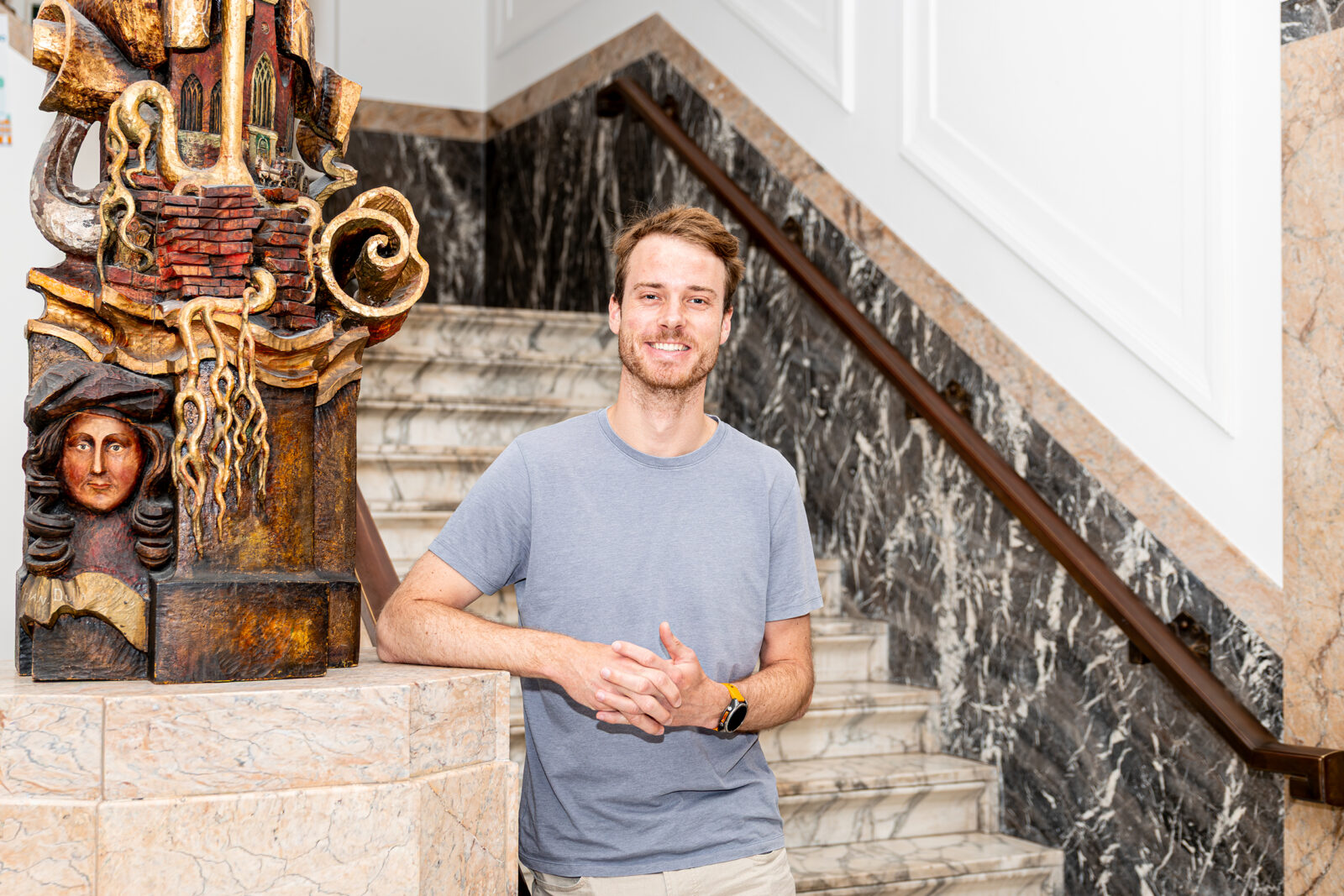
Image by: Pien Düthmann
The wonder
“Humans are often portrayed as something special, but I have never felt that way myself. I find animals much more fascinating. They are intelligent, and you can see it. When I was around fifteen and was in Canada with my parents, we came across a colony of seals. I asked if I could stay and watch. An hour and a half later my parents came back from their walk, and I was still sitting in exactly the same spot. We can learn a lot from animals, including about ourselves.
“For my graduation thesis I did an internship at the seal centre in Pieterburen. There, Andrea Ravignani, who would later become my doctoral supervisor, was conducting research into the vocal development of seals. A number of animals, such as dolphins, bats, parrots and elephants, can learn new sounds or adapt existing ones to their environment. This is called vocal learning. Seals have been on that list since the eighties, when it emerged that a seal in the US could imitate human words. But little research has been done into that since.”
Koen de Reus is a biologist and lecturer at Erasmus University College, where he is affiliated with the Life Sciences department. Alongside his teaching, he conducts research into how animals communicate, with a focus on seals and the evolution of language.
“I had a discussion with my internship supervisor, who said that seals are not social because they spend a lot of time alone. I thought that was nonsense. Being alone does not mean you have no social skills. That was exactly what I wanted to investigate.
“At the centre there are three separate basins where pups were kept. Within a location they can hear each other, but not between locations. That gave me an idea: would seals that can hear each other also start to sound similar?”
The research
“Already during my internship I walked around with a recorder around my neck, recording the sounds of pups during feeding times. In total I collected more than a thousand hours of recordings from 64 seals. More than half of them I could recognise by their call within the few weeks they were in the shelter. In the wild, this helps mothers to find their pups again on land after they have gone fishing in the sea.

Image by: Pien Düthmann
“During my doctoral research I analysed sound recordings on eleven properties, such as pitch, duration and intensity. For each call I calculated a midpoint across those eleven properties. Using that, I calculated the ‘acoustic distance’ between different calls. Sounds that resemble each other have a small distance, while differing sounds are further apart. I then used those distances to test whether the calls of seals that can hear each other resemble each other more than those of seals that cannot hear each other.”
The eureka moment
“Building the statistical model was not that difficult, but I did have to wait for the data and prepare a great deal. I remember exactly that one test which showed that the difference was truly significant. That was really cool. I had been eagerly anticipating this for months. You see, seals are unique, social creatures, with their own social lives!
“Seals adapt their communication to one another. We humans do that too: we adjust our speech to create connection or distance. You can see that in accents. It therefore seems that seals can do that as well. They are attentive, and their social interactions influence their communication.”
The aftermath
“At presentations of my findings to a general audience, I have seen some people’s eyes light up. Humans often do not really feel part of nature. But we are also animals, and we are part of nature, of the ecosystems, and we need other animal species to survive. It is important to show that other animals have characteristics that we as humans often attribute only to ourselves.

Image by: Pien Düthmann
“There is still a lot to do in this kind of research. For example, I have only focused on the common seal, while the grey seal is also interesting, as are other vocally learning species. And it could be that seals also communicate non-verbally. Perhaps there is a sea of meaning in the way they move their whiskers or slap their flippers.”
Read more
-

How Unilever survived the Second World War
Gepubliceerd op:-
Eureka!
-
De redactie
-
 Manon Dillen
Editor
Comments
Comments are closed.
Ad
Read more in Eureka!
-

Did your parents know what your sex life was like when you were eighteen?
Gepubliceerd op:-
Eureka!
-
-

How a thousand women recognised a pattern that science did not see
Gepubliceerd op:-
Eureka!
-
-
How Unilever survived the Second World War
Gepubliceerd op:-
Eureka!
-