Ad

Feeling and thinking must go together, Paul van Geest knows
Narziss und Goldmund by Hermann Hesse runs like a thread through Paul van Geest’s life. Almost every summer, the book marks the beginning of his holiday, and he reflects on whether over the past year he has been too occupied with intellectual matters and whether he has missed something.
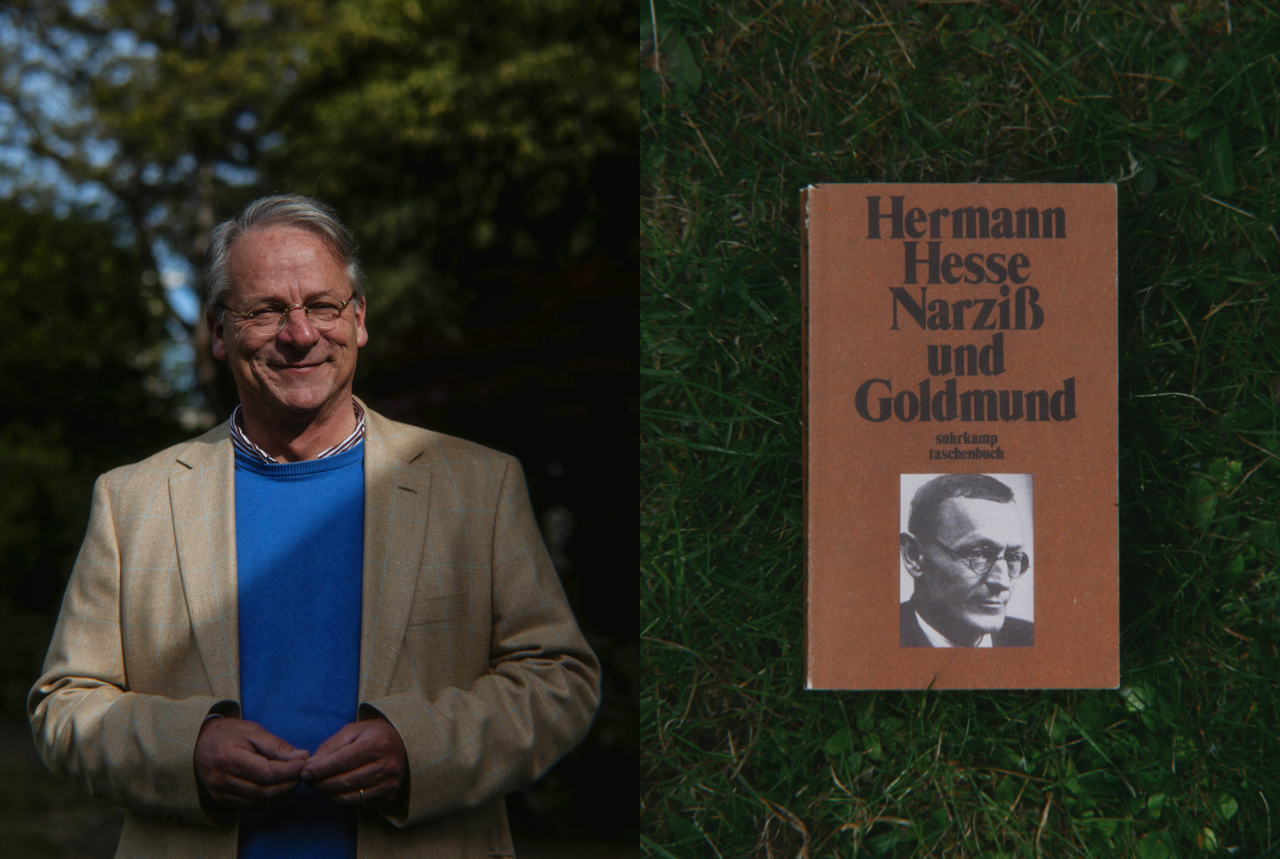
Paul van Geest reads Narziss und Goldmund almost every year.
Theologian Paul van Geest reads an original German copy of Narziss und Goldmund. At secondary school in Delft, a Jesuit school, Frau Wagner, his German teacher, advised him to read Hermann Hesse’s classic. “She had seen through me a little”, says Van Geest. “I wanted to study Theology and I was even considering the priesthood, but priests live celibately and as a schoolboy I was basically always in love.” He calls the book ‘the mirror of my life’.
Paul van Geest is professor of Economics and Theological Thought at Erasmus University. In addition, he is university professor at Tilburg University.
The book is about a friendship between two opposites. Narziss is the spiritual man who thinks and reflects. He does not feel or experience and devotes his life to the monastery. Goldmund, by contrast, is a sensitive artist. He is restless, leaves the monastery, seduces many women and loses the love of his life to death. “Narziss and Goldmund are two separate characters in the book, but within an individual they cannot do without one another. Feeling and thinking must go together.”
Kissing one side of yourself awake
As a Theology student, Van Geest was a real thinker. He studied at the Gregoriana, a pontifical university in Rome, and lived in an international college. Everything revolved around study. In the morning breakfast was ready in the refectory, in the afternoon students were served a three-course lunch with two glasses of wine, and at the end of the day another meal was provided. “We did pour the coffee ourselves from jugs and put our trays in a trolley afterwards. I had to clean my own room, but apart from that I was only busy studying.” Van Geest remembers it as a happy time, orderly. “That was where the Narziss in me was kissed awake. The order in the world was the order in my head.”
But Van Geest is equally sensitive to the turbulent side of life. When he returned from Rome and went on holiday with friends he knew from when he studied Dutch in Leiden, he understood Goldmund better again. He also recognised much of Goldmund’s instability during the phases in life when he had to make choices. “Do I marry Ingrid? Do I want children? In what kind of world do I bring those children? When I had to make those kinds of decisions I was in my feelings and became restless. Less happy than when I lived in the cathedral in my head”, he says now he has passed sixty. “Thinking and feeling cannot do without one another. Narziss and Goldmund are two sides of the same person.”
Summer begins with reflection
In the third week of July, when the summer holiday begins and work at the university can pause for a while, Van Geest finds it tempting to start a new project, to keep working. But instead, he likes to take up Narziss und Goldmund at that moment. He rereads the book and reflects on the past academic year. He asks himself whether he has missed something. And there were years when he had. “Long ago my wife put a plate of food next to my computer and walked away; and when my eldest daughter asked why I got up so quickly after dinner, then you know you have missed something. I have occasionally focused too much on work, which made me careless with my relationships.”
Van Geest is now 61 years old. He would quite like to stay this age for a while. He can look back and be satisfied. At 23, in Rome, he was asked to become a diplomat for the pope, an honourable and celibate life. “Intuitively I felt that life dictated something else for me. I knew: Paul will not become what has been placed in Paul if he becomes a diplomat”, he says. The professorship combined with family life, and the golden mean between Narziss and Goldmund, is the life that suits him. In the yearbook of the college in Rome, Van Geest wrote a motto from Hermann Hesse: Wohin noch mag mein Weg mich führen? Närrisch ist er, dieser Weg, er geht in Schleifen, er geht vielleicht im Kreise. Mag er gehen, wie er will, ich will ihn gehen. (Where will my path take me? This path is foolish; it twists and turns, perhaps it even goes in circles. Let the path be what it is, I will walk it.)
Reading habits
Number of books per year: “Many. My work is reading. In my previous house the books stood in the hallway, so I was always confronted with work there. Now they are in my study. If I sit in the living room, there is not a book in sight and I can look outside.”
Main motivation: “I have always been an incredible reader. I am a studious type.”
Favourite genre: Biographies. “Tomorrow on the train I will finish the biography of Jac. P. Thijsse by my good friend Dik van der Meulen. We know each other from our student days in Leiden. He writes incomparably beautifully.”
Last book read: “The biography of Annie M.G. Schmidt. She lived here in Berkel en Rodenrijs just around the corner. Jip and Janneke are my neighbour children.
Een lijst met artikelen
-
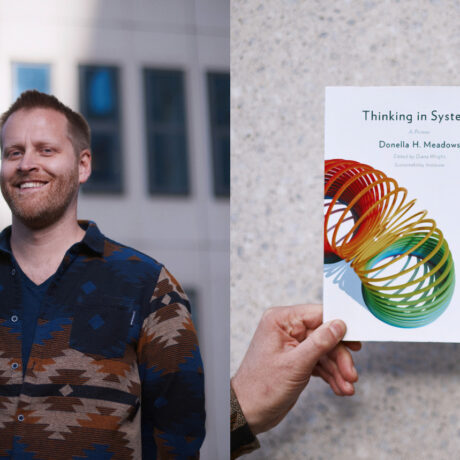
Fantasy and down-to-earth thinking go well together, knows Joost Oude Groeniger
Gepubliceerd op:-
Page-turners
-
De redactie
-
 Maartje Braam
Editor
Comments
1 reactie
Comments are closed.
Ad
Read more in Page-turners
-
Kindred spirits are closer than you think, Lara Fizaine knows
Gepubliceerd op:-
Page-turners
-
-

Once you have found what suits you, things fall into place, says Lenya Slierendrecht
Gepubliceerd op:-
Page-turners
-
-
Fantasy and down-to-earth thinking go well together, knows Joost Oude Groeniger
Gepubliceerd op:-
Page-turners
-
Julia op 7 May 2026 om 17:57
Such a beautiful read, thanks for sharing! This is a beautiful perspective on the book.
Maybe the song “Goldmund” by the German band “Jeremias” will appeal to you as well, it also centers around the book and captures its energy very well in my opinion.