Ad

This is where these students get their news

In light of the current geopolitical issues and the municipality elections this week, it is important to follow the news to get informed. But where do students get their news from? While it can be puzzling to find a reliable (and accessible) source, students and staff can benefit from free access the University Library provides.
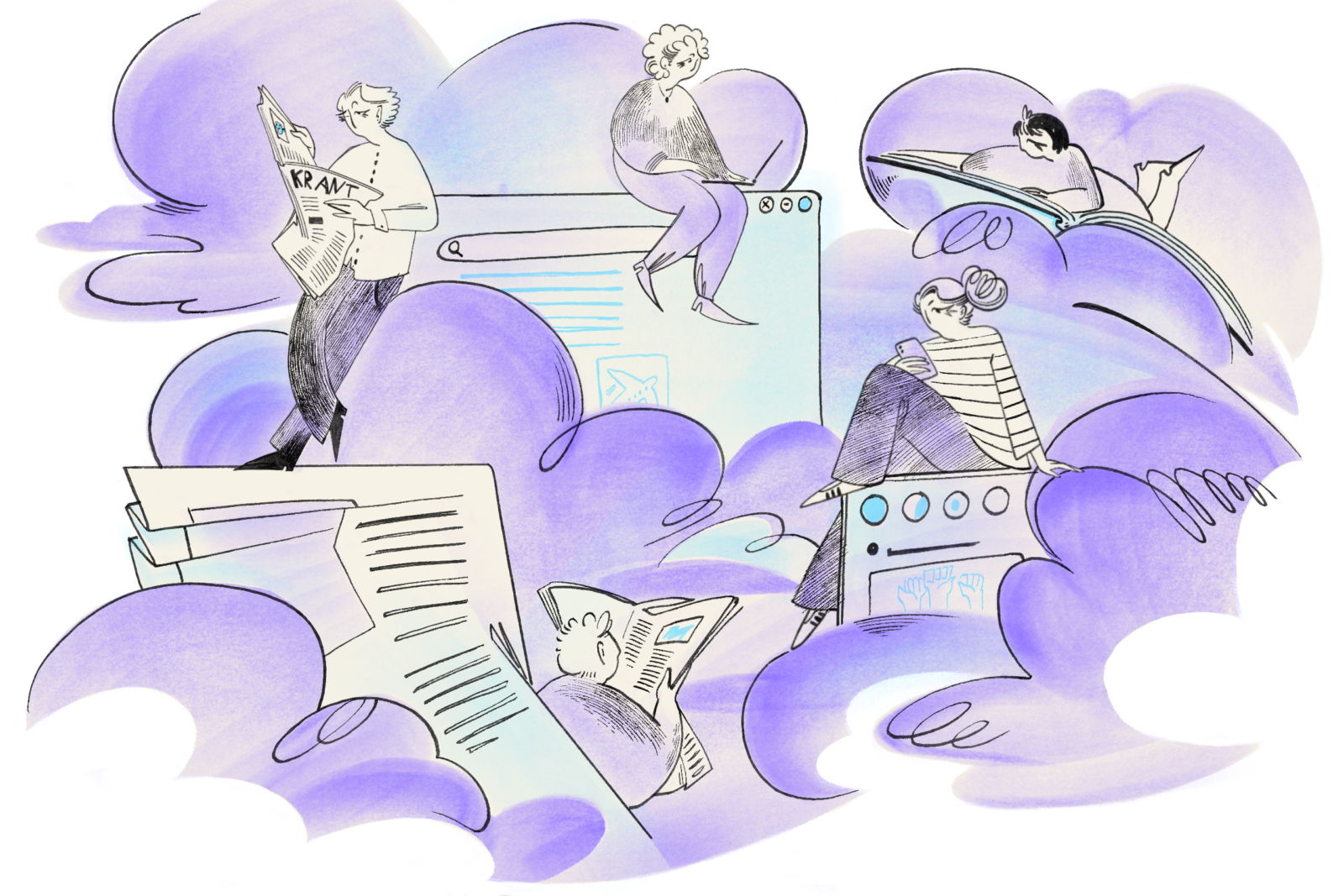
Image by: Ami Rinn
Jesse Pantin, a Marketing Management student, has a folder on her phone with many news apps, amongst which are The Guardian and Al Jazeera, that she reads through daily. Her choice of outlets, however, is limited to the ones that provide free access.
YouTube for gossip
Quinten Plaisier, a History student, sticks to the traditional ways: “I get the paper at home, so I read my news in print every day. That’s where I follow the more serious news, the politics, and then YouTube is for the gossip.”
Like many other students, Quinten and Jesse were not fully aware that the University Library provides free subscription to students for news outlets such as The New York Times and the Financial Times. Not only that, students can also freely browse through the print newspapers and weekly magazines on the ground floor of the library.
“I knew about the New York Times subscription I can get from the library, but not about the other news outlets”, Jesse shares. “While I’m interested in such offers, I prefer sources with less opinion and subjectivity, so I don’t always find the options from the library to my liking. The New York Times is a bit too political for me and the Financial Times has too many opinion pieces.”
Een lijst met artikelen
-
‘Without journalism we are dependent on people with power’ – This is why we need journalism (episode 1)
Gepubliceerd op:Article type: Video-
EM TV
-
Journalism
-
Free subscription
There are also students who have learned about these access opportunities. IBACS student Dina Nemirovsky, for example, mainly uses the subscriptions provided to her by the University Library.
“I rely on the New York Times quite heavily for international news, so it’s nice that you can get a free subscription from the library”, starts Dina. “Although it took me some time to find out about this offer, so I would be nice to receive an email with all the benefits you can get when you start at uni.”
When Dina was doing a minor with students from Delft and from Leiden, she informed them about the access they can get with their Erasmus account.
“They were in shock. I think this is crazy because their universities probably have this opportunity as well, people just often don’t know about it.”
The Epstein files
Apart from news apps and newspapers, social media also tends to be a popular source where students get their news from, though both Quinten and Dina admit they don’t find it reliable.
“I see a lot of random people telling me what’s happening with the municipality elections. And I’m listening to them. It’s not like I don’t believe them but sometimes I’m like… who are these people? Why am I just listening to you? I don’t know”, shares Dina.
“It requires a bit of critical thinking, though. It is easy to hear someone talk about something and then take it as truth. For example, I fully believed everything I heard online about the Epstein files until one day I talked to someone and they fact-checked me. It’s good they did, helped me have this moment of reflection with myself. I learned I need to be more critical with information from social media. Though I don’t remember where they fact-checked me, which is funny because now I realise I didn’t fact-check their fact-check…”, she concludes.
Een lijst met artikelen
-
‘A university, where critical thinking is central, must allow itself to be critically followed’ – this is why we need journalism (episode 2)
Gepubliceerd op:Article type: Video-
EM TV
-
Journalism
-
Research purposes
The free access the library provides to students and staff is mainly for research purposes – news content sources are often used in research and in teaching. While the library is eager to provide as much access as possible, the cost and budgets remain the main obstacle.
“We look at the user needs through surveys for students and researchers each year”, explains Matthijs Holwerda, the head of the Collection Management and Access department of the University Library. “We discuss with the deans of each faculty what they need.”
Western perspective
Frea Haandrikman, faculty liaison librarian, goes more in-depth into the different sources students and staff have as options: “Our databases offer access to news sources from around the world, but you see that the Western world (and thus the Western perspective) is overrepresented. We keep an eye out for opportunities to provide access to other global sources. For example, we have recently added access to the historical archives of South African newspapers.”
Apart from apps, most newspapers can be accessed through databases, such as Nexis Uni, Factiva, or Gale OneFile: News. Holwerda also points out that staff and students have free access to Vers Beton, a journalistic platform about Rotterdam.
Een lijst met artikelen
-
How an EM article is made – This is why we need journalism (Episode 3)
Gepubliceerd op:Article type: Video-
EM TV
-
Journalism
-
De redactie
-
 Radina Kirilova
Student Editor
Comments
Comments are closed.
Ad
Read more in Student life
-

RSC/RVSV accused of poo stunt targeting student houses in Utrecht
Gepubliceerd op:-
Student life
-
-

Carolina could wake up ten minutes before her lectures
Gepubliceerd op:-
Housing
-
-

No joint introduction week for vocational, applied sciences and university students for now
Gepubliceerd op:-
Eurekaweek
-