End to years-long legal battle: settlement between RSM part-time students and EUR

The Erasmus University has reached a settlement with a group of alumni from the part-time master in Business Administration for an unknown amount of money. This brings an end to a legal battle that has dragged on for years over the tuition fees charged.

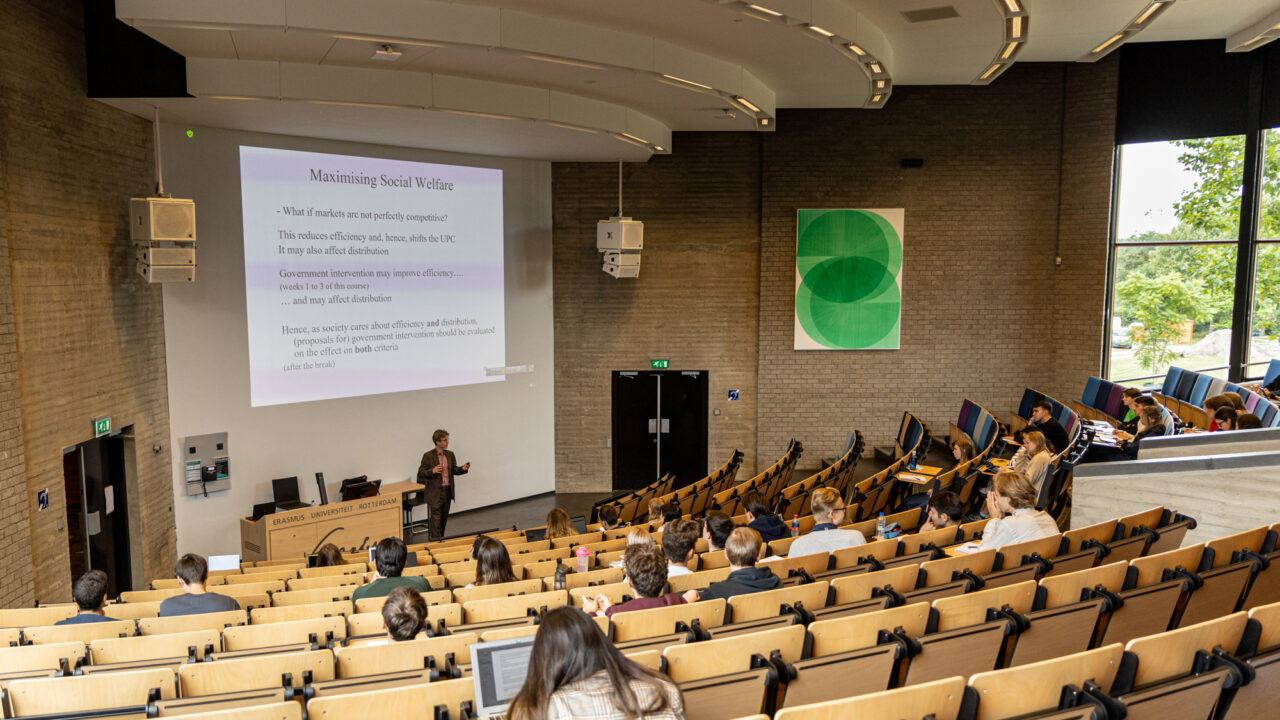
Image by: Eric Fecken
“EUR and RSM have reached an agreement with the former students in good consultation”, a university spokesperson said. “Both parties have agreed to refrain from any further legal action and will not provide any further details about the agreement.”
The amount for which the university and the students have settled thus remains unknown. Previously, the university estimated the cost would be 5 million euros, according to the 2025–2029 multi-year policy plan. Whether the financial blow to the faculty ultimately turns out to be higher or lower than that, may become clear in a future annual report. The case is especially inconvenient for the RSM, which is already in financial difficulty and undergoing reorganisation.
Tuition fees too high
The conflict between 133 former part-time students and Rotterdam School of Management, which has been ongoing since 2018, revolves around the tuition fees. The students paid 17,000 euros per year for what was officially a publicly funded programme. The statutory tuition fee at the time was about 2,000 euros. According to the students, they paid roughly 30,000 euros too much over the course of the two-year master.
The part-time master was marketed as a programme for working professionals, not regular students. The university also justified the higher tuition fees by offering various luxuries such as high-end sandwiches, biscuits, smaller class sizes, and a study trip to Brazil. Institutions such as Nyenrode and the French INSEAD offer similar programmes at similar rates. The difference, however, is that Erasmus University is a public university and cannot simply offer a publicly funded programme in the same way as a commercial one.
Older students excluded
In 2019, RSM already introduced a compensation scheme for some of the students. They were eligible to receive 50 percent of their tuition fees back. This scheme – which also included alumni from the part-time master in Finance & Investments who had a similar complaint – cost the university 3.7 million euros. However, the arrangement applied only to alumni who had started their master’s between 2016 and 2018. Earlier cohorts were excluded, as EUR argued that their claims had expired under the statute of limitations.
Those former students then took the university to court. This group demanded a large portion of their tuition fees be reimbursed, potentially leading to an additional hit of around 4 million euros (133 times 30,000 euros).
All the way to the Supreme Court
The legal proceedings that followed were complex. In 2021, the students were rejected by the Rotterdam District Court, which ruled that they should have taken their case to the Higher Education Appeals Tribunal (CBHO) instead. However, the CBHO, the ‘court for education’, no longer existed. On appeal, the judge overturned the decision that the students had approached the wrong court. But this was not a victory for the students: the court of appeal also ruled that the students were not entitled to a refund, as the university had sufficiently informed them about the nature of the programme and the tuition fees.
The students then turned to the Supreme Court, convinced by their lawyers that the court of appeal was wrong. In her opinion, the Advocate General of the Supreme Court sided with the students. The university had wrongly created the impression that the programme was privately funded – a misunderstanding partly caused by the faculty’s organisational structure, where the commercial branch (RSM BV) practically bears the same name as the faculty. The Supreme Court adopted this advice and referred the case back to the Amsterdam Court of Appeal. Now that an agreement has been reached, there will be no further ruling in the case.
Read more
-
Erasmus University loses lawsuit over high tuition fees
Gepubliceerd op:-
In court
-
De redactie
-
 Elmer Smaling
Deputy editor-in-chief
Latest news
-

Anti-Israeli Pettit not allowed to work at Brussels university
Gepubliceerd op:-
Staff
-
-

Member of far-right student association given two-year prison sentence
Gepubliceerd op:-
In court
-
-

Faculty honours programmes mostly continue, but have to adapt to budget cuts
Gepubliceerd op:-
Education
-



Comments
Comments are closed.
Read more in Education
-
Faculty honours programmes mostly continue, but have to adapt to budget cuts
Gepubliceerd op:-
Education
-
-
Universities recognise each other’s training for lecturers
Gepubliceerd op:-
Education
-
-

Universities welcoming fewer and fewer students
Gepubliceerd op:-
Education
-