Ad

Students still undecided after ‘their own’ election debate
They’re definitely going to vote, said students at a lively election debate in Amsterdam about vocational and higher education. But even afterwards, many still didn’t know which party to vote for.
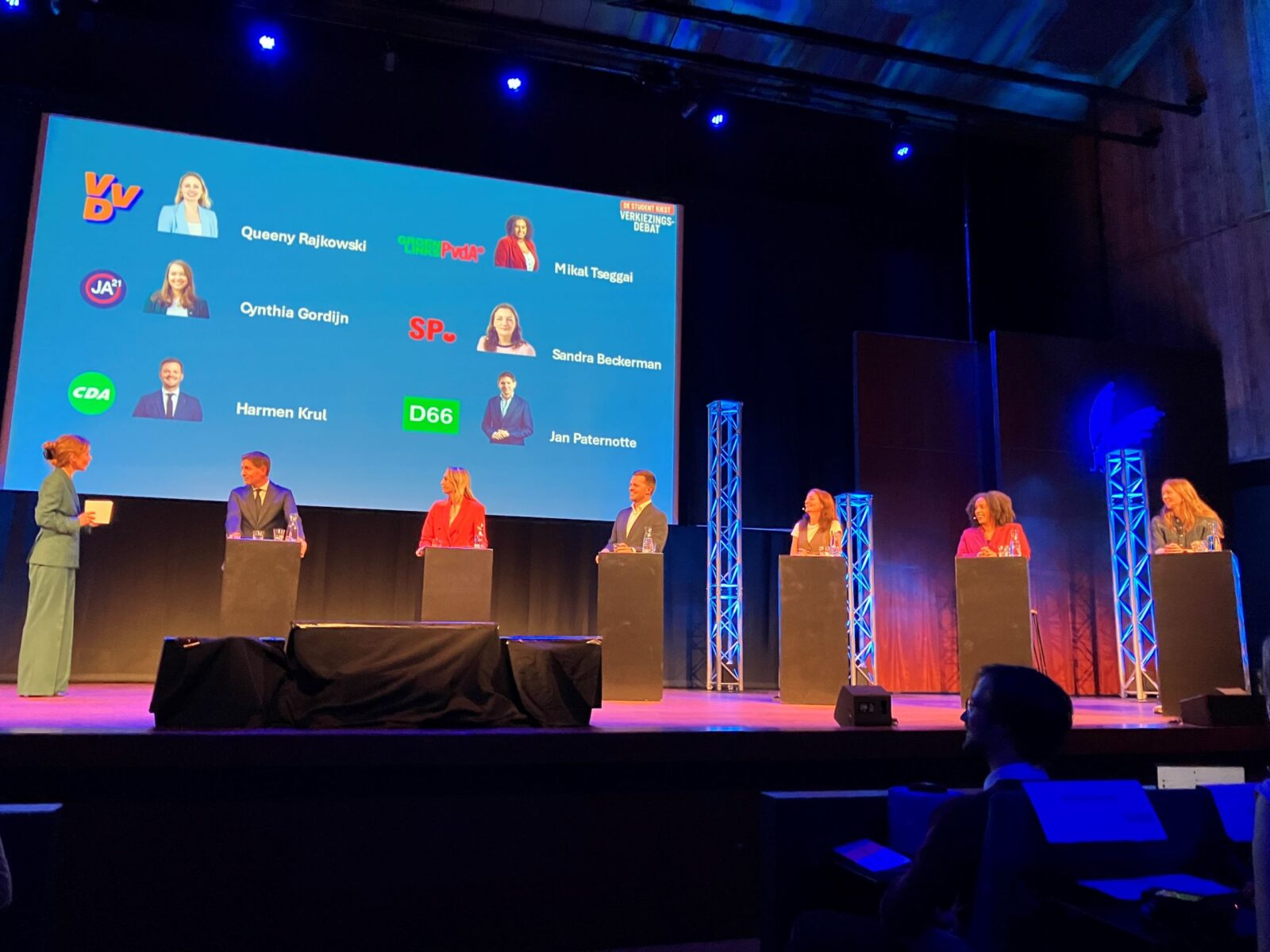
The student election debate took place in Amsterdam.
Should the basic grant be increased? Should all students receive an internship allowance? And should the government have a say in young people’s choice of study?
These were the questions debated on Wednesday evening during ‘The student decides’, a special election debate for students in vocational education (mbo), universities of applied sciences (hbo) and research universities (wo). Around three hundred to four hundred students attended the event in the auditorium of Vrije Universiteit Amsterdam.
Six parties took part in the debate: governing party VVD and opposition parties CDA, D66, GroenLinks-PvdA, SP and JA21. BBB and PVV were also invited but declined to attend.
Basic grant
Students in the audience were invited to share their views on various statements by sitting or standing. Almost all agreed that the basic grant should be increased. D66, SP and GroenLinks-PvdA support this too. SP even wants to go further by eventually abolishing tuition fees altogether.
‘Housing costs are sky-high and you can’t even do your weekly shop properly anymore’
But CDA, VVD and JA21 take a different view. The causes of students’ financial difficulties go beyond the basic grant, said Harmen Krul of the CDA: “Housing costs are sky-high and you can’t even do your weekly shop properly anymore.” He’d prefer to address those issues.
“Lowering rent for student rooms is a good idea”, said Jan Paternotte of D66, “but we haven’t managed that yet.” That’s why he still wants to increase the grant (which was already raised temporarily under the previous cabinet) and also make housing benefit available for student rooms.
According to Cynthia Gordijn, candidate for JA21, the real solution is to reduce the number of international students coming to the Netherlands. That way, Dutch students would be more likely to find affordable rooms, she argued.
Internship allowance
Mikal Tseggai of GroenLinks-PvdA repeatedly highlighted the issue of internship allowances, a point that clearly struck a chord. One student shared how he works early mornings at Albert Heijn and then does an unpaid internship in education during the day. According to Tseggai, an internship allowance should be made mandatory.
Queeny Rajkowski of the VVD agrees that everyone should get an internship allowance, ‘but we shouldn’t make it a legal requirement’. There are exceptions, she explained. Some businesses are struggling financially. If a baker has to supervise a trainee, it costs time and effort. If that baker also has to pay the trainee, he might simply stop offering internships.
Naturally, Tseggai doesn’t want to cause problems for such small businesses, she replied. That’s why her party, together with the CDA, proposed a public-private internship fund: a pot of money for such cases.
Other topics discussed included government budget cuts, discrimination against vocational students, and free choice of study for young people. Strikingly, no one mentioned the pro-Palestinian protests currently taking place at universities.
Reactions
Afterwards, a public administration student said the debate hadn’t exactly increased his faith in politics: “There’s always something to be said for each side, and then they start attacking each other personally. That’s a big issue for me: I need to have confidence in order to vote. And they just never seem to work things out.” He’s leaning towards the VVD but also believes an internship allowance should be mandatory.
A clinical psychology student said she’s now ‘a little less undecided’ than before. “I’m nearly finished with my degree, so a higher basic grant wouldn’t benefit me personally. But I think about others too. That’s why I support it.” She also sees internship allowances as important: “It really highlights the gap between rich and poor.”
‘I really feel like I have to get involved now’
A physics and chemistry student from Utrecht, active for GroenLinks-PvdA, thought it was a great debate. “There was a real battle of ideas. Of course I valued my own party’s position on internship allowances. But you have to stay critical too. The VVD really emphasised the economic realities around internship pay. That’s something you need to take seriously.”
Another student, who doesn’t rent a room herself, said she hadn’t realised how expensive it had become. “I found that really interesting.” She appreciated the fact that the politicians were empathising with students. “We have to do that too. We need to understand mbo students and students living in rented rooms. I’m not just voting for my own wallet.”
Some students had voted before. One 22-year-old said: “I didn’t think much about it last time, I just filled in one of those voting guides. But now so much is at stake. I’ve only just started my degree and I can already feel how much depends on it. This current cabinet thinks completely different than me. I really feel like I have to get involved now.”
That was also the message Harmen Krul of the CDA gave the audience in his closing words: go vote, because if you don’t get involved in politics, politics will get involved with you.
The debate ‘The student decides’ is an initiative by student organisations LSVb, ISO and JOBmbo, together with the umbrella organisations for vocational, applied and academic education.
Read more
-

What will you vote on 29 October?
Gepubliceerd op:-
Politics
-
De redactie
Latest news
-
Students and staff join the Pride March: ‘We must stand up for this community’
Gepubliceerd op:-
Diversity
-
-

EM TV newsflash: Too many internationals, too many information platforms and more collaboration with the military
Gepubliceerd op:Article type: Video-
EM TV
-
-

18-year-old student dies after ‘hazing party’ in France
Gepubliceerd op:-
Student life
-


Comments
Comments are closed.
Ad
Read more in Politics
-
After a second compensation payment, that must be it for students who missed out
Gepubliceerd op:-
Money
-
Politics
-
-
Far-right extremists use campuses to normalise their ideas
Gepubliceerd op:-
Politics
-
-

Prime minister Jetten sees potential for AI to improve education
Gepubliceerd op:-
Artificial Intelligence
-
Politics
-