Medical student rightly expelled from master programme, rules Council of State

The Council of State has rejected the appeal of a medical student who was expelled. The student was removed from the programme due to concerns regarding future patient safety should they become a doctor. According to the university, there was a ‘pattern of unprofessional behaviour’. The student was already presenting himself as a doctor on LinkedIn.

Image by: Hanneke Rozemuller
Lying, arriving late and thus missing the medical handover meeting in which patient cases are discussed, inadequate medical knowledge, and fraud. Seven months after the start of the clinical placements, reports about the medical student began to surface. After psychotherapeutic treatment, the student’s behaviour appeared to improve, until several months later, when new reports came in to the examination board.
During this time, the student portrayed himself as a doctor on LinkedIn, while still being a master’s student and thus unlicensed. Once again, there were reports of absenteeism, arriving late, being uninterested, and unprepared. In dermatology, the student was present during a surgical procedure but was more focused on their phone. Subsequently, they handled sterile materials with bare hands and removed their face mask to drink from a bottle they had brought along. During their time on a mental health unit, they left a window open and had their keys still in the door. These keys provided access to locked patient wards. Additionally, fraud was once again demonstrated in relation to an assignment.
Read more
-
Why it is so difficult to expel unsuitable medical students
Gepubliceerd op:-
Education
-
Defence
The student contended in their defence that the expulsion of a medical student according to the iudicium abeundi can only occur if patient safety is seriously and structurally jeopardised. He argued that this was not the case. The university, according to the court, sufficiently substantiated that the student ‘displays a pattern of dishonest behaviour’ and ‘that this behaviour poses a threat to the safety of healthcare providers and patients’.
The university considered the incident of the student leaving the key in the door at the mental health unit as the most serious, as patients from the locked ward could have escaped. The assessments of the Longitudinal Professionalism Assessment Committee were also taken into account. Although the student did pass the clinical placements, physicians had recurring doubts about the same competencies.
Read more
-

‘Iudicium abeundi must protect both patients and students’, says advocacy group
Gepubliceerd op:-
Education
-
Lack of reflection
The examination committee conducted eleven conversations with the student over the years and strongly urged him to seek a different career. A psychologist saw potential for remediation, provided the student was willing to reflect on their behaviour. There were strong doubts whether the student would be capable of doing so. It took months for the student to begin psychotherapeutic treatment, leading the involved psychologist to indicate that they no longer saw a chance for recovery. The student then eventually began the treatment, which initially seemed successful.
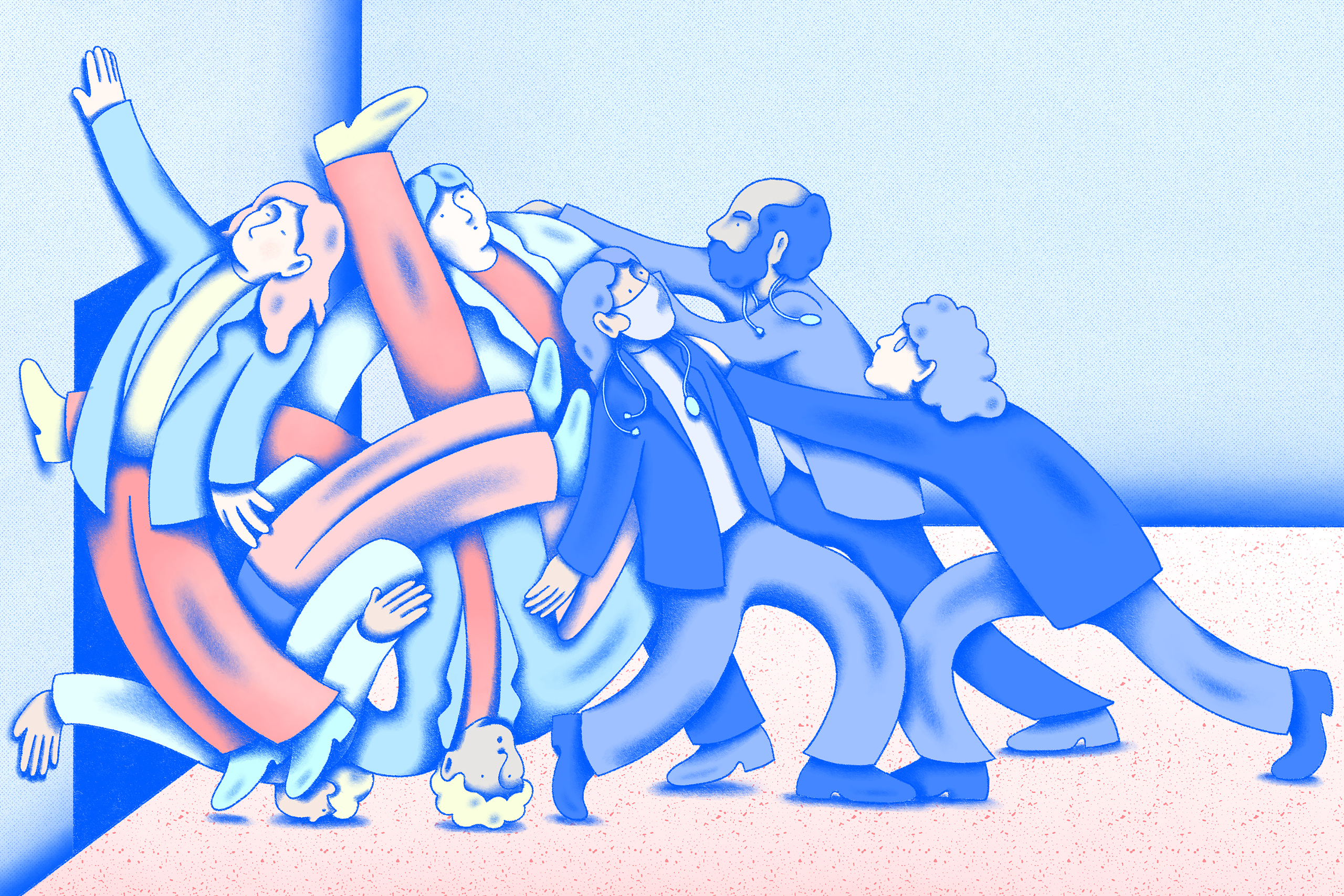
Research from EM had previously indicated that Erasmus MC has been trying since the beginning of this century to gain more opportunities to expel unsuitable students from the programme. Expelling someone is extremely challenging, those involved in the programme in Rotterdam explained. A well-documented case is necessary, and a student must demonstrably have put patients, fellow students, or colleagues at risk.
In practice, patient safety is not often jeopardised. A doctor who doubts the suitability of a student does not leave the particular assistant alone with a patient. “Good supervision usually prevents actual breaches of patient safety during training”, the chairs of the examination committees stated in 2022. They proposed that the choice to not leave an assistant alone with patients should weigh as heavily as an incident where patient safety has actually been breached. Both the previous and the current ministers of Education rejected this proposal.
Response Erasmus University:
“We are pleased with the ruling of the Council of State”, let an Erasmus University spokesperson know, also on behalf of Erasmus MC. “It confirms that the iudicium abeundi is an appropriate and necessary instrument to ensure safety and professional behaviour within healthcare and education in exceptional cases. At the same time, we believe it is important that this instrument is more structurally embedded in processes, to create greater clarity and legal certainty for all parties involved.”
“The timing of this ruling comes at an important moment. This Monday, a national meeting will be held (organised by NFU and UNL) where education professionals and examination committees will come together to revise the protocol regarding the iudicium abeundi (IA). The current protocol is proving effective in practice due to the emergence of case law, as demonstrated by this seventh IA ruling from the administrative court where an IA decision is upheld, but this application of the protocol is still insufficiently legally and policy-wise established. Therefore, it is good that work is now underway on a revision and further embedding for addressing serious unprofessional behaviour in higher education.”
“The expansion of case law is seen as very valuable and underscores the need for more structural safeguards. Erasmus MC and Erasmus University Rotterdam have been advocating for clear frameworks and guidelines for intervening in cases of serious unprofessional behaviour for years. Every ruling contributes to further clarification of the application of article 7.42a WHW. This ruling aligns with previous cases, such as those concerning the master’s programme in Pedagogical and Educational Sciences.”
An earlier version of this article stated that the door the student had left his keys in gave access to closed patient wards. That is incorrect. The key the student left in the door gave access to those wards.
De redactie
-
 Tessa Hofland
Editor
Latest news
-
Away with the ‘profkip’, says The Young Academy
Gepubliceerd op:-
Science
-
-

House of Representatives wants basic grant for university master after HBO
Gepubliceerd op:-
Money
-
Politics
-
-

Company takes a huge chunk of the student finance of at least 350 internationals
Gepubliceerd op:-
Internationalisation
-

Comments
Comments are closed.
Read more in In court
-

Member of far-right student association given two-year prison sentence
Gepubliceerd op:-
In court
-
-
Prosecutor and defence want to know again whether Fouad L. was criminally accountable
Gepubliceerd op:-
In court
-
-

Preliminary relief for ESL PhD candidate in Gaza case rejected
Gepubliceerd op:-
In court
-