PwC: Some universities at greater risk if international students stay away

If the number of students from outside Europe falls by 10 per cent, universities will sink 37 million euros further into the red. For Erasmus University, this would mean an additional setback of around 3 million euros.

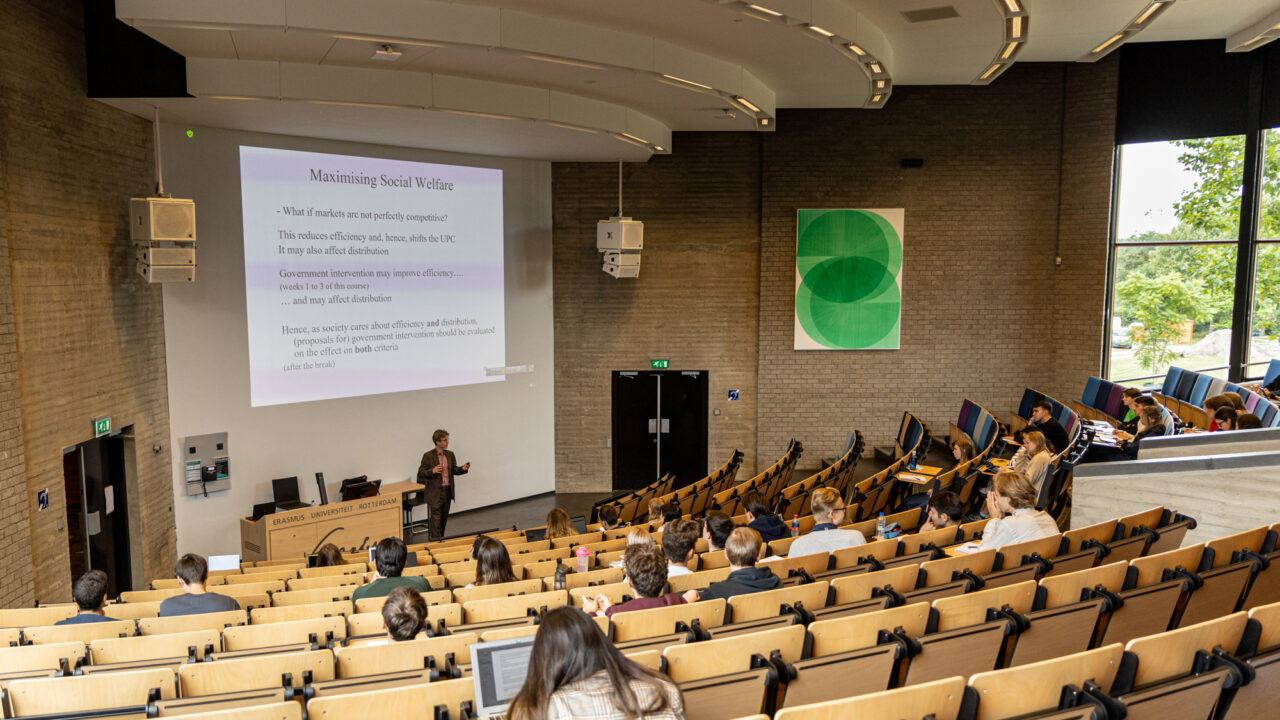
Image by: Josine Henneken
In a report on the financial position of universities, accountancy firm PwC sounded the alarm last week: with declining numbers of domestic students, universities are already receiving less funding. Now that the government also wants to curb the influx of international students, this could lead to significant shortfalls.
No wild scenario
You cannot immediately cut staff and buildings as soon as income decreases, says PwC. The consultancy has estimated the financial impact on universities if fewer international students enrol. What happens, for example, if 10 per cent of students from outside Europe stay away?
The situation is slightly worse than the analysts reported last week. Due to a calculation error, the report initially stated that universities would run a ‘loss’ of 27 million euros. However, after inquiries from the Higher Education Press Agency, it turns out that the actual figure is 37 million euros.
A 10 per cent decline in international enrolment is not an unlikely scenario. In September, it became clear that international enrolment in university bachelor’s programmes had already fallen by 6 per cent – and that was without any government intervention. The government ultimately wants to cut 168 million euros in spending on international students, partly by encouraging more programmes to switch from English to Dutch.
Uneven impact
However, the financial impact of such cuts will not be the same for every institution. Some universities have far more international students than others. In Utrecht, for instance, international students make up around 20 per cent of the student body, according to PwC, while in Maastricht, that figure exceeds 70 per cent.
It also matters where these students come from. European students typically generate less income than non-European students due to the high institutional tuition fees paid by students from outside the European Economic Area (EEA). These students – often from China, India and Turkey – pay between 10,000 and 37,000 euros per year.
This provides some universities with a relatively large financial boost. At the University of Amsterdam, for example, tuition fees from non-European students account for 7 per cent of total income, according to PwC – the highest percentage of any university, making it particularly vulnerable to fluctuations in international enrolment.
In Delft, Eindhoven and Wageningen, this percentage is around 5, while in Nijmegen, less than 1 per cent of total income comes from non-European students. The other universities fall somewhere in between. In Rotterdam, approximately 3 per cent of income comes from the institutional tuition fees paid by students from outside Europe.
Adjustments
The question is how quickly universities can adjust if student numbers decline. That action is needed is clear, says one of the authors of the report. Politicians want to make higher education funding more stable, but that is easier said than done. “I’m curious to see when a new funding model will be introduced”, says Sander van Veldhuizen, PwC partner and education specialist.
Read more
-

Fewer first-year students for universities again, Rotterdam sees number rising
Gepubliceerd op:-
Student life
-
De redactie
Latest news
-

Away with the ‘profkip’, says The Young Academy
Gepubliceerd op:-
Science
-
-

House of Representatives wants basic grant for university master after HBO
Gepubliceerd op:-
Money
-
Politics
-
-

Company takes a huge chunk of the student finance of at least 350 internationals
Gepubliceerd op:-
Internationalisation
-


Comments
Comments are closed.
Read more in Education
-

EUR master’s in International Management among sixteen ‘excellent’ masters in the Netherlands
Gepubliceerd op:-
Education
-
-

Faculty honours programmes mostly continue, but have to adapt to budget cuts
Gepubliceerd op:-
Education
-
-
Universities recognise each other’s training for lecturers
Gepubliceerd op:-
Education
-