Ad

Dijkgraaf does not want ban on protests against Israel at universities
Minister Dijkgraaf has reiterated his stance that anti-Semitism must be dealt with firmly. However, as controversial opinions are allowed at universities, activists there are allowed to call for a boycott of Israel.
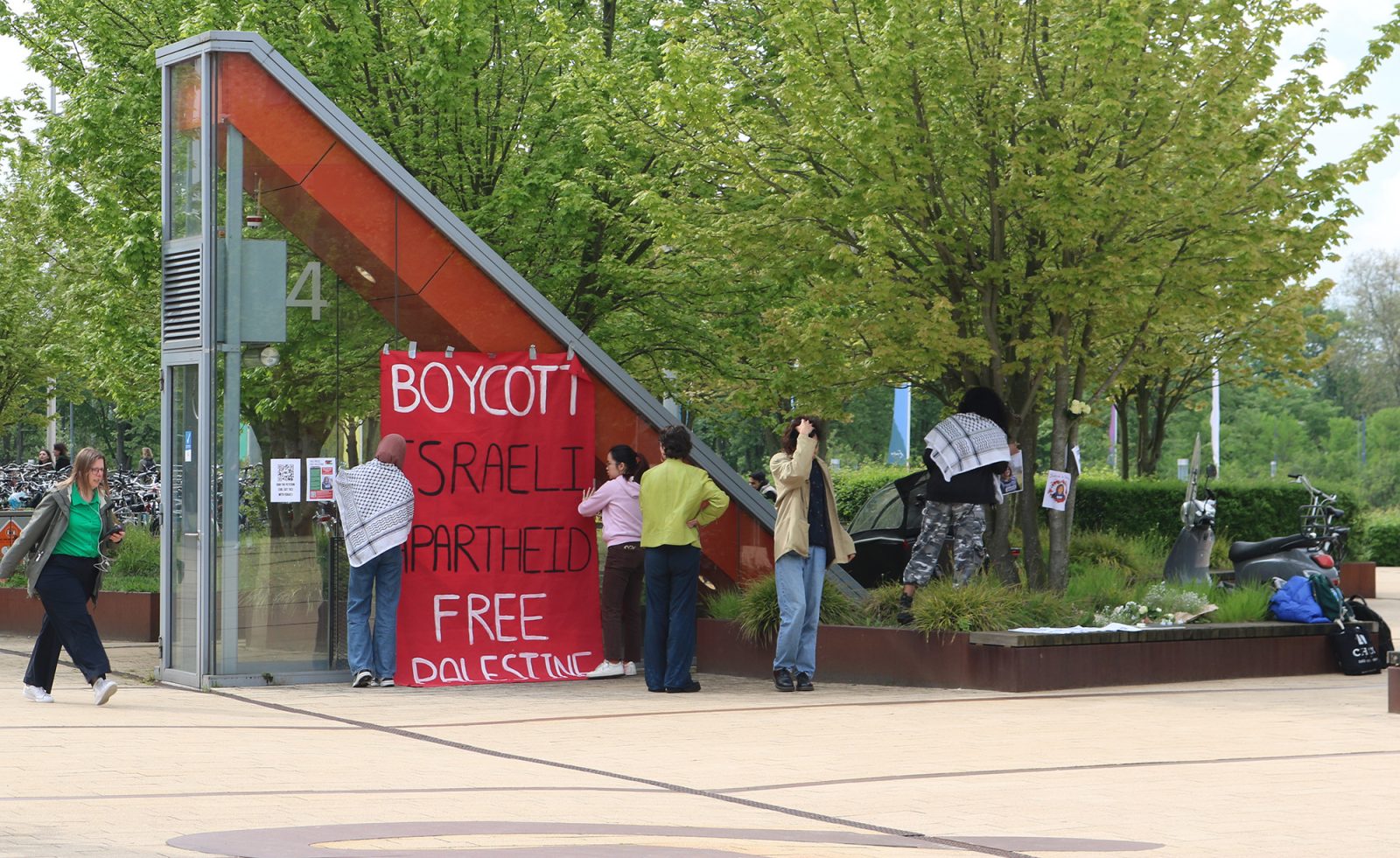
In May 2023, demonstrators held a protest in the Plaza against Israel and a vigil for the killed Palestinian-American journalist Shireen Abu Akleh.
Image by: Melis Zavlak
In March, Palestinian activist Omar Barghouti spoke at the University of Groningen (RUG) as part of ‘Israeli Apartheid Week’. His controversial Boycott, Divestment, Sanctions (BDS) movement calls for a boycott of the state of Israel until Palestinians and Arabs have equal rights with Jewish Israelis.
Critics say the campaign group is anti-Semitic because it demonises Israel, along with those who support the state. The German Bundestag has also labelled BDS activists as anti-Semitic.
Threatened
In the Reformatorisch Dagblad newspaper, the Center for Information and Documentation Israel (CIDI) strongly disapproved of the University of Groningen providing a platform for the activists and their week of action. It claimed pro-Israel Jewish students would feel threatened as a result. The Reformed Political Party (SGP) raised the issue in parliament.
“I can imagine that this week might evoke unsafe feelings among Jewish and other students”, Dijkgraaf wrote, also on behalf of Minister of Justice and Security Yeşilgöz. “That said, there must be room within an academic environment – within the limits of the law and respecting academic standards – for controversial or unwelcome views that may meet with resistance. This is not at odds with a safe learning environment.”
Was that the case in Groningen? According to the Minister, there was at least one instance in which this criterion was not met. “In retrospect, it has emerged that one meeting took place during which the necessary conditions were not ensured, and there may therefore have been an unsafe environment.”
Tightening protocol
Those conditions were that the meetings during ‘Israeli Apartheid Week’ would be open to all, that a moderator had to be present and that the law would not be broken. The Minister did not specify which condition was violated. While the university has indicated it is willing to tighten its protocol,the Minister has stated he will not be discussing the week with the university further. “Considering a general call for a boycott or sanctions against a country as discrimination would not be logical”, he believes.
Together with all institutions, he is working on an approach to improve social safety and inclusion in higher education. He is also involving the National Coordinator for Combating Anti-Semitism and Jewish youth organisations, he reports.
Reporting a crime
Dijkgraaf cannot answer the question of whether anti-Semitism in the Netherlands is on the rise due to the ‘growing number of anti-Israel events’: “There are no unambiguous data on this.”
He emphasises: “Anti-Semitism must be dealt with firmly. I therefore urge students and others who are victims of this to make a report to the police.”
Lees meer
Latest news
-
Interest on student debt at highest level in 17 years
Gepubliceerd op:-
Money
-
-

Behind on repaying your student debt? DUO may soon pass the details on to your municipality
Gepubliceerd op:-
Politics
-
-

Extra funding for higher education does not keep pace with inflation
Gepubliceerd op:-
Education
-
Politics
-

Comments
Comments are closed.
Ad
Read more in Campus
-
Interest on student debt at highest level in 17 years
Gepubliceerd op:-
Money
-
-
Behind on repaying your student debt? DUO may soon pass the details on to your municipality
Gepubliceerd op:-
Politics
-
-
Extra funding for higher education does not keep pace with inflation
Gepubliceerd op:-
Education
-
Politics
-