The anti-politics of climate change guidelines
May 2023: Ocean water temperatures have never risen as rapidly or been this high so early in the year. In Canada, more than 25,000 people have been evacuated due to wildfires that have devastated 122,000 hectares of forest. Spain and Portugal have already had their first heat wave of the year. Earlier this year, Shell, BP, ExxonMobil and Chevron all reported record profits for 2022.

Image by: Migle Alonderyte
More about climate and the university
- Broader public transport scheme, report on links with fossil fuel industry and dialogue sessions. Executive Board announces climate measures
- Activists occupy Erasmus building
- UvA announces moratorium on new research with Shell
- First meeting following Sanders Building occupation: ‘More emotion and humour, less Shell’
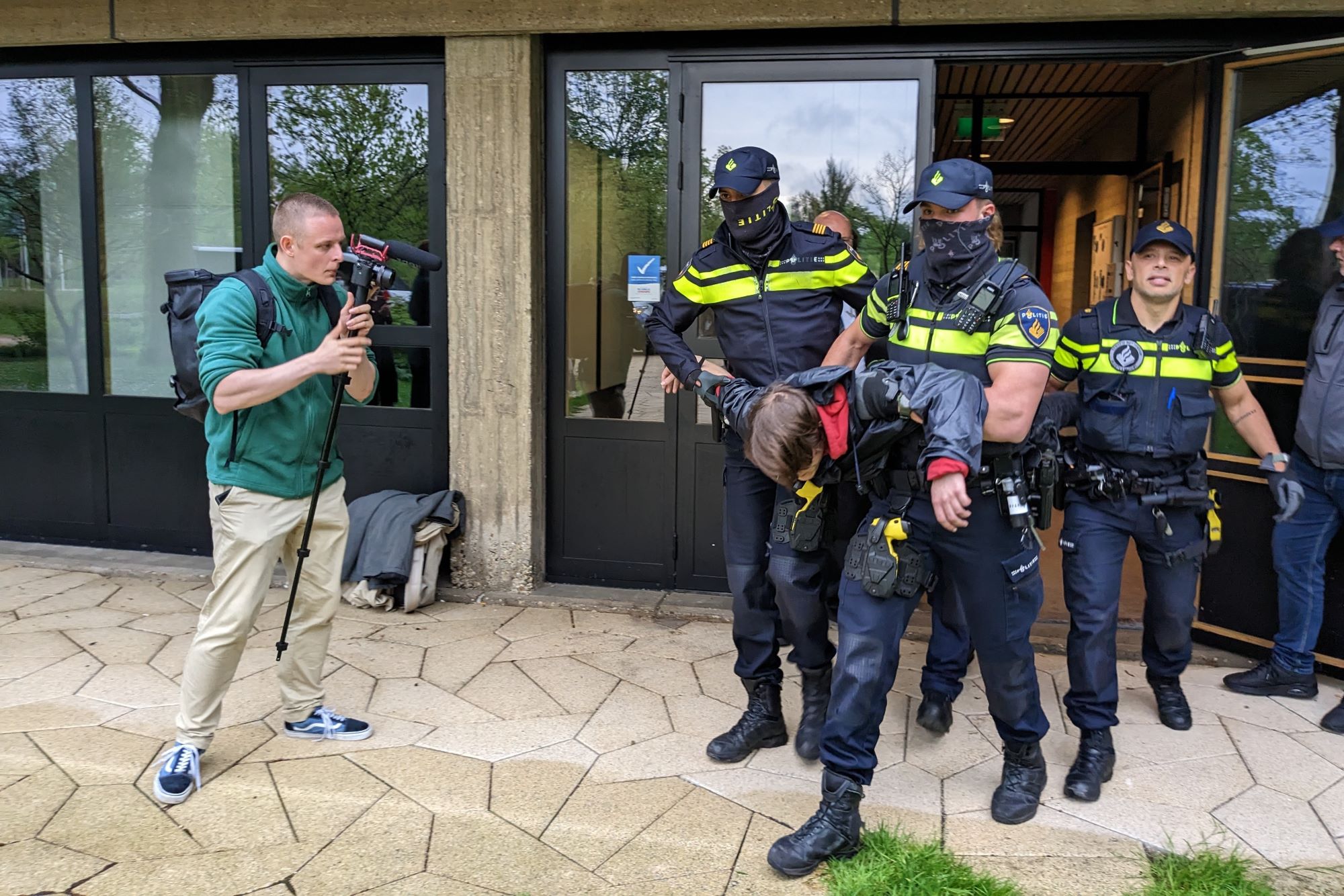
Meanwhile, things are brewing on our campus. Concerned, brave and angry students and members of staff are committed to a different world: a world that doesn’t centre around the profits of predatory capitalists, but around caring for one another – and for our planet. However, this speculation about the possibility of realising a different and better future is mainly seen by our dear Executive Board as simply being an annoying disruption of business as usual. After the police – and riot police – were called in to tackle the first occupation in November, our Executive Board seems to have gone past the point of no return. Last Tuesday, the police were again called in and mobilised to forcibly remove students from our (their!) campus.
In the meantime, there seems to be at least some movement. For example, in an email to all EUR students and staff, the Executive Board announced that it would be holding a series of faculty and interfaculty dialogues, in which members of staff will be discussing a broader sustainability agenda for EUR. The email of April 25th tells us that these dialogues are intended to ‘initiate an internal debate on sustainability in research, education, leadership/management and business operations and the contribution of disciplines to sustainability (or lack thereof)’. In terms of those complicated ties to the fossil fuel industry, the Executive Board states that ‘ties with the fossil fuel industry [will] be taken into account in all these dialogues’.
‘Anyone who believed that these dialogues would be the place to ask fundamental questions about the role of a university should realise that they should absolutely not be allowed to result in any impact or implications’
At first glance, this appears to be a hopeful sign, in that the Executive Board seems to be taking the demands of the local and international student movement seriously. And yet the email quickly takes a negative turn. Although a project group has been set up to conduct a critical review of the university’s ties with the fossil fuel industry, there is exactly zero positioning that would lead to a principled and political discussion of the issue. Instead, the insights of the project group, combined with the dialogues, should ‘lead to guidelines being established for relations with the industry.’
This email, which was sent at a time in which a lot of people were away on holiday, is an appalling example of depoliticisation. Anyone who believed that these faculty and interfaculty dialogues would be the place to ask fundamental questions about the role of a university at a time characterised by climate change should realise that although these kinds of discussions might be able to be take place (briefly, in the right forum) albeit within this prescribed setup, they should absolutely not be allowed to result in any impact or implications. After all, the outcome has already been preordained: the establishment of guidelines!
The broader issue of whether we, as a community, wish to accept funds from those driving the wholesale loot and pillage of our planet has thus been neutralised, as has the question of whether such guidelines are the best instruments available to address wider political issues. Because let’s face it: existing ethical codes that prescribe transparency about ties with external parties are already widely flouted. The Financieel Dagblad posited that ‘individual professors are by no means always transparent about their financial backers’. Why should it be any different in the case of these guidelines?
And this is irrespective of the types of influence exercised on academic research and teaching that often have a more subtle effect, and often continue to fly under the radar. Do we really think that a set of ‘guidelines’ for individual researchers will be able to compete with these conflicts of interest and influence? Guidelines are more often than not a sign of capitulation: toothless legal checklists for the sake of appearances. Furthermore, guidelines would suggest that they would only affect future relationships. A fundamental reconsideration of existing relationships and the responsibility of the university in that regard are therefore not addressed, despite the fact that one of the most pressing political issues is how we can harness the power that accompanies knowledge to counterbalance the power that emanates from money.
‘If we were so keen to help them out of the goodness of our hearts, why shouldn’t we do so without financial dependence on the same problematic multinational corporations?’
And that’s just on an individual level. Because, as regards the wider community, we must equally have the guts to address the broader issue of whether we want to be financially entangled with Shell and other companies. These companies make mind-blowing profits by depleting and plundering the earth and its inhabitants. Can’t we just say ‘No thanks – we want nothing to do with this’? The argument that these parties need ‘assistance’ in relation to a ‘transition’ is irrelevant in the context of this broader issue: if we were so keen to help them out of the goodness of our hearts, why shouldn’t we do so without financial dependence on the same problematic multinational corporations? Aren’t we already funded by the government? Is our ‘positive societal impact’ that conditional?
Meanwhile, the International Institute of Social Studies – formally part of EUR – has already come to its own conclusions. On May 11th, it announced that it would no longer be accepting funds from or entering into partnerships with parties in the tobacco, arms and fossil fuel industries. Ending up in this category of businesses is a nightmare for Shell and a blow to their ‘social licence to operate’, but they have more than earned this classification. Current – and conservative – projections show that the climate-related mortality rate – mortality attributable to climate change – will amount to some 250,000 deaths per year between 2030 and 2050. Is this the impact that we, as scientists, are agreeing to?
Anyone who does not want to participate in this murderous reality must speak up, both within and outside of the ‘sustainability dialogues’. This late in the day, we not only need brave students, but brave, principled and outspoken members of staff and administrators.
Irene van Oorschot is an assistant professor at the Department of Public Administration and Sociology and conducts research into climate change and nature conservation (NWO Veni). Sophie van Balen is a Climate philosophy PhD candidate (NWO in the Humanities), a lecturer at Erasmus University College and head of the editorial board of the philosophy café Felix & Sofie.
Lees meer
-
Arrests at forced end of protest in Erasmus building (update)
Gepubliceerd op:-
Protest
-
De redactie
-
Irene van Oorschot
Author
-
Sophie van Balen
PhD candidate
Latest news
-
Letschert gives nothing away in first parliamentary debate
Gepubliceerd op:-
Education
-
Politics
-
-
Away with the ‘profkip’, says The Young Academy
Gepubliceerd op:-
Science
-
-

House of Representatives wants basic grant for university master after HBO
Gepubliceerd op:-
Money
-
Politics
-

Comments
1 reactie
Comments are closed.
Read more in Opinion
-
Minister Letschert and the academic tower
Gepubliceerd op:-
Column
-
-

Spinach seed wounds
Gepubliceerd op:-
Column
-
-

Leftover dame blanche
Gepubliceerd op:-
Column
-


I'm frustrated op 22 May 2023 om 12:56
I’m glad people are speaking out against the hypocrisy that is educational neutrality. Universities are centres of knowledge production; ignoring that universities cannot be neutral keeps us blind to the biases of our research and knowledge reproduction…