Ad

Sanders building occupation: easy-going atmosphere, no-show from Executive Board, riot police on the scene
OccupyEUR, the group of staff and students occupying the Sanders building, had the coffee ready shortly before 6 p.m. for talks with the Executive Board. The Executive Board, rather than showing up for those talks, had the building cleared.
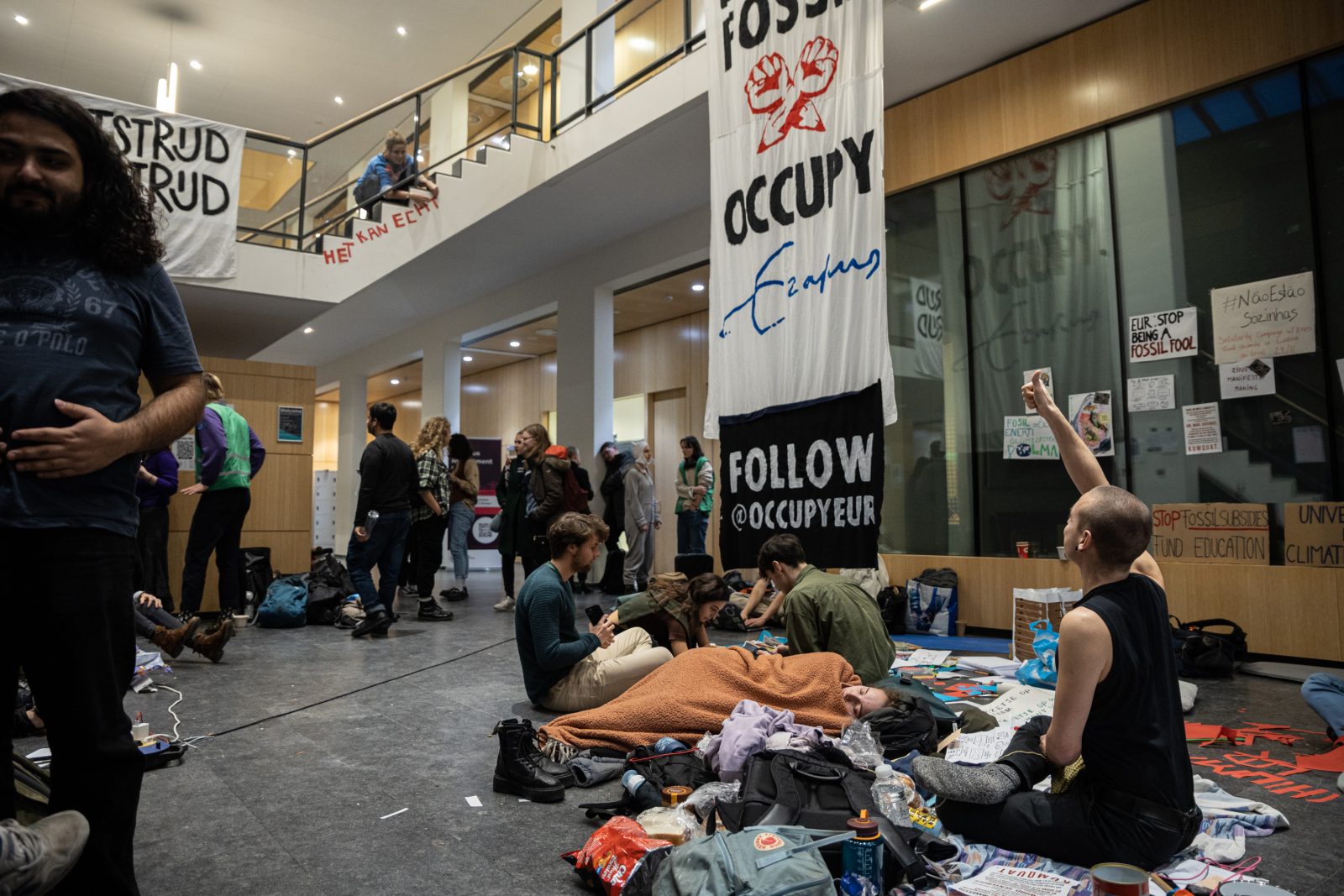
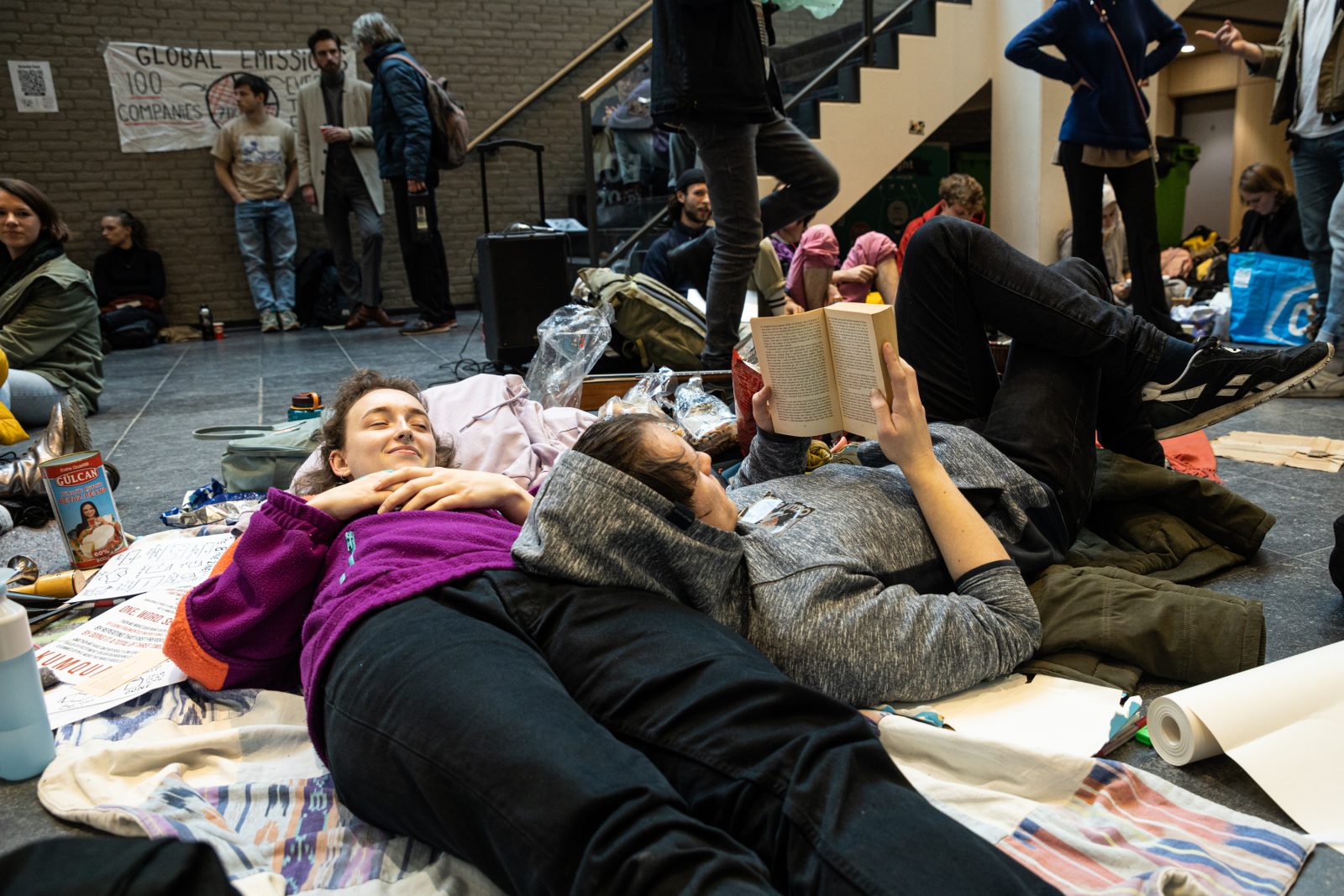
One of the activists takes a nap before dinner.
Image by: Wouter Sterrenburg
After a day of slogans, panel discussions and speeches, the protest in the Sanders Building was brought to a sudden end at 6 p.m. on Monday. The atmosphere had been easy-going up to that point, and the campaigners of OccupyEUR were looking forward to talks with the Executive Board. Those talks never happened, as security staff ordered everyone out, saying that anyone who did not leave voluntarily would be escorted out by the police not long after. Ten activists were eventually removed by the police. The university also cleared all the other buildings on the campus, much to the irritation of students.
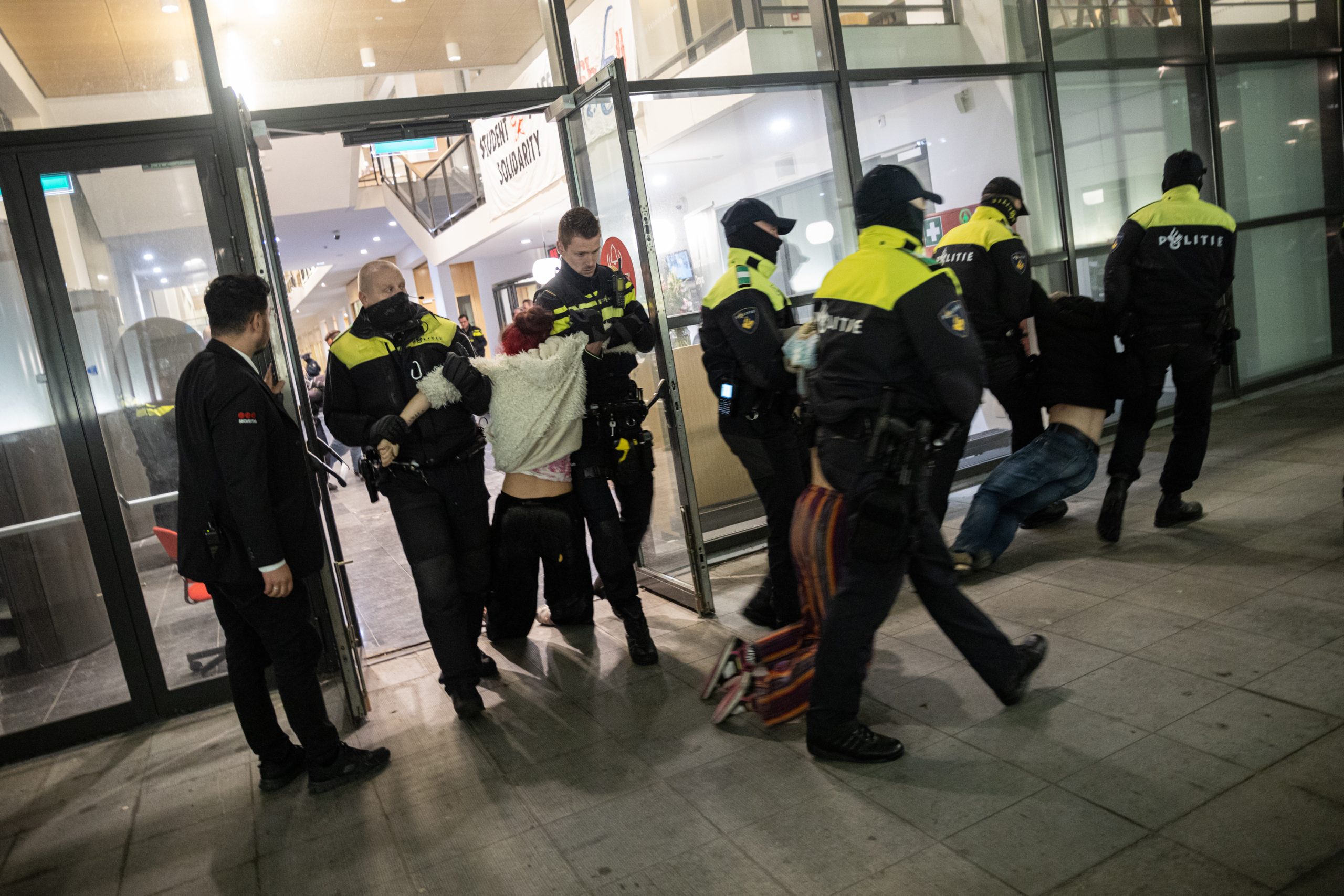
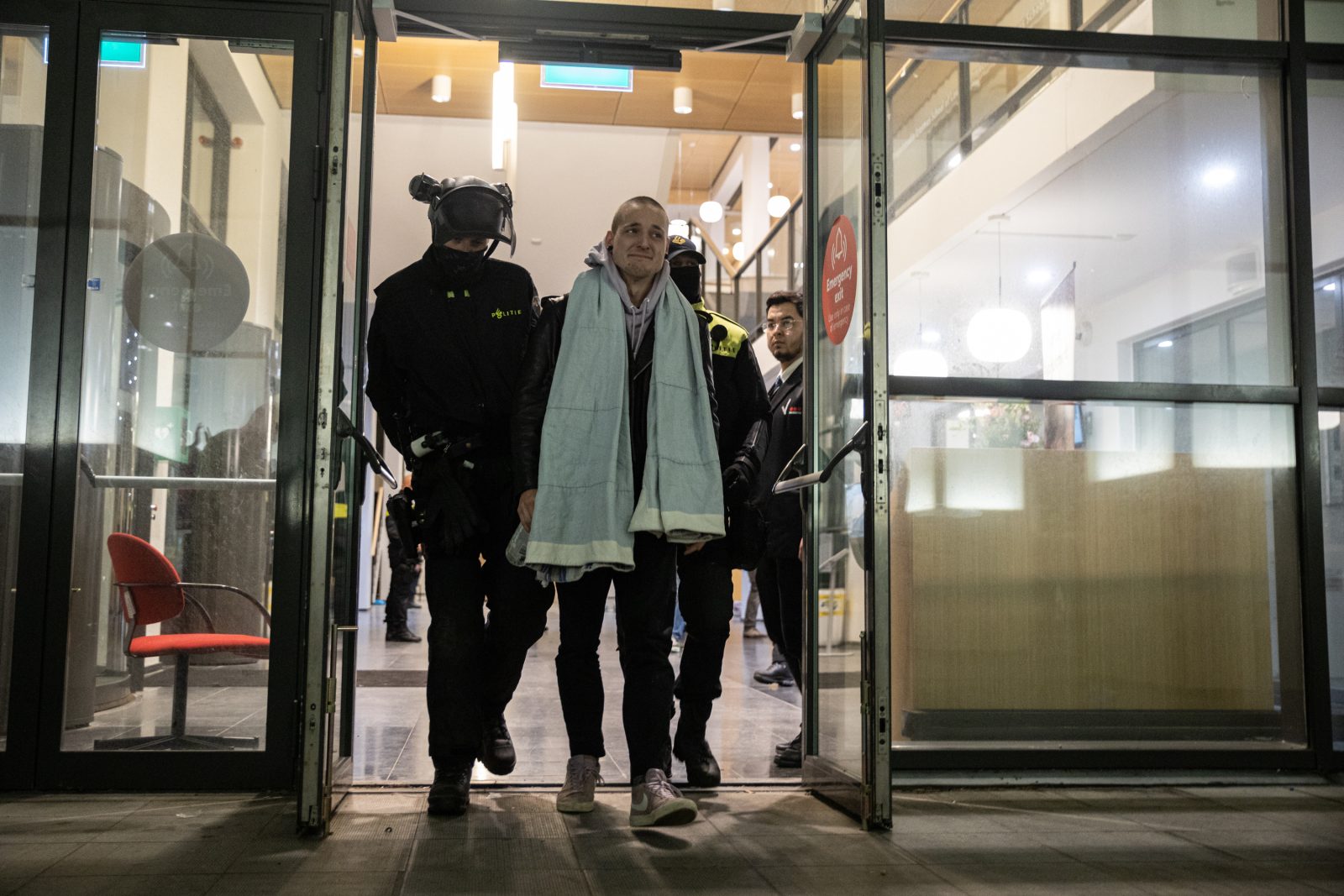
The police arrests the ten remaining attendees.
Image by: Wouter Sterrenburg
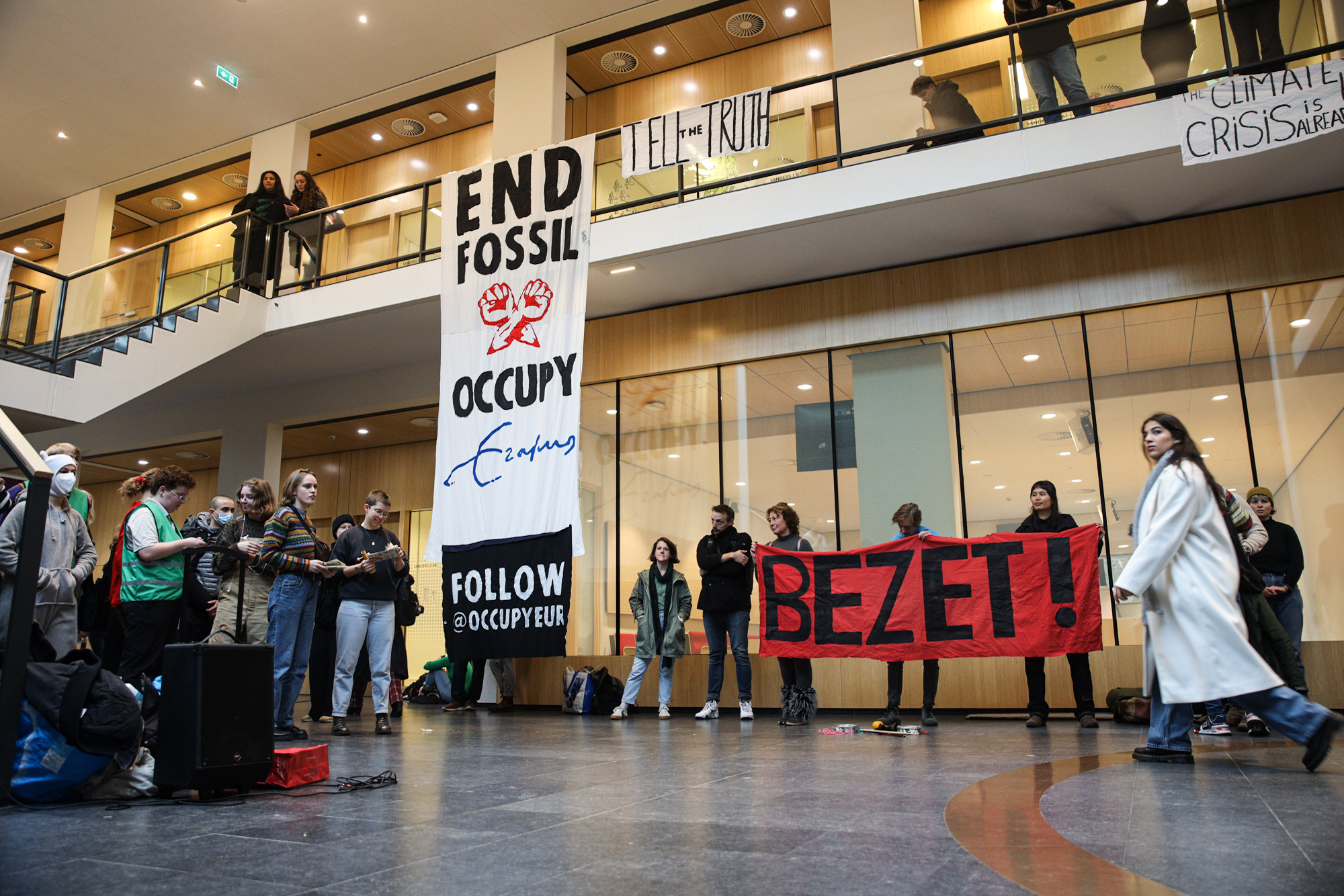
It is Monday morning, and things are busy around the entrance to the Sanders Building. Protest group OccupyEUR is ‘occupying’ the central foyer and demanding that the university cut ties with the fossil fuel industry. The demonstrators also demand an end to the precarious situation of researchers and teaching staff, an end to student debt and improved accessibility to teaching facilities. Banners are on display, and a large speaker has been set up next to the staircase, ready for a packed programme over the course of the day.
Read more
-
Activists occupy Sanders building Erasmus University
Gepubliceerd op:-
Campus
-
Problematic ties
Vatan Hüzeir, a PhD student at EUR, talks to demonstrators about the ties between the fossil fuel industry and the university. “We’ve researched those ties extensively in the past, and they were really deep-rooted. From studies drawn up by Shell with a view to bolstering support for gas extraction in Groningen to professors being paid hundreds of thousands of euros for research work that can be used to lobby for the abolition of dividend tax.”
Read more
-
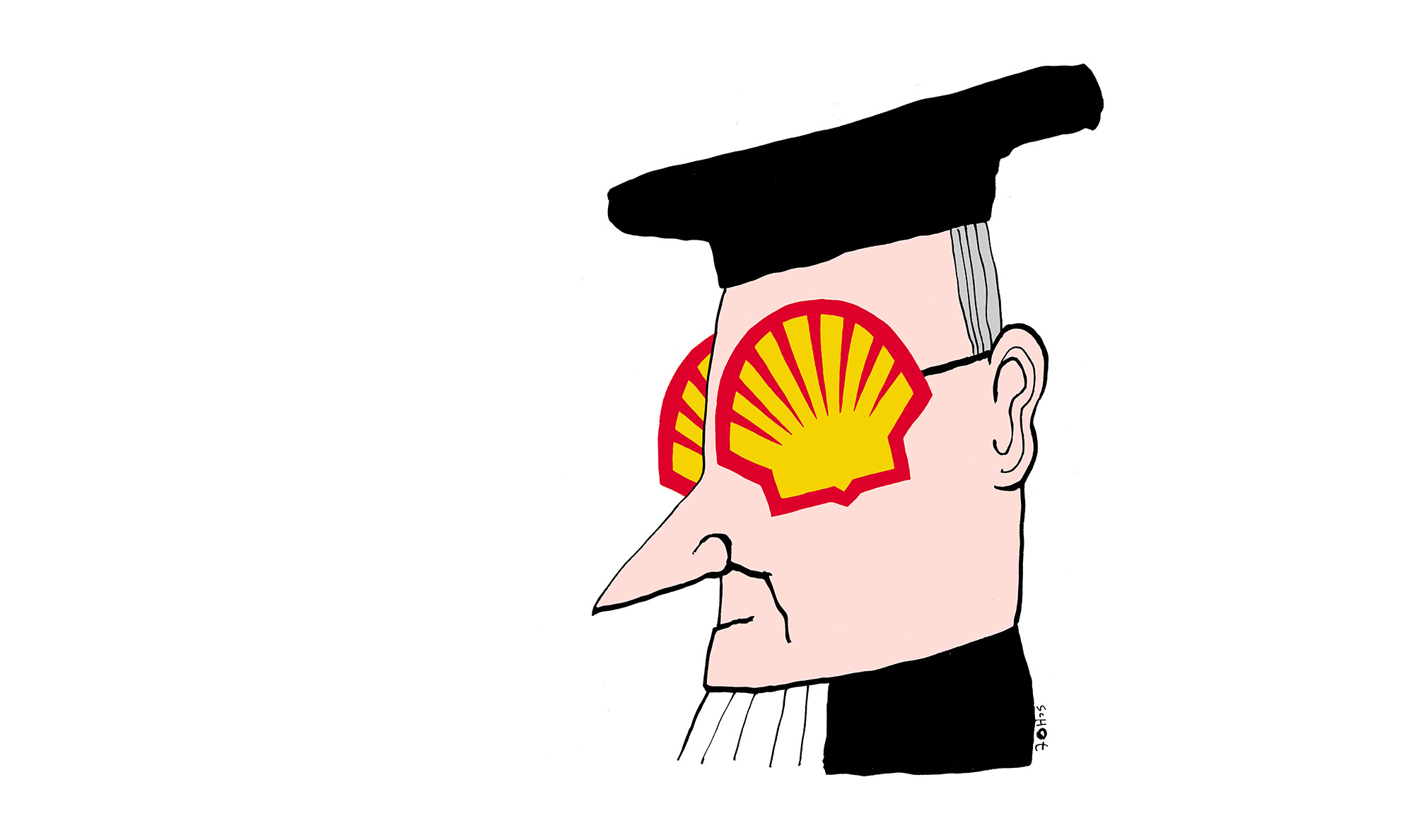
‘Shell able to influence design of RSM curriculum’
Gepubliceerd op:-
Research
-
The university cancelled a partnership agreement with Shell a few years ago, but Hüzeir insists that they still have close ties. “The university is wilfully avoiding transparency. In fact, it’s worse than that: if you seek clarity, you hit a wall of opposition. And yet Shell is a prominent sponsor at all manner of events, with their logo draped pompously in front of the Forum Room on campus.” Hüzeir deems this problematic, comparing the fossil fuel industry to the tobacco and arms industries. “They’re responsible for death and destruction. The university won’t partner with those other industries because they aren’t willing to support death and destruction, so why are they willing to get into bed with the fossil fuel industry? It has to stop.”
'Bloody nuisance'
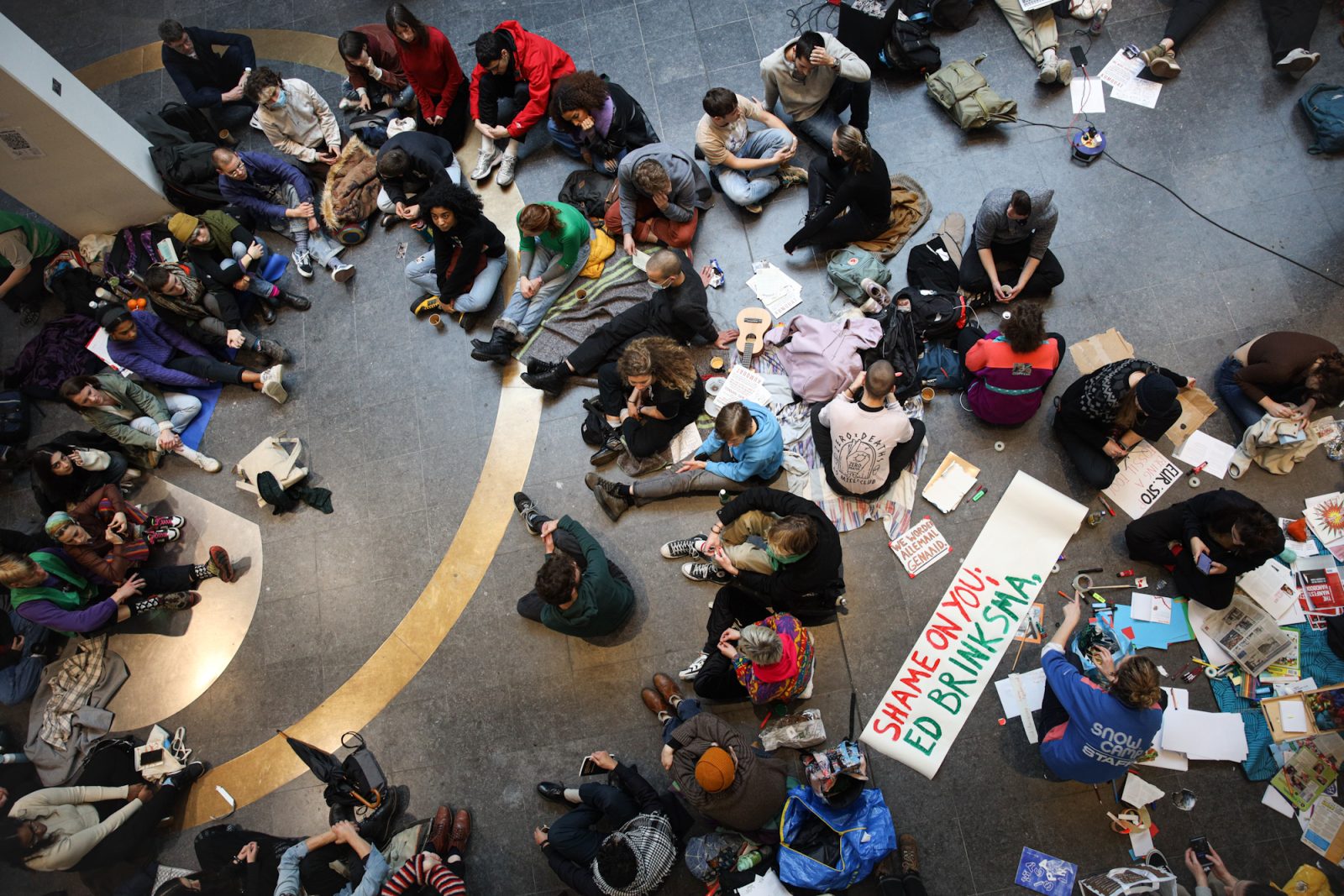
After the opening speeches by Hüzeir, Professor Alessandra Acuri and others draw to a close, campaigners spread out in the Sanders Building’s foyer. Some of them write messages like ‘Ed Brinksma, shame on you’ on banners or hand out flyers, while others read books or participate in a clothes repair workshop. The atmosphere is relaxed, with 60 to 70 campaigners on site, even if the foyer does get a bit crammed during break times or at the end of a lecture. A gaggle of econometrics students tries to weave their way through the campaigners. “Bloody nuisance”, one of them sighs.
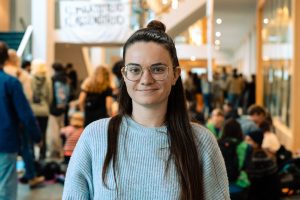
Arts and Culture-student Sinnead understands the action.
Another student, Sinnead (first year in Arts and Culture), thinks it is no big deal: “The only hassle was having to show my student card at the entrance. You can just take the stairs to your lecture. I think it’s a good thing that the campaigners are highlighting this issue. The way I see it, the university is being hypocritical by signing up to a climate agreement on the one hand and inviting people from Shell to speak and accepting sponsorships from them on the other.”
Impact
After a brief break for lunch, Professor of Social Theory Willem Schinkel takes to the microphone. He is hoping for a change of course too, “When it comes to impact, we need to completely rethink things. As a university, we’ve got the slogan ‘creating positive societal impact’, but ‘positive impact’ is also the slogan of Deutsche Bank. Automatically associating ‘impact’ with a positive contribution is problematic. If you subject the university’s historical impact to scrutiny, you’ll find that its contributions have been destructive at least as often as they’ve had a positive effect.”
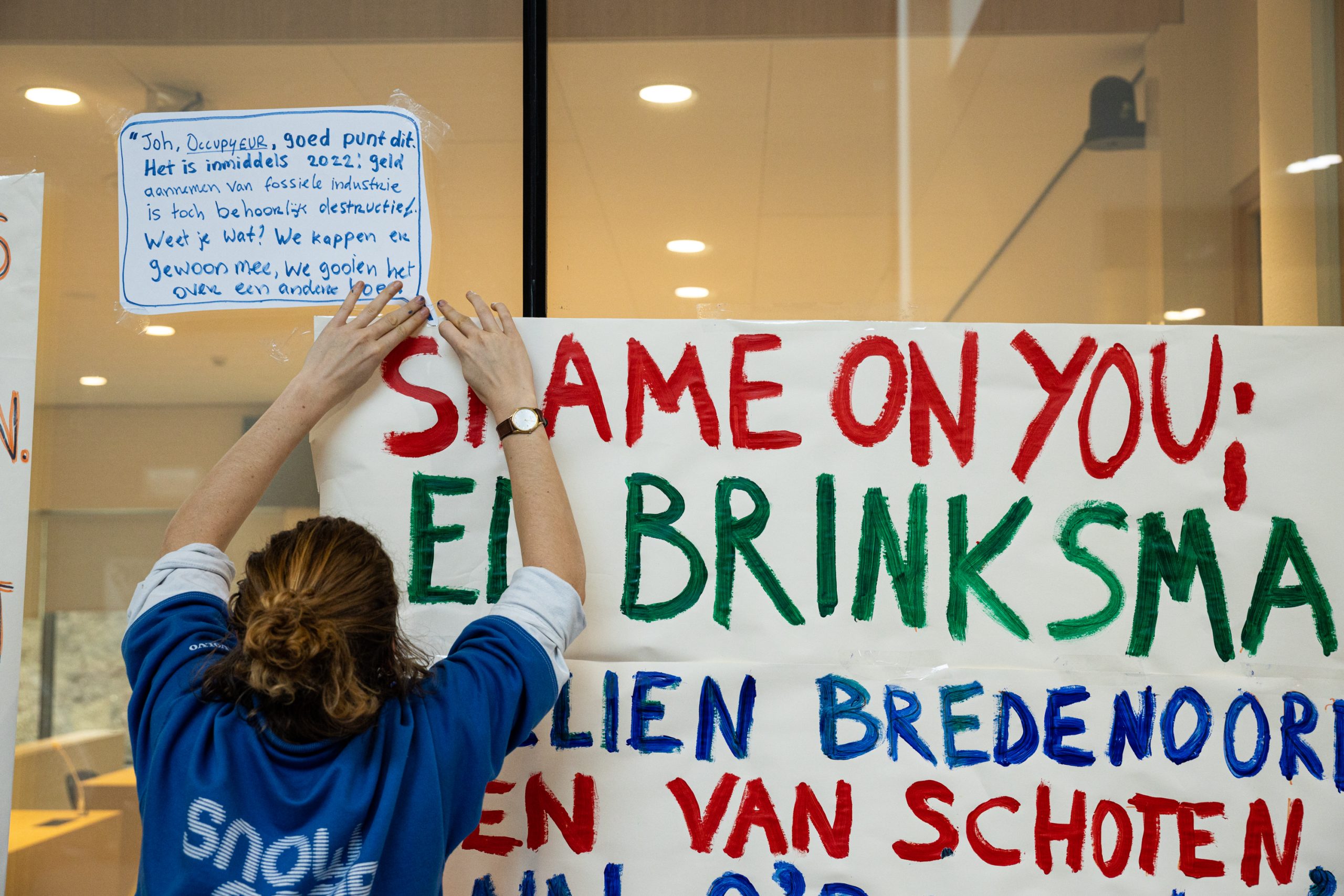
Throughout the day, students hang texts, protest signs and drawings on the walls and windows.
Image by: Wouter Sterrenburg
The professor takes the view that this fact ought to steer the relationships that the university forges and that collaborative efforts with Shell ought to be discontinued. Applause erupts. Elsewhere, a small band of people form a circle for a teach-in on the racist aspects of climate pollution. Alongside them, plenty of others are still writing, drawing and cutting to fill up the Sanders Building’s increasingly full walls.
Muddled communication
By 3 p.m., the police and special investigating officers next to the food plaza are clearly growing bored of the situation. The occupation is proceeding peacefully. The Executive Board is tolerating the protest; several hours earlier, it stated that it understands the campaigners’ motives and will gladly talk with them. That said, student cards and staff passes are being checked at the door.
This gives rise to a degree of friction from time to time, and there’s a lengthy discussion on whether or not the founder of Fossielvrij NL should be allowed in to take part in a panel discussion. Later on, one of the organisers is temporarily refused access despite his student card. A journalist from the Financieel Dagblad newspaper gets turned away too.
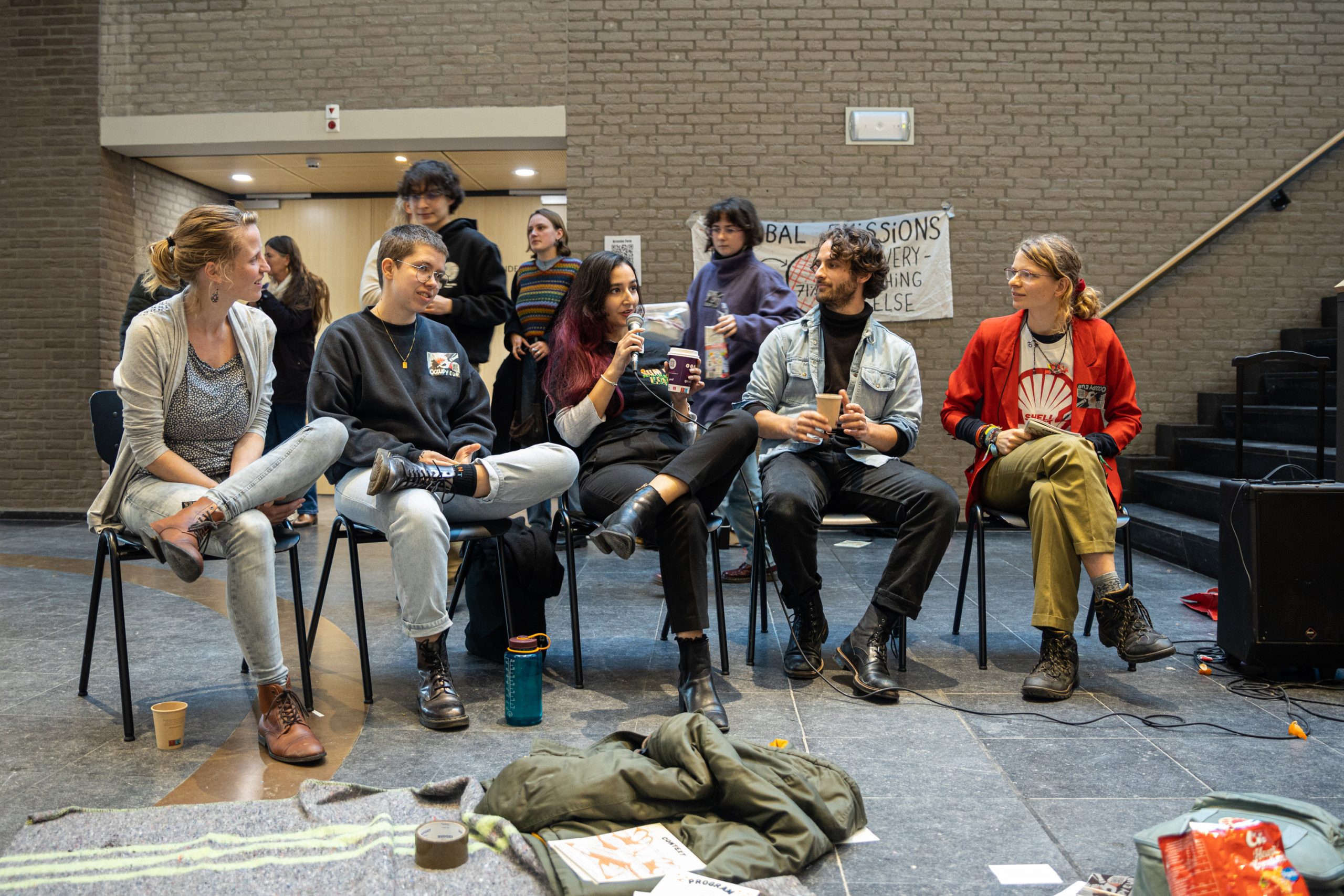
The panel discussion with Mina Morkoç (middle), EUR student and member of the municipal council for Groenlinks.
Image by: Wouter Sterrenburg
The programme for the day continues with a panel discussion, with the panel including law student and municipal councillor Mina Morkoç (GroenLinks party). She has submitted questions to the Municipal Executive on the ties between the university and the fossil fuel industry as well as on the accessibility of studying in Rotterdam. Morkoç: “It’s great to be able to discuss this with students, campaigners and politicians. There needs to be impetus on all fronts if we genuinely want to effect change.”
Riot police
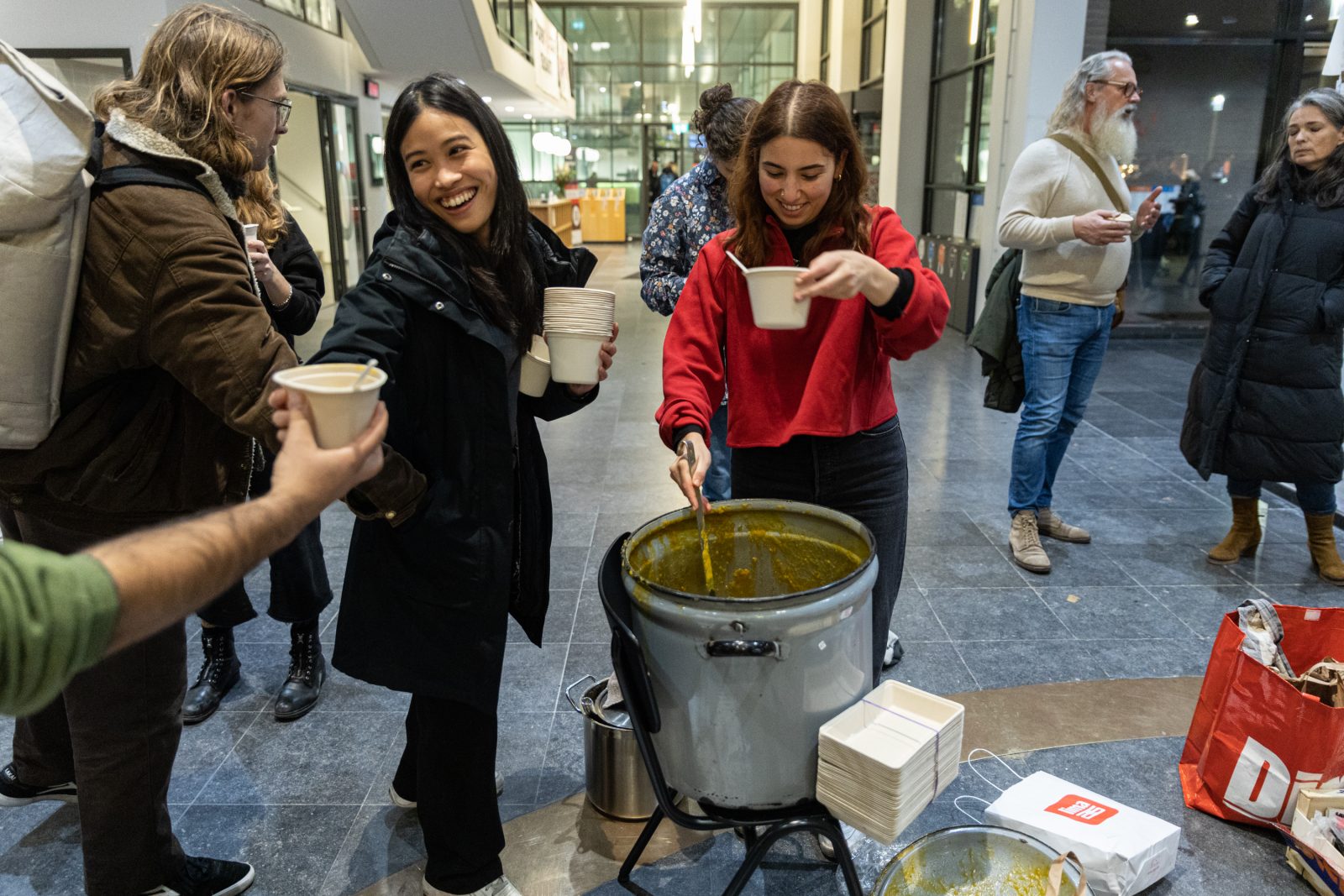
Whilst enjoying a bowl of soup, the campaigners prepare for a plenary session and the arrival of the university’s Board members. Just before the meeting is due to start, additional security staff and police suddenly flood in, and the entrance is closed off. The security team announces that the building is to be vacated and that anyone remaining will be removed by the police. Dozens of police officers and riot police officers stand ready behind them.
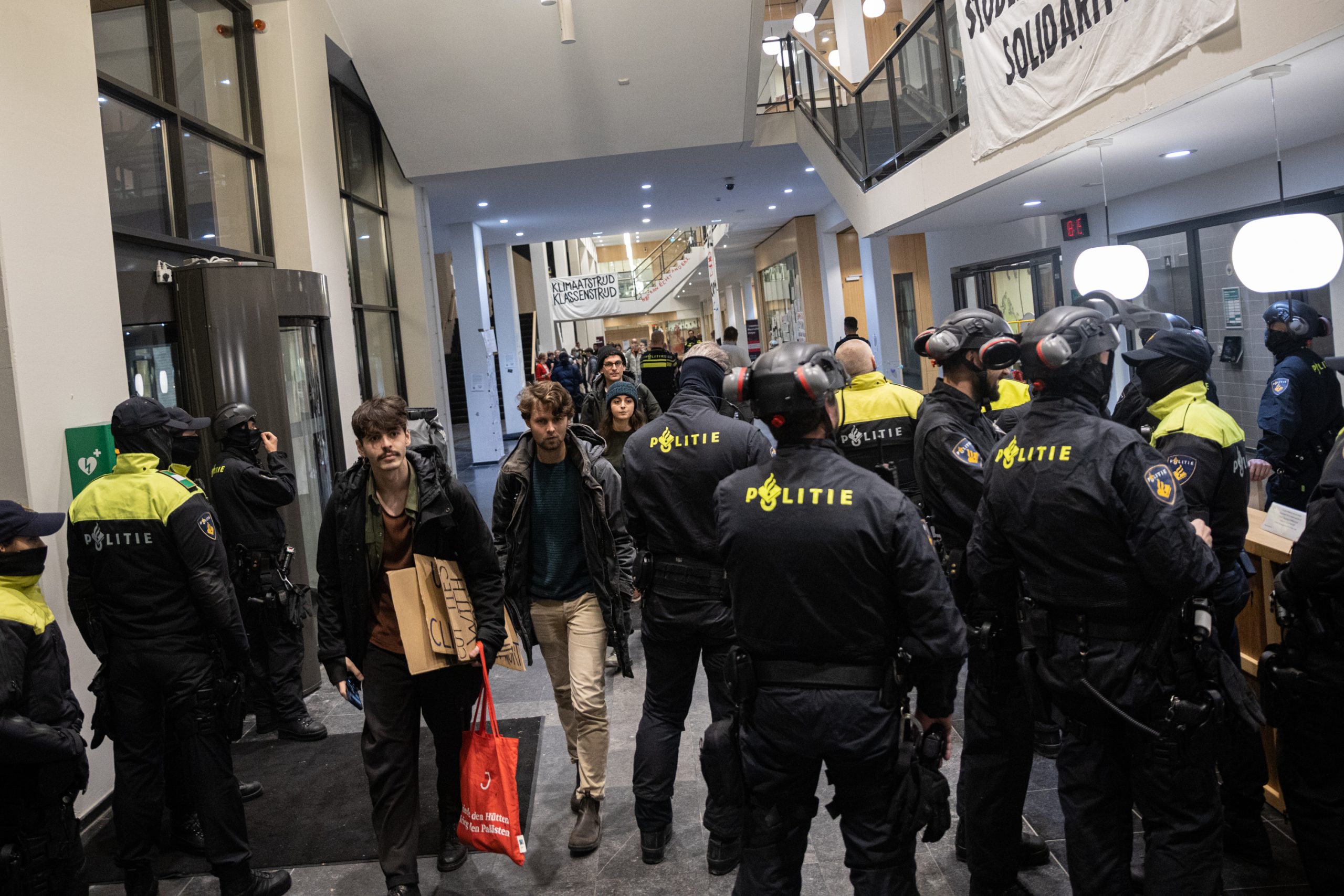
During the occupation, ctivists were given the choice of leaving voluntarily or being removed by the police.
Image by: Wouter Sterrenburg
Campaigners and organisers cannot understand why security and the police suddenly want them out. Hans Versluis, responsible for liaising with the police on OccupyEUR’s behalf, is dumbfounded, “We agreed this morning that there’d be a meeting with the Executive Board, which is abruptly being called off. A peaceful student demonstration is now getting dispersed by riot police on the university’s behalf. Evidently, the Board is unwilling to engage in dialogue.”
Most of the campaigners leave the building voluntarily, but 10 stay behind. A few moments later, the riot police pull them out by the arms, to loud condemnation from the demonstrators now standing outside. The 10 are released that same evening. Some of the students head over to the Erasmus Building to express their dissatisfaction by chanting in front of the entrance for a few minutes. ‘Erasmus Uni, shame on you!’ echoes around the square.
Bewilderment
The campaigners and the police leave between 7.30 and 8 p.m. Small groups of confused students wander round the campus everywhere, finding all the buildings suddenly shut. A few law and economics students exiting the Mandeville Building are at a loss as to what is going on. “There was an announcement that there was a non-urgent danger or something like that, but the demonstration is already over”, one of them says. “I just wanted to do some more studying on campus. It’s ridiculous that that’s not being allowed.”
Een lijst van afbeeldingen
De redactie
Latest news
-
EM TV newsflash: Shorter waiting time for medical interns, lively trade in graduation tickets and purchasing power increase
Gepubliceerd op:Article type: Video-
EM TV
-
-
In memoriam Rob van der Wal
Gepubliceerd op:-
In memoriam
-
-
Lively trade in tickets for graduation ceremony: ‘Excessive prices are undesirable’
Gepubliceerd op:-
Student life
-
Comments
1 reactie
Comments are closed.
Ad
Read more in Protest
-
Students will still be allowed to occupy a building, but perhaps not while masked
Gepubliceerd op:-
Politics
-
Protest
-
-
TU Delft will no longer pass activists’ names to police
Gepubliceerd op:-
Privacy
-
Protest
-
-
Pro-Palestinian protests in student cities
Gepubliceerd op:-
Protest
-
Helena op 2 December 2022 om 14:41
I’m really curious about the university’s ties with fossil fuel companies. I think it would be great if some sources on that were published. Or are they already somewhere?