This is why the buildings on campus have these letters

What is the logic behind the names of the buildings on the Woudestein Campus and the letters assigned to the rooms in those buildings? Is there any logic behind them whatsoever? After all, the Tinbergen Building is not the same as the T Building. The letter T, for some reason, goes with the Mandeville Building. For its part, the M Building is the Van der Goot Building. And H Building is not the Hatta Building, as you might expect; actually, it’s the Tinbergen Building. Where did it all go wrong?
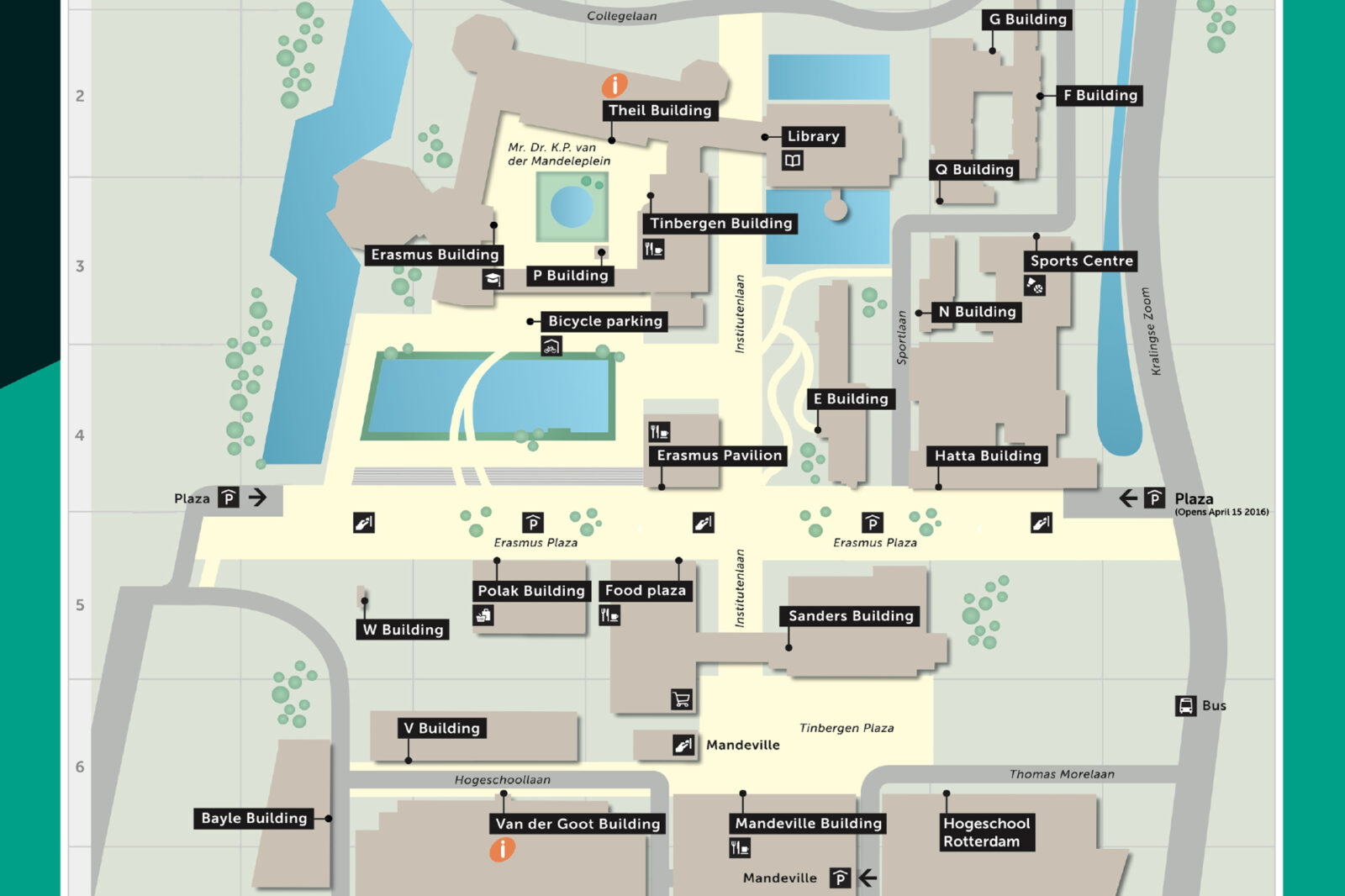
EUR’s walking and talking collective memory, Cora Boele, the Academic Heritage Project Leader, explains. First, though, let’s have a look at this overview:
A Building = Erasmus
B Building = Library
C Building = Theil
D Building has been demolished. This used to be an official residence. (The Dutch word is dienstwoning)
E Building = E Building
F Building = F Building
G Building = G Building
H Building = Tinbergen
I Building does not exist.
J Building = Bayle
K Building does not exist.
L Building = Sanders
M Building = Van der Goot
N Building = emergency building (the Dutch word for ‘emergency’ starts with N)
O Building does not exist.
P Building = P Building
Q Building = Q Building
R Building does not exist.
S Building = Sports Centre
T Building = Mandeville
U Building = Hatta
V Building = V Building
W Building = Security booth at the entrance
X Building = Erasmus Pavilion
Y Building = Polak
Z Building does not exist.
For many years, the buildings on the campus were unnamed. When the Woudestein Campus was opened in 1968, the first buildings to be put to use were only known by letters. These letters corresponded to the Dutch words for their functions. For instance, A Building held the Administratie (record-keeping department) and the Aula (auditorium), C Building was home to the Collegezalen (lecture theatres) and B Building held the Bibliotheek (library), while S Building was home to the Sportcentrum (sports centre). The H in H Building is derived from Hoogbouw (high-rise building). The square between A, C and H used to be called P, for ‘patio’. When offices were built under the square, they formed the P Building together.

Image by: EURmemes
“When the new buildings were constructed, they used up the next letters in the alphabet,” says Boele. She has to admit, though, that there is no rhyme or reason to the naming procedure. ‘I’ and ‘K’ do not exist, and the M Building is older than the J Building. “It’s impossible now to find any information on why things were done that way.”
The actual name-names were introduced in 2012. Then EUR Rector Magnificus Henk Schmidt came up with the idea of giving the buildings actual names, which was already customary at other universities. The deans of the various faculties were tasked with deciding together which buildings were to be named, and what names they were to be given. “The dean of the Faculty of Economics insisted on the building in which his faculty was located, which was then known as the H Building, being named after the economist and Nobel Prize laureate Jan Tinbergen.” So the H Building was rechristened the Tinbergen Building, but its room numbers still start with H.
This is why the letters denoting the buildings do not correspond to the first letters of the buildings’ names.
Lees meer
-
The royal toilet and seven other secrets about the massive concrete blocks on campus
Gepubliceerd op:-
Campus
-
De redactie
-
 Tessa Hofland
Editor
Latest news
-

Letschert gives nothing away in first parliamentary debate
Gepubliceerd op:-
Education
-
Politics
-
-

Away with the ‘profkip’, says The Young Academy
Gepubliceerd op:-
Science
-
-

House of Representatives wants basic grant for university master after HBO
Gepubliceerd op:-
Money
-
Politics
-



Comments
Comments are closed.
Read more in Campus
-
Letschert gives nothing away in first parliamentary debate
Gepubliceerd op:-
Education
-
Politics
-
-
House of Representatives wants basic grant for university master after HBO
Gepubliceerd op:-
Money
-
Politics
-
-

Company takes a huge chunk of the student finance of at least 350 internationals
Gepubliceerd op:-
Internationalisation
-