Ad

‘I think that paper newspapers will be gone by 2020’
Goodbye paper, hello online. It’s a trend that has been unfurling for some time in the media landscape. Leaving the question: do users actually want this digital news revolution? Or are they still attached to fixed delivery moments, the feel of paper and subscriptions? EM asked five 20-year-old experts. “I think that paper newspapers will be gone by 2020.”
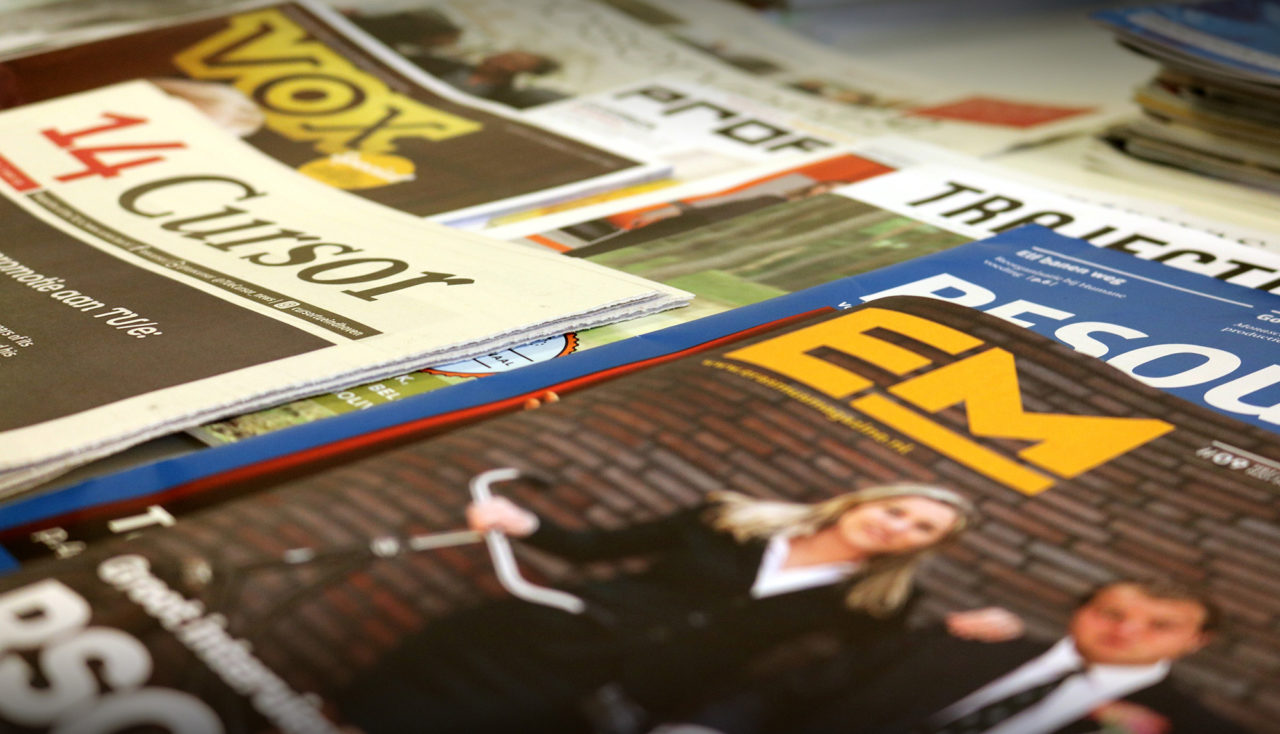
Verschillende edities van Nederlandse universiteitsmedia.
Image by: Elmer Smaling
Dean Bessems, IBCoM
Image by: Geisje van der Linden
Media consumption
News on TV: ‘Once in a while, when I’m on the couch with a plate of spaghetti.’
Paper: Hardly ever
News sources: Google, professional journals
Subscriptions: No
Pay for news: ‘Hardly ever, and definitely not for things I’m not really interested in anyway.’
“The only paper news medium I read occasionally is the free daily Metro – on the train. Apart from that, it’s all digital. Most of the time, I rely on Google’s suggestions. Google makes a selection based on which websites I’ve visited and articles I’ve read. It works perfectly: I get exactly the stuff I’m interested in reading. That’s why I never buy a newspaper. I’m definitely not paying for all those articles that don’t interest me anyway.”
“I think that paper newspapers will be gone by 2020. It’s completely outdated. Even my father has switched to a digital subscription – it’s so much cheaper. And hardly anyone my age reads a newspaper anymore. I hardly watch TV either. If I want to see something, I’ll check it out online later on.”
“I want to access information that interests me personally, including longer articles. I have no problem paying for that. My generation doesn’t mind paying for news – we just don’t want to pay for the entire newspaper. The next generation won’t be used to paying for news at all.”
“It’s not a bad thing at all that the entire landscape is changing for the traditional media. It’s more or less inevitable. When people no longer have use for something, it simply disappears. You can find so much bitesized and good information online.”
Rose Li, BSc² in Econometrics & Economics
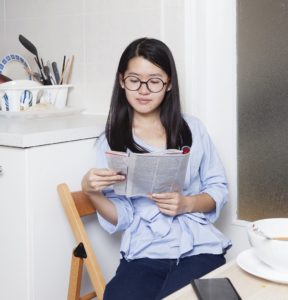
Media consumption
News on TV: ‘Never. I don’t even have a set.’
Paper: Occasionally
News sources: The Economist / National Geographic /WeChat
Subscriptions: Yes
Pay for news: Yes, but not that many
“I really enjoy reading from paper. It’s a more pleasant reading experience, less fleeting. I can save clippings, add notes and it’s easy to find them later on. When I read information online, I’m afraid I’ll lose track of it. I have two magazine subscriptions: The Economist and National Geographic. They both deal with specific themes: economic developments and our environment. ”
“In fact, that’s precisely why I pay for those two magazines. Because when I’m paying for news, I don’t want to be bothered with subjects that don’t interest me – like you get with newspapers. And that’s also why I don’t pay for news. It would be a shame, because I’d be spending that money for nothing. One time, I checked out how much a subscription to the Financial Times costs, but it was way too expensive.”
“As far as social media are concerned, I mainly use WeChat. That’s a Chinese platform that rolls the different functions of WhatsApp, Facebook and Instagram into a single package. I mostly use it to stay in touch with Chinese friends and stay up to date on Chinese news. In WeChat, you can choose what you want to read by registering for specific channels. That’s ideal. It means the media don’t constantly hassle you with other news.”
“I don’t have a television set, but that isn’t a problem. I stay up to date via other channels. I never watch the news on TV either. I wouldn’t even if I did have a TV set.”
Read part 2
-
‘EUR should offer students a free newspaper subscription’
Gepubliceerd op:-
20 Years of EM
-
De redactie
Latest news
-
TU Delft may not favour women in admissions to courses
Gepubliceerd op:-
Education
-
-

Hate campaigns and political pressure: KNAW wants legal protection for academic freedom
Gepubliceerd op:-
Science
-
-
Signing up for a Dutch course ‘feels like a race’, no more places available for now
Gepubliceerd op:-
Internationalisation
-

Comments
Comments are closed.
Ad
Read more in 20 Years of EM
-
Bike ride through Africa took this medical student all over the world
Gepubliceerd op:-
20 Years of EM
-
-

Samuel Scheimann studied Psychology in Rotterdam, today he is a pro football player in Israel
Gepubliceerd op:-
20 Years of EM
-
-
‘I don’t regret giving up my studies’
Gepubliceerd op:-
20 Years of EM
-