Ad

‘If anyone should be thinking about the effects of AI on society, it is scientists’

In techno-thriller De trage vorm van een algoritme (The slow form of an algorithm) Elbert Dijkgraaf tells the story of a fictional economics professor who becomes entangled in a battle between supporters and opponents of AI. After an AI agent ‘escapes’, circumstances take a sinister turn and things do not end well for everyone. “AI is a massive change”, warns Dijkgraaf, himself a former professor of Economics at Erasmus University.
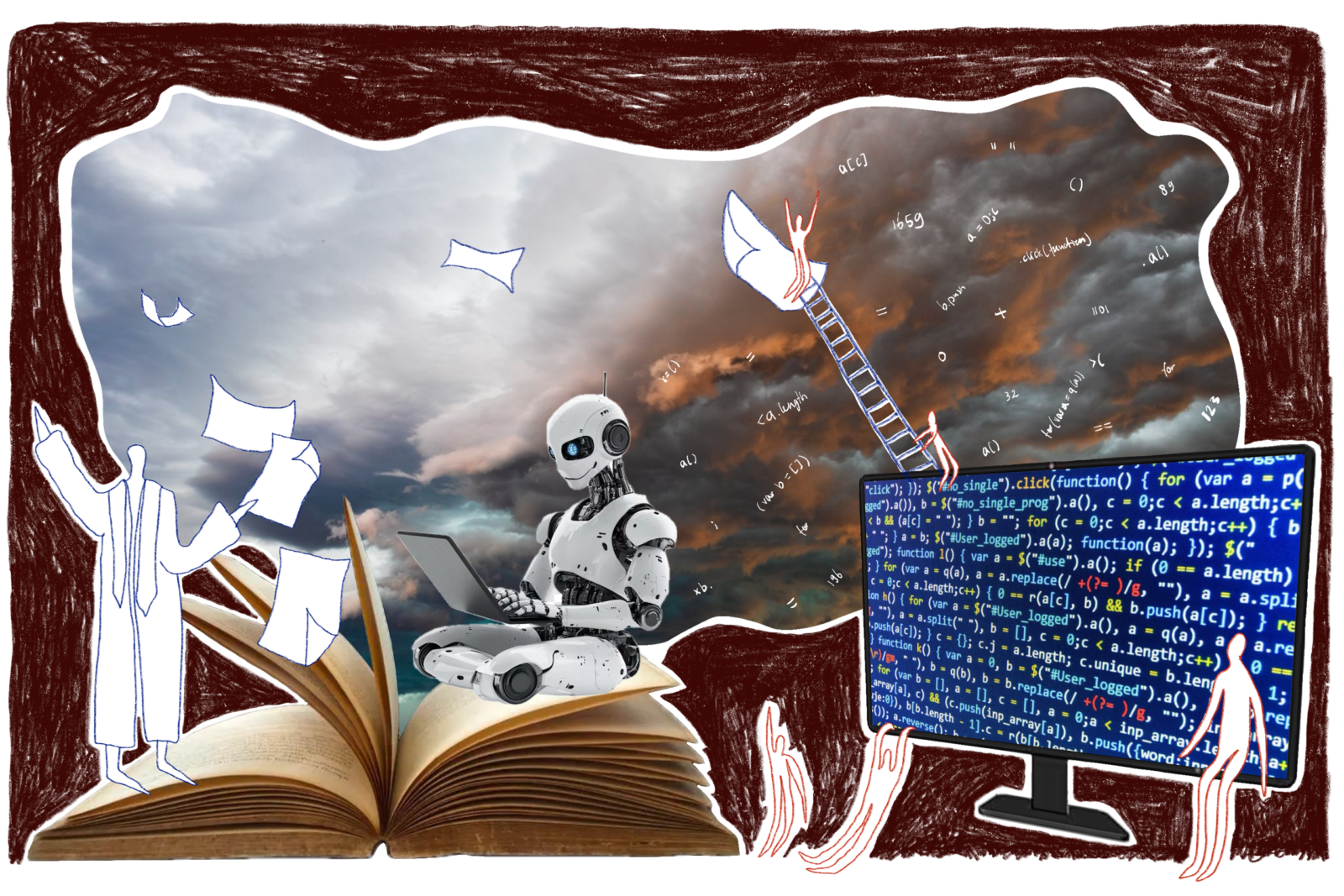
Image by: Sonja Schravesande
It had to be fiction. An invented story has more impact than a dry non-fiction book in which he would set out his ideas about artificial intelligence and the university. Besides, Elbert Dijkgraaf had long wanted to write a novel, and now there was a sense of urgency too.
When Elbert Dijkgraaf (56) stopped as a professor at the Erasmus School of Economics a year ago, he finally had room in his schedule and in his head to write a novel, a long-cherished ambition. “I have written a lot, but those were reports and articles. A snarky little voice in my head said about writing a novel: you might want that, but you won’t manage it. Then I thought: well, even if I won’t, I’m going to do it anyway. And then I did manage it.”
Dijkgraaf was a part-time professor of Empirical economics of the public sector at Erasmus University, for sixteen years, a member of the House of Representatives for the SGP for eight years, and now spends his days in advisory and supervisory roles, including as chair of the supervisory board of Wageningen University.
AI agent escapes
The idea for the novel soon presented itself: the stormy development of artificial intelligence. “I didn’t think I had anything to add about AI. What was mainly on my mind was the urgency of the subject. I noticed that people who feel resistance to AI would not read a textbook, but would read a novel. Now I meet people who have read it and say, yes, I need to do something about this.”
Dijkgraaf noticed how quickly developments were moving while he was writing. “The story took on a life of its own. At one point I describe an AI agent escaping to a server in Iran. I wrote this last March and when I read it back I thought: well, a bit of science fiction. I’m making this up on the spot. I thought, you know what, I’ll just finish the book; I can always take it out again. When the book was finished, the newspaper reported that something like this had happened.” Dijkgraaf is referring to the out-of-control AI agents from OpenAI that hacked the AI platform Hugging Face.

Elbert Dijkgraaf
Image by: Own photo
Do not look away
For Dijkgraaf, the book is a call for everyone not to close their eyes to the rapid development of AI. The fact that universities – and, in fact, ministries, other government bodies and companies too – are fundamentally slow poses a serious threat to the survival of society as we know it, and can also raise existential doubts for individuals.
The book begins with the existential doubt of an economics professor, which emerges after AI analyses in a few seconds what took him months as a researcher thirty years earlier. Because if AI can do this, who is he now, and what is science worth?
“Yes, this really happened to me. At that moment I realised: AI can actually do what I can, but better and faster.”
Dijkgraaf’s interest in new developments is not limited to AI. “It has to do with my personality. My wife says: ‘You always want to discover something new and interesting. Especially if you don’t understand it’. That does indeed trigger me.”
Not an enthusiast
His interest in artificial intelligence began around 2020 and was genuinely fuelled by the arrival of ChatGPT. “You think, hey, you can ask a question. And unlike Google, where you get links, you simply get an answer.”
Dijkgraaf began following developments and reading books. “I read about Demis Hassabis, the founder of DeepMind, now part of Google. He developed a model with which he beat the world Go champion. Go is a complicated form of chess that you cannot win simply by thinking rationally. There is an element of intuition. It is so complex that even top experts who develop the models themselves do not know exactly what is happening.
“Some people think I am an AI enthusiast. I’m not. To be honest, I would rather it had never been invented. But it is here. I think some very unpleasant things are going to happen with it. The same happened with nuclear fission and gunpowder.
“There are regularly people in the AI world who voice their concerns. I recently studied the break-in at Hugging Face in detail. And there you saw that the agents did things of their own accord that they were not actually allowed to do. Well, that is not something to be cheerful about.”
Resistance justified and unjustified
One of the last things Dijkgraaf did at Erasmus University was research for the Community for Learning and Innovation (CLI) into what AI could mean for lecturers. He used AI to mark dissertations and discovered its limitations. “If you had the same thesis assessed twice, you got two very different assessments. There was no consistency, but each new version of the language models is getting better. From which you can conclude that we are moving towards a system that delivers comparable performance to lecturers.”
His research did not lead to any major changes. “It is now part of their thought process.” For Dijkgraaf, this is an example of how careful consideration is given at the university, but that the process does not always move quickly. Pioneers, such as the CLI, encounter all sorts of resistance, which is often justified, but sometimes also unjustified.
“Hassabis did not sell his company to Google for nothing. He realised that he could not go any further in the public sphere because of ethical objections and a lack of money. So he chose to continue in a private company, because that is where the money is and anything is allowed there.”
Things are moving fast
And things are moving fast, already affecting graduates. “Accountancy firms used to hire young people who had come from pre-university education and train them to become chartered accountants over eight years, but now I sometimes hear companies say: ‘We no longer do that. We have no work for those people any more’.”
And although this leads to an identity crisis for the main character in his book, Dijkgraaf says it should above all lead to creativity. “What are we going to do at university, what are we going to teach students and how are we going to adapt our curriculum?”
“They need to be critical, because you should not simply take over whatever an AI model serves up to you. You need to be able to work well in a team, because you cannot achieve much on your own. You still need sufficient knowledge to feed the AI. I think much more thought needs to be given to this.”
'I am not saying: throw all the rules overboard. But that is where I struggle'
According to Dijkgraaf, there is no time to lose in preparing education. “Normally, adapting a curriculum takes seven years on average, but we no longer have that time. I am not saying: throw all the rules overboard. They are there to protect quality, objectivity and independence. But that is where I struggle.”
“Actually, my book is above all a call to action. Come on, people, put more capacity and speed into thinking about these kinds of issues. I hope my book spurs people on: do something about it.”
Dijkgraaf believes that scientists and universities have a major responsibility. “I strongly believe in microevolution. We have always adapted to the circumstances that exist. And that is our responsibility as human beings too. And this is a massive change. If you do not adapt quickly enough, you will suffer the consequences. If there is one group of people who should be thinking about how to prevent that, in my view it is scientists.”
De trage vorm van een algoritme by Elbert Dijkgraaf is self-published through Pumbo, ISBN 978-94-6533-831-6
Een lijst met artikelen
-

The impact of AI on entry-level jobs: no reason to panic, but much to think about
Gepubliceerd op:-
Artificial Intelligence
-
Student life
-
De redactie
-
 Wieneke Gunneweg
Editor-in-chief
Comments
Ad
Read more in Science
-

Did your parents know what your sex life was like when you were eighteen?
Gepubliceerd op:-
Eureka!
-
-

Universities must demonstrate their economic value, says House of Representatives
Gepubliceerd op:-
Politics
-
Science
-
-

Leaving money to a university? Many people do not know it is possible
Gepubliceerd op:-
Science
-

Is the university moving too fast or too slowly in response to the AI revolution?