Ad

‘With gadgets like Meta Glasses, we pay to be surveilled’

Glasses that are barely distinguishable from ordinary Ray-Bans, but can make videos, take photos and have a built-in AI assistant that peeks along: Meta Glasses came onto the market in 2023. Around seven million of these ‘smartphones in the shape of glasses’ have already been sold worldwide, and they have been available in the Netherlands since last year. Marc Schuilenburg sees a dark side to the handy gadget: “The promise of convenience ends in paranoia and a false sense of security.”
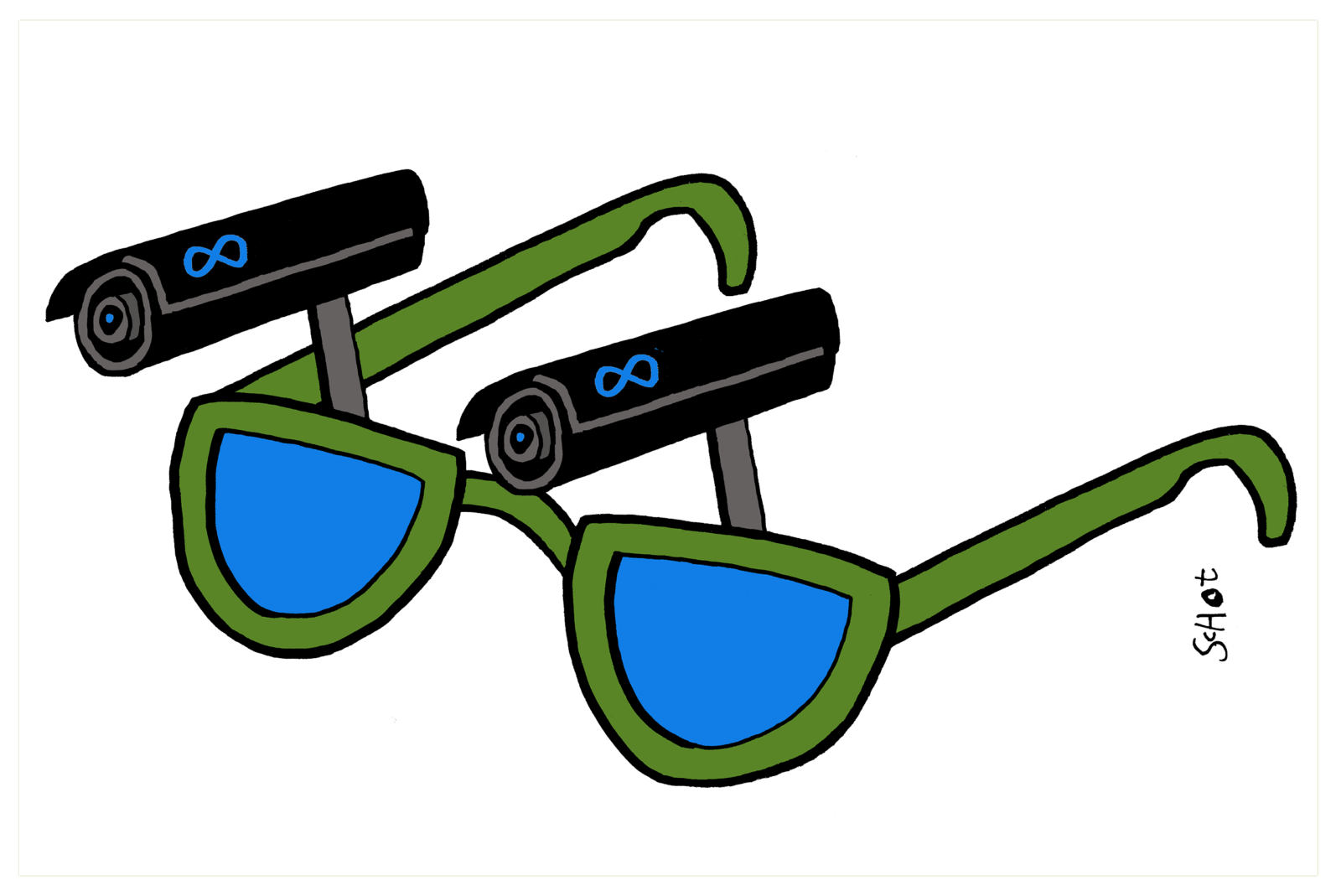
Image by: Bas van der Schot
What are Meta Glasses?
Meta Glasses are smart glasses with built-in cameras, microphones and speakers, allowing you to take photos and videos, make calls, listen to music and talk to an AI assistant. The glasses connect to your smartphone and have no screen: you receive information mainly through sound and speech. The cameras use your field of vision as input for the AI assistant. The glasses are therefore a kind of smartphone interface for the real world, without you having to constantly take out your phone. Meta developed the gadget together with eyewear manufacturer EssilorLuxottica, known for brands such as Ray-Ban and Oakley.
Marc Schuilenburg is professor of Digital Surveillance at Erasmus School of Law. He researches the consequences of AI and surveillance technologies for power, security and society.
Meta sells the glasses as a useful tool. What is your view on that?
“Meta AI Glasses are part of a long line of gadgets sold with the promise of convenience, efficiency and security, which I describe as ‘luxury surveillance’. Similar to devices like Fitbit, Apple Watch, Amazon’s Ring doorbell and robot vacuum cleaners such as the Roomba.
Surveillance is about watching and being watched. In the social sciences, we’ve always associated that with security cameras, scanners at airports, police bodycams or the Chinese government: externally imposed surveillance. But citizens buy these products themselves, and they are willing to pay a great deal for them. These are gadgets initially marketed as exclusive products for a wealthy upper class. Eventually, they become cheaper and are normalised and made available to everyone. A Ring doorbell once cost hundreds of euros; nowadays, you might say you get one for free when you take out home insurance. That’s how we pay for surveillance on ourselves.”
What’s problematic about that?
“Not so much the fact that cameras are constantly switched on everywhere. We have already become used to that through other gadgets, such as smartphones, and it is now almost impossible to move anonymously through public spaces. It becomes a bigger problem when the footage is linked to other databases by AI, and machine-learning algorithms then determine that some groups are ‘trusted’, while others are seen as ‘unknown’.
As a result, all kinds of people are labelled ‘suspicious’ in advance
“The Ring doorbell, for example, has a ‘familiar faces’ function, or automatic facial recognition. It is highly likely that Meta Glasses will acquire such a function too. The feature decides what is familiar. What is not familiar is therefore automatically viewed as suspicious. But recognition is not a neutral process; it is shaped by long-running cultural and political processes, which are also embedded in those algorithms. As a result, all kinds of people are labelled ‘suspicious’ in advance, encouraging all kinds of stigmatising categories, from ‘youths hanging around’ to ‘illegal immigrants’.
Who legally owns the footage captured by Meta Glasses?
“Meta asks whether you want to share data to improve or personalise the product. You need to switch on that option to use certain features of the Glasses, such as sharing photos and videos with friends using voice control. That means your footage ends up with Meta. In this way, as a user, you are effectively working for the tech company for free. Meta uses that footage to train its AI further, and there is a whole infrastructure behind that. From energy-guzzling data centres to the people who have to view and label the footage for starvation wages.”

Image by: Bas van der Schot
Both Meta Glasses and the doorbell store footage of people without their consent. Is that not a serious breach of the GDPR, the European privacy law?
“Absolutely. But it happens on such a large scale that the Dutch Data Protection Authority, which is supposed to enforce the rules, cannot do anything about it. By now, 1.6 million Dutch households have a smart doorbell. That cannot be monitored. As a result, these companies have to meet far lower legal and ethical standards than, for example, the police. That is paradoxical: tech companies are increasingly taking on public responsibilities such as security, while the safeguards that apply to the police don’t apply to these companies to the same extent.”
Can’t we ban companies such as Meta from building these kinds of functions into their products?
“The EU is trying to impose stricter requirements through the AI Act. But it is constantly lagging behind developments. And it is difficult that these products are mostly made in the US, from which we have little to expect in terms of legislation and regulation.”
Should we also be concerned about the entanglement between these commercial companies and the state, examples of which can already be seen in the US?
“Amazon was once a bookshop. It now makes enormous profits from its security products. We should also remember that Amazon Ring worked with Axon and Flock Safety. These companies provide automated surveillance technology to US police departments. Flock, in turn, shared data from its nationwide camera networks with the immigration service ICE. With a smart doorbell, Amazon is thus building an entire AI infrastructure that no longer has anything to do with the traditional function of ringing the bell and opening the door.
“Things work differently in the Netherlands. By law, the police here may request data going back up to four years, but only if there is suspicion of a criminal offence. Citizens can voluntarily register their cameras with the police, which can use them in cases where there is suspicion. The police may only compel people to share camera footage through an official legal order from the public prosecutor.”
How should society deal with the introduction of Meta Glasses and similar gadgets?
“There is barely any public debate about this in the Netherlands. There are some organisations, such as Bits of Freedom, that are alert to these issues, but there really needs to be more critical discussion. People need to become more aware of the AI infrastructure behind the convenience products they use, of their data, where it goes and what the social consequences are.”
How do you see this technology developing?
“For a study I did together with two students, we spoke to people in four Rotterdam neighbourhoods who use the Amazon Ring. This showed that the promise of convenience and security mainly leads to paranoia and a false sense of security. Such a device keeps beeping whenever something or someone it does not recognise passes by. As a user, you are constantly being alerted to potential threats. That makes you anxious.
“I think this technology will become increasingly integrated into all kinds of consumer products, and that there will be more and more links between those databases. Think of camera-equipped drones constantly flying over our heads, or Meta Glasses with emotion recognition. Through this technology, we expect everything in our lives to run as efficiently, comfortably and smoothly as possible, without friction or risks. As long as we do not start thinking more critically about it, people will continue to be willing to give away their personal data in exchange for these promises from US tech companies.”
Een lijst met artikelen
-
Ten years of the GDPR: access to your personal data is still not routine at EUR
Gepubliceerd op:-
Privacy
-
De redactie
-
 Manon Dillen
Editor
Comments
Comments are closed.
Ad
Read more in The Issue
-

‘There should be a minimum age for fatbikes’
Gepubliceerd op:-
The Issue
-
-

‘Most medical influencers do not think they are unqualified’
Gepubliceerd op:-
The Issue
-
-

War in Iran: will the energy transition get a push or a blow?
Gepubliceerd op:-
The Issue
-