Ad

Critical questions for American ambassador Joseph Popolo in guest lecture

Economics students spoke with the American ambassador to the Netherlands, Joseph Popolo, on Tuesday. He spoke about trade and the economic relationship between the United States and the Netherlands. The students asked critical questions about import tariffs and the role of the Trump administration in world politics.
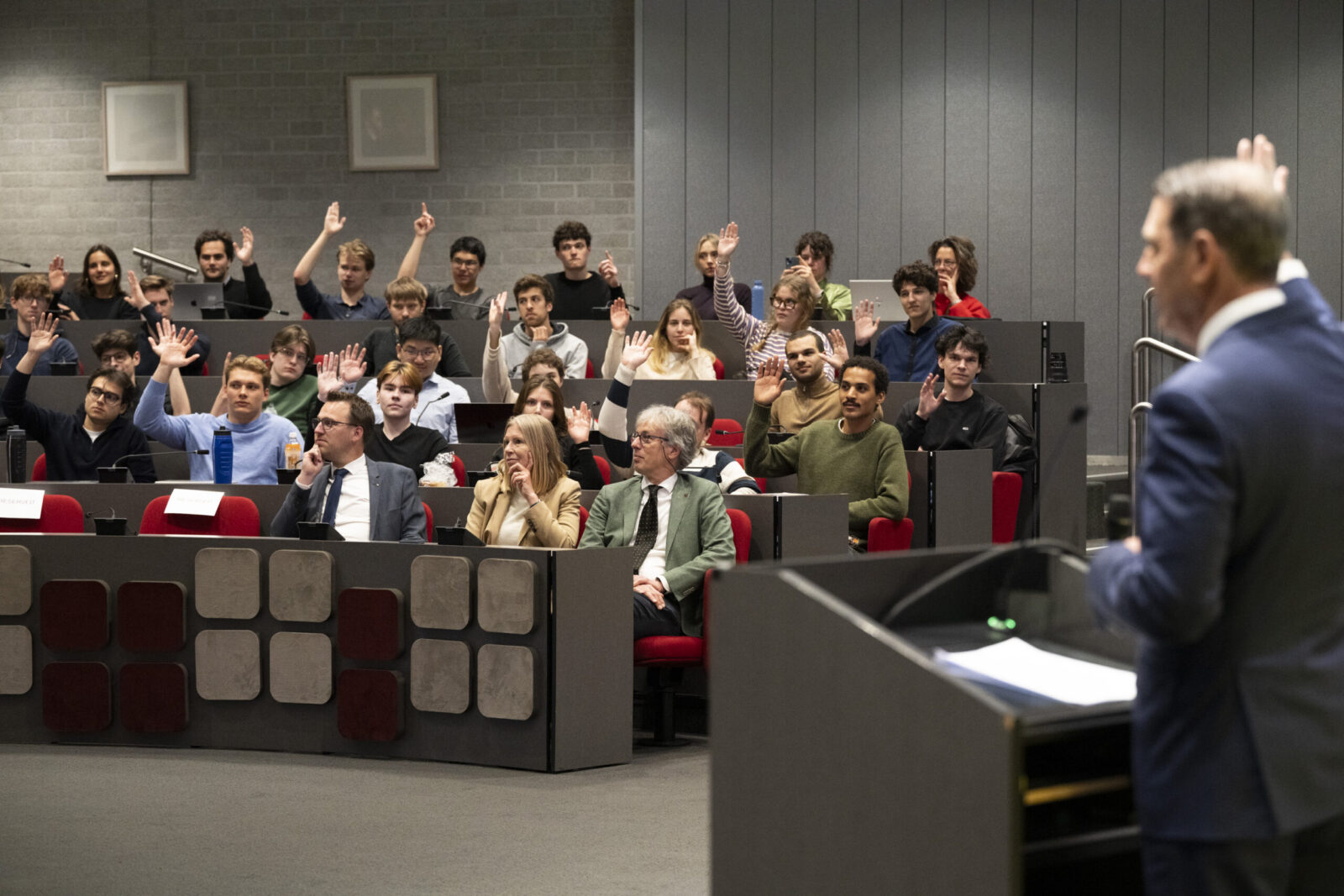
Students ask ambassador Joseph Popolo some challenging questions.
More than two hundred students had signed up for the lecture by American ambassador Joseph Popolo on economic cooperation between the United States and the Netherlands. Shortly after 1.00 pm on Tuesday, the first students began to arrive in the Forum Hall on the third floor of the Van der Goot Building. Econometrics and Economics student Gabriel was one of them. He is originally from the United States himself and was curious about the story of ‘his’ ambassador. “I’m especially interested in his views on the relationship between the US and the Netherlands”, he said beforehand.
Thijs, a student of Economics and Tax Economics, was curious about that as well. “I would like to know what exactly his work involves and how contacts take place”, he said. “I think this meeting will mainly focus on economics and less on the sensitive geopolitical situation, although that naturally also plays a role.”
But for Tygo and Bon, both students of Economics and Business Economics, current affairs were precisely the reason for attending this lecture. “With everything happening in international politics, it is interesting to hear how an American ambassador looks at it”, said Bon, who is himself half American. Tygo mainly wondered how open the ambassador will be. “I’m curious whether he will really dare to answer critically, or whether it will mainly be standard answers from the Trump administration.”
Crucial role
At 1.30 pm, associate professor and organiser Julian Emami Namini opened the meeting. Among the audience were rector magnificus Jantine Schuit, Erasmus School of Economics dean Patrick Groenen and director of the Economics department Niels Rietveld.
During his lecture, Popolo repeatedly emphasised how important the Netherlands is to the United States. He referred to the historical ties between the two countries, which date back to New Amsterdam in the seventeenth century. According to the ambassador, the Dutch were not only among the first allies of the young United States, but also helped the country financially during the War of Independence. “Many Americans do not know that the Netherlands played a crucial role in financing the creation of the United States”, he said.
Economically too, he described the relationship as exceptionally strong. The US is the largest foreign investor in the Netherlands, while the Netherlands is among the largest investors in the United States. He also pointed to the millions of jobs dependent on trade between the two countries and the close cooperation in technology, security and defence.
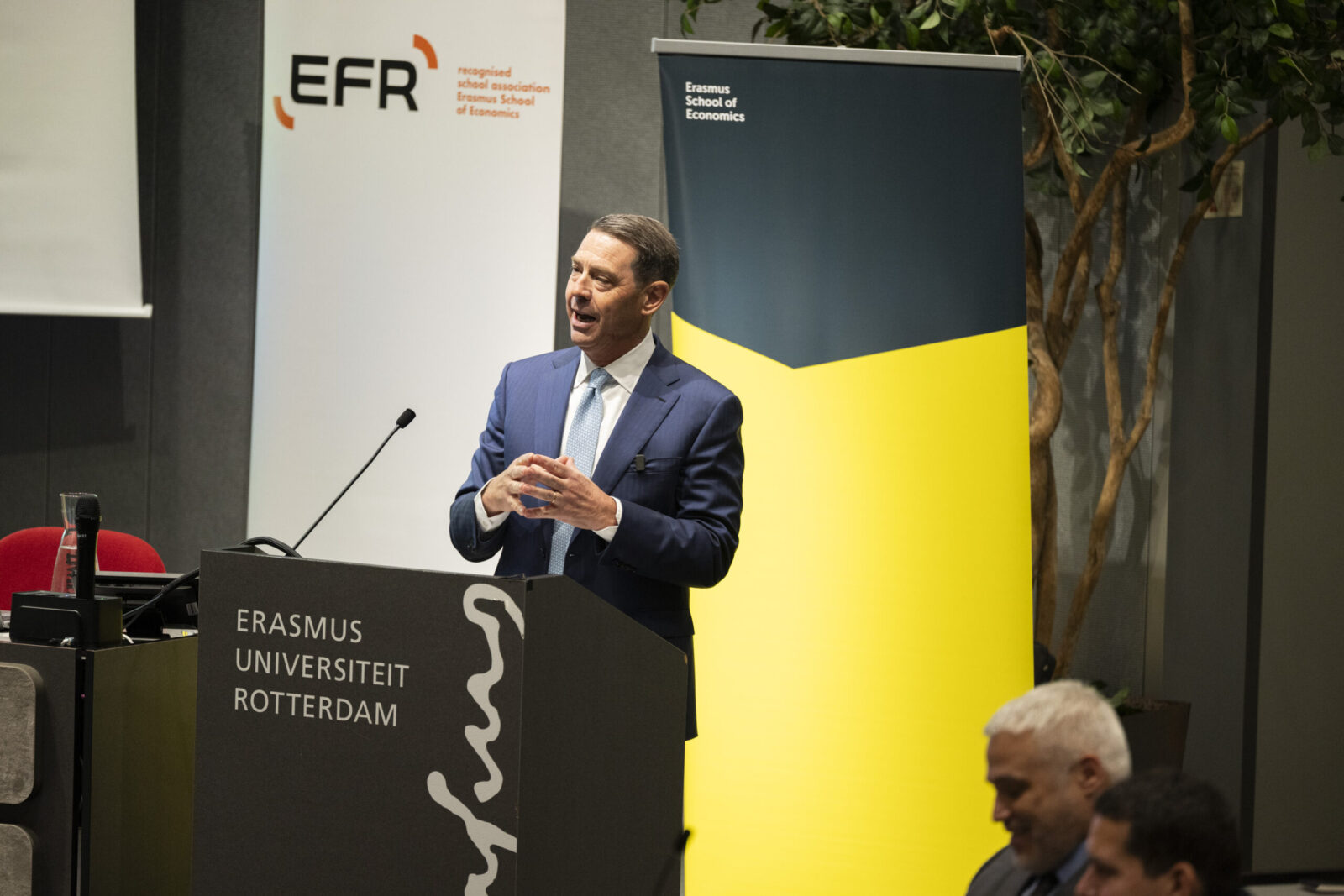
Ambassador Popolo gave a lecture about economic cooperation between the US and the Netherlands.
Import tariffs
After the lecture, a discussion moderated by student and EFR board member Christian Stevens followed. A student in the second row was given the opportunity to speak. “In economic theory, we learn that import tariffs reduce prosperity, but we are currently seeing a trade war take place. So how do the United States justify this trade war, beyond the official explanations we read in the news and newspapers?”, the student asked.
Popolo then pointed to three goals of import tariffs: generating government revenue, protecting strategic industries and creating ‘free, fair and reciprocal trade’. According to him, uncertainty surrounding tariffs is especially harmful to companies. “Companies can deal with tariffs”, he said, “but uncertainty makes planning almost impossible.”
The role of NATO was also discussed extensively. In response to questions about American foreign policy, Popolo said Europe must take more responsibility for its own defence. “We cannot simultaneously defend Europe, restore our own economy and prepare for competition with China”, he stated. According to him, the United States will remain committed to NATO, but expects European countries to invest more in defence.
Existential crisis
One student asked why the United States appears less willing to contribute financially to the defence of Ukraine. According to Popolo, the American government primarily sees the war in Ukraine as a European security issue. “If this really is an existential crisis for Europe, then Europe must also take more responsibility”, he said.
Tensions with China and Iran were also briefly touched upon. According to Popolo, the American government is ‘finally’ trying to actively address long-term geopolitical problems.
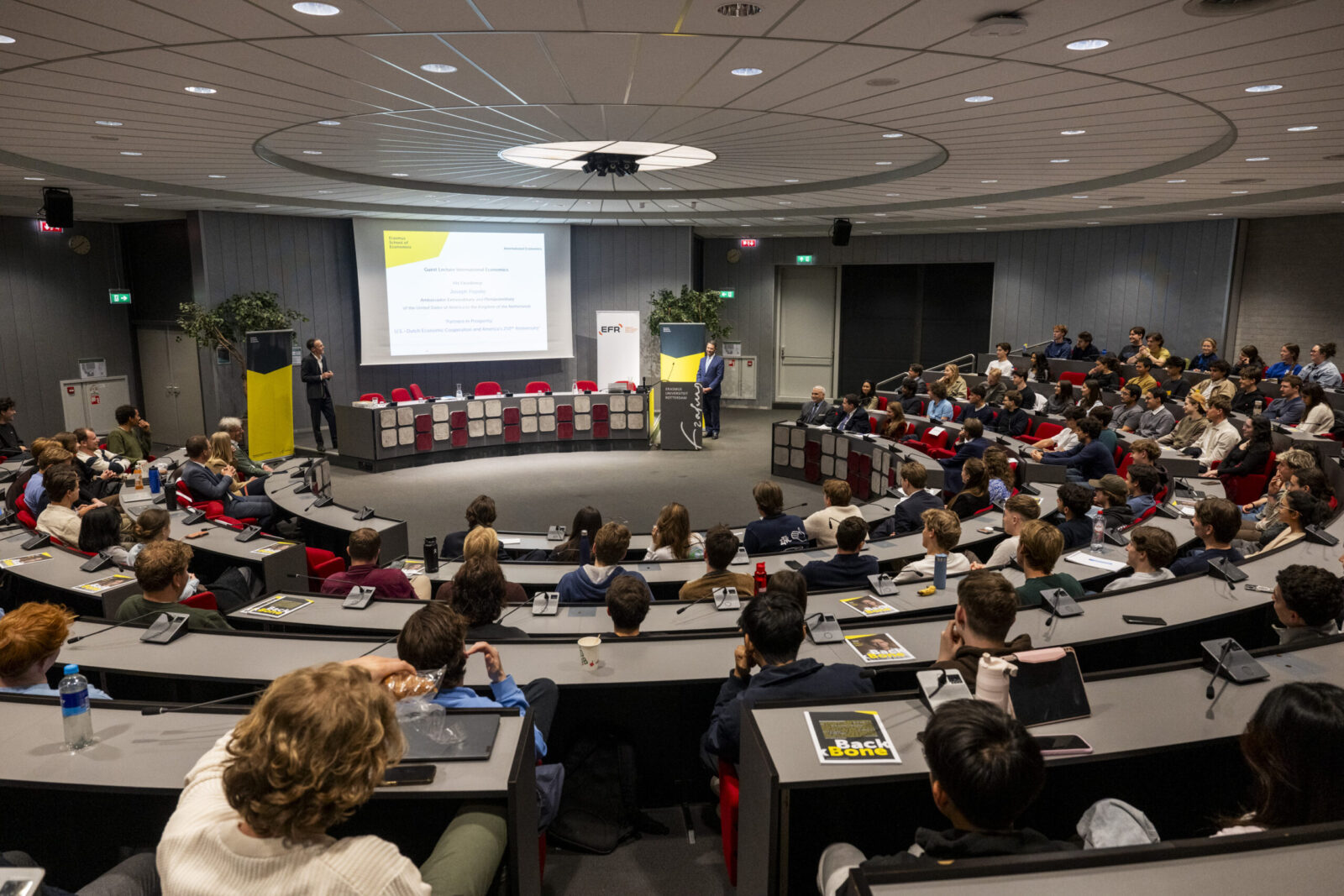
Students responded positively to the lecture, they appreciated the open atmosphere.
Valuable
Afterwards, students Tygo and Bon responded positively to the lecture. They especially appreciated the open atmosphere and the opportunity to ask critical questions. “I found it surprisingly interesting”, said Tygo. “Of course, he sometimes gave diplomatic answers, but he did not shy away from the difficult questions.” Bon was particularly interested in the theme of economic cooperation between the Netherlands and the US. “I actually didn’t realise how economically important the Netherlands is to the US.”
Associate professor Julian Emami Namini, the organiser of the meeting, also looked back on the event with satisfaction. Every year, he invites guest speakers as part of the international economics course. Inviting the American ambassador this time was a deliberate choice. “Precisely in times of geopolitical tensions, it is important to keep talking to one another”, he said. “Students were able to ask questions directly and clarify certain matters. That makes a meeting like this valuable.”
Read more
-
Fewer students choose the United States
Gepubliceerd op:-
Internationalisation
-
De redactie
-
 Feba Sukmana
Editor
Comments
1 reactie
Comments are closed.
Ad
Read more in Education
-
TU Delft may not favour women in admissions to courses
Gepubliceerd op:-
Education
-
-
RTL: More than half of master’s theses contain AI-generated text
Gepubliceerd op:-
Artificial Intelligence
-
Education
-
-
Education pioneer Etienne Augé: ‘Technology should give us more time for people’
Gepubliceerd op:-
Education
-

Joe Popolo op 19 May 2026 om 14:21
Thanks Feba…well done. It was a pleasure to join you and your peers at Erasmus!