Ad

Lecturers in Canvas crisis: ‘Ultimately, everyone uses whatever works best for students at that moment’

The hack of education software Canvas hasn’t only caused frustration among students in recent days, but is also putting major pressure on lecturers. To solve the problems, they are regularly turning to platforms outside the university.

Image by: Elzeline Kooy
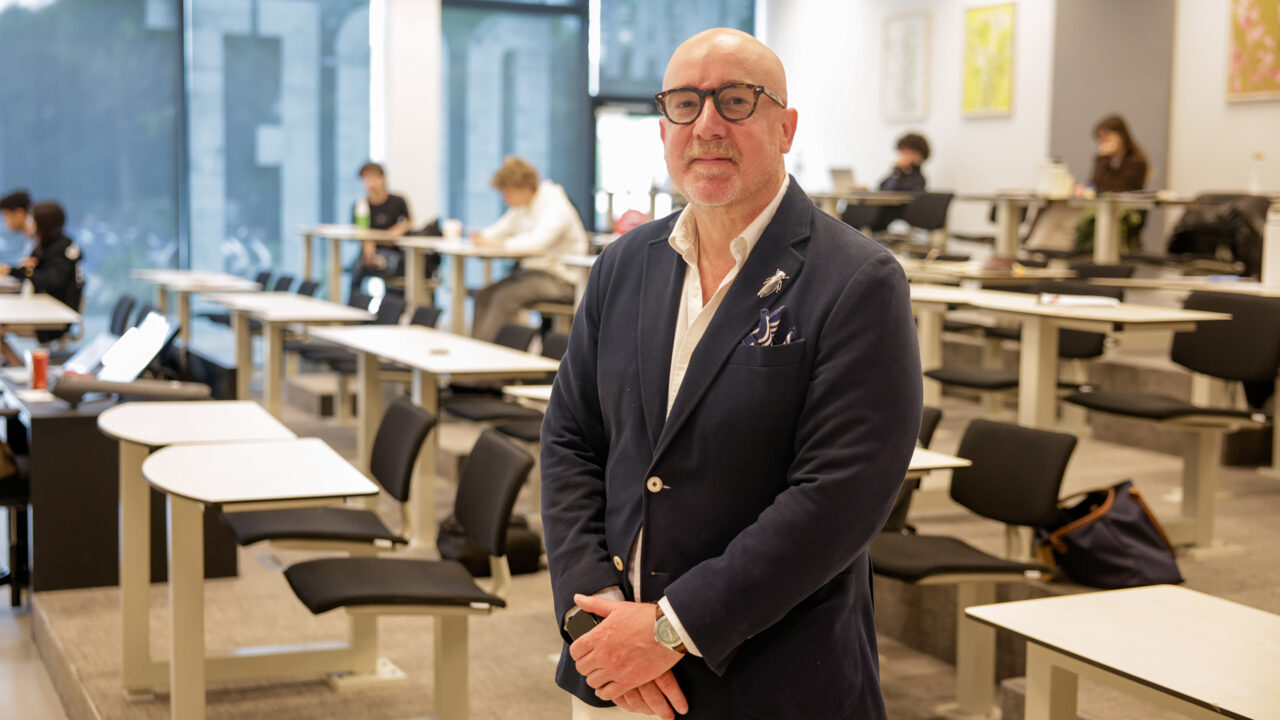
Associate professor Sjoerd van Tuinen (Erasmus School of Philosophy) has invested a great deal of work into Canvas. For the class Philosophy of Art, Media and Technology, he and another assistant professor, together with three tutors, built an extensive system within the platform: instructions, videos, literature, deadlines and forums where students can discuss topics among themselves. In addition, thesis supervision and academic writing training also run through Canvas and the SpeedGrader function. “That also includes the plagiarism check and all kinds of tools that are essential for feedback on writing assignments.”
Een lijst met artikelen
-

Canvas available again from Wednesday
Gepubliceerd op:-
Education
-
IT
-
Around 150 students follow the tightly scheduled class. “Because we have many dual-degree students, only some of the students attend the classes. The rest work with videos and instructions on Canvas. That means this course is really dependent on the digital learning environment”, Van Tuinen explains. “Things are becoming a bit of a mess now.”
Confusion
Now that Canvas is temporarily offline, a great deal of confusion is arising among students. Van Tuinen is constantly receiving emails with questions about deadlines, assignments and course information. “It is very frustrating. I get many emails that I cannot answer, because I also do not yet know exactly how things will proceed. You just have to let things run their course a bit, but that is obviously not good when you only have eight weeks and have high ambitions for everyone within that period.”
Alternatives
Ward Vloeberghs, lecturer and team coordinator at Erasmus University College, is also running into the consequences of the disruption. He returned from a week’s holiday on Monday morning and wanted to complete the assessment of an assignment together with two colleagues. Without access to Canvas, that proved impossible. At the institute as well, submitted assignments, feedback and course information are largely stored on Canvas.
While Van Tuinen is now mainly using ANS and Teams as alternatives, Vloeberghs is temporarily relying on email and services such as Google Docs, Dropbox and Miro, a platform that allows people to work together on a whiteboard, to inform students. Although the university has advised staff not to use external platforms outside the internal environment, he says this is not always feasible in practice. “I understand the instructions, but I fear that not all coordinators receive that information in time. Ultimately, everyone often uses whatever works best for students at that moment.”
Van Tuinen’s students are now submitting their assignments through ANS instead, a digital environment that the university normally uses for exams but that can also be used for take-home assignments. Still, he sees clear limitations. “ANS has less favourable feedback options, so it becomes more difficult to give good feedback. Moreover, I do not think we will still manage to do that within the original deadlines. That means students may already have to start a second assignment without feedback on the first.”
Delays
The disruption is creating extra work, lecturers say. Nevertheless, Vloeberghs does not see that as the biggest problem. “Whether you write an email or post a Canvas announcement, it takes about the same amount of time”, he says. According to him, the real challenge lies in the chain reaction that arises once deadlines begin to shift. Students may request extensions, causing assignments to be submitted later and lecturers to process grades later as well. That then has consequences for other parts of the educational process. “In my course, the first assignment builds on the second. If feedback arrives too late, the next assignment also risks being delayed.”
According to him, those delays could ultimately affect examination boards, resits and even graduation ceremonies. “There’s potentially a snowball effect”, he says. “I don’t want to be dramatic, but the risk does exist.” Van Tuinen agrees. “It may mean that we will have to mark more assignments during the resit period in the summer.”
Een lijst met artikelen
-
Canvas down: ‘This couldn’t happen at a worse time… Today is my deadline’
Gepubliceerd op:-
Education
-
Pleasant communication
Associate professor Ruth van der Hallen (Erasmus School of Social and Behavioural Sciences) is less affected by the Canvas crisis because she is currently not teaching. She mainly supervises students with internships and theses and therefore uses Canvas less intensively. To work around Canvas, she uses email for communication.
What stands out to her most is the communication from the university. “I am positively surprised”, she says. “Every day I receive an update from the university about the situation. Normally, as a lecturer, you are often waiting for the next step without knowing when it will come. Now it is clear when you can expect a new update.” According to her, that communication is taking place through several channels at once. “Not only through email and MyEur. When I open Canvas, there is information there as well. The university is using many different channels to inform people. I find that very pleasant and I feel supported.”
Vloeberghs has the same impression. According to him, intensive cooperation is taking place, both within the university and between Dutch universities. “I get the impression that the university is on top of the situation”, he says. “There are coordination meetings at university level and between universities themselves. That is absolutely necessary.”
Dependence on software companies
According to lecturers, the current disruption mainly shows how vulnerable the educational process becomes when almost all communication, administration and assessment take place through a single digital platform. Van Tuinen points out that universities have increasingly started working with blended learning in recent years. “That quickly makes you dependent on these kinds of commercial applications”, he says.
According to Vloeberghs, the disruption also ultimately raises a more fundamental question: how dependent universities have become on external software systems such as Canvas. “The long-term question is how exposed we are to external software suppliers”, he says. “This is not only about technology, but also about financial and political choices. Do we want to continue outsourcing so many essential services purely because of cost efficiency?”
Comments
Comments are closed.
Ad
Read more in Education
-
TU Delft may not favour women in admissions to courses
Gepubliceerd op:-
Education
-
-
RTL: More than half of master’s theses contain AI-generated text
Gepubliceerd op:-
Artificial Intelligence
-
Education
-
-
Education pioneer Etienne Augé: ‘Technology should give us more time for people’
Gepubliceerd op:-
Education
-