Ad

Study success through binding study advice on shaky ground, but EUR holds on to Nominal=Normal

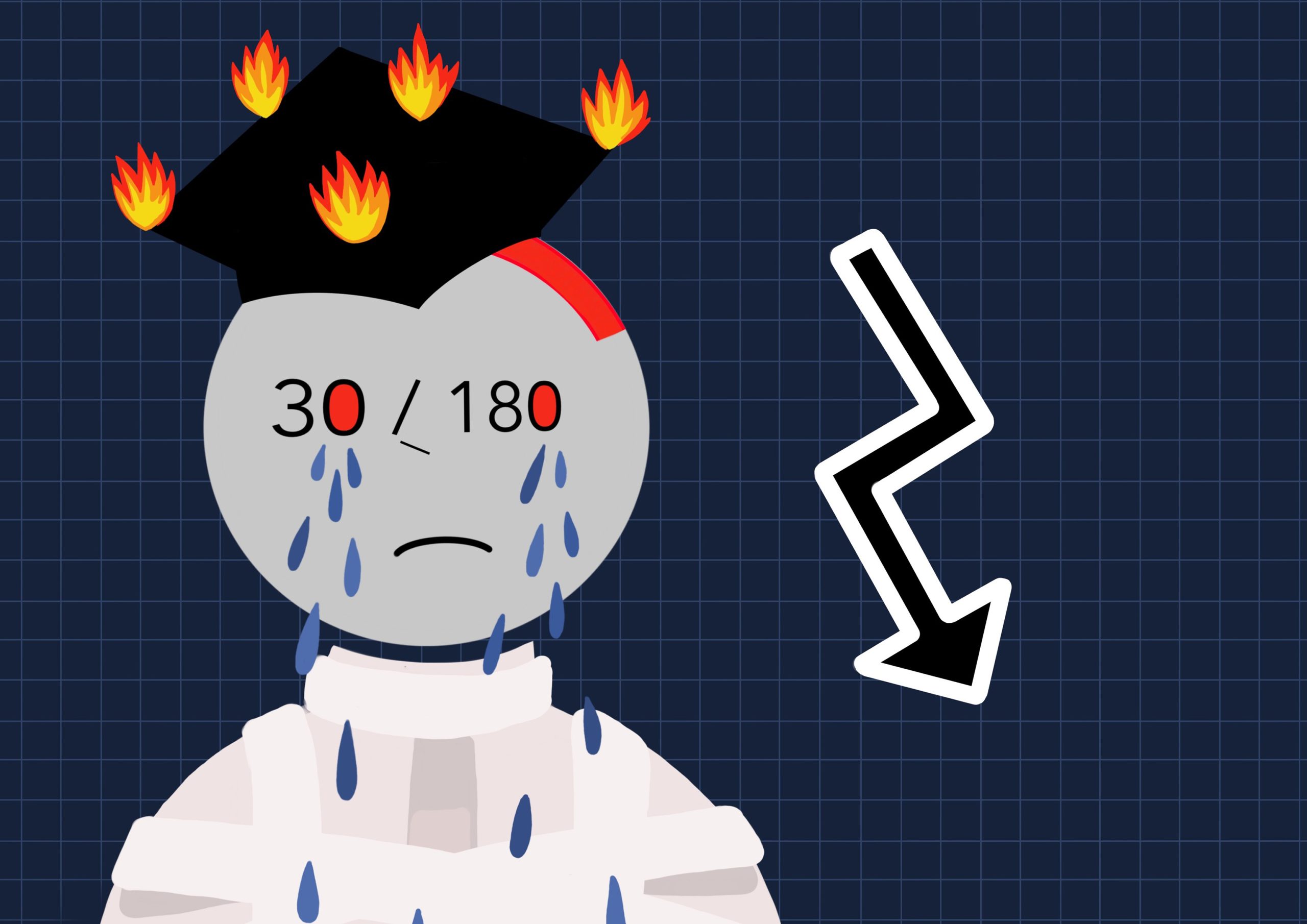
The binding study advice (BSA) doesn’t contribute to study success, a large national study shows. Researcher Rob Kickert is critical of the pedagogical effects of the measure. The university takes the findings seriously, but for now will not abolish the BSA of sixty credits in the first year.

Image by: Ami Rinn
An investigation by VU PhD candidate Sander de Vries among 700,000 bachelor’s students concludes that the bsa – the rule that you must leave your programme if you have too few credits after the first year – is not an effective means of improving study success. It has negative effects rather than positive ones: it increases first‑year dropouts and does not shorten the duration of study. Around half of the students who are forced to stop because of the BSA would probably have completed their programme without it.
It also has no positive effect on graduation rates. On the contrary: in total 1.7 percent fewer students obtain a diploma. The research is based on Statistics Netherlands (CBS) data from the period 1994 to 2014. The National Student Union sees the results as confirmation that the BSA mainly causes stress. As far as they are concerned, the BSA should be scrapped.
Internal study and evaluation
Erasmus University regards the research as valuable and is using it as a reason for internal study and evaluation, says policy adviser Aida Tunović of Academic Affairs. Within her department, but also in faculties, they are looking at what the findings mean for current policy. “We welcome this kind of research because it helps us enrich and test our policy”, she said.
At the same time she adds an important caveat: the data De Vries uses runs up to 2014, the very year the university fully implemented the ‘nominal is normal’ policy. That makes it difficult, according to Tunović, to apply the conclusions to the situation at EUR. “For the time being we want to study the findings further. Not only this research, but also, for example, that of Zuyd University of Applied Sciences. Several universities of applied sciences have dropped or adjusted the BSA and we are curious about the effect of that.” Whether this will lead to policy changes is too early to say.
Een lijst met artikelen
-
Binding study advice mainly has disadvantages, according to new large-scale research
Gepubliceerd op:-
Education
-
Wrong discussion
Researcher and assistant professor Rob Kickert at the Educational Master Primary Education of the Erasmus School of Social and Behavioural Sciences finds it interesting that the new study is causing such a stir. “I also find it somewhat odd that the debate is mainly an economic one, while you would hope it would be an educational or pedagogical discussion.”
By ‘economic’ he means that the BSA is often used to improve study efficiency. The new study also focuses on how quickly and how many students obtain their degree. “Whereas that is actually not your goal as a programme. Your goal is to provide good education. I understand that efficiency is relevant, but I would not primarily base the decision to introduce a BSA on that. You should ask: what is the aim of your programme and does the BSA contribute to that?”
Quality of education
For his dissertation Kickert himself investigated the ‘nominal is normal’ policy at EUR – a set of rules to promote study progress, of which a strict BSA is part. He looked at students’ performance and motivation. His conclusions differ from the new national study, namely that higher performance requirements often do lead to better results. “Requirements such as a BSA of sixty credits help students to be more motivated and to keep working hard even when it is not fun or interesting. On measurable aspects, such as grades and study progress, you see positive effects”, Kickert says. “But what happens to non-measurable aspects – such as critical thinking, creativity or personal development – is much harder to determine.”
When it comes to those non-measurable aspects, Kickert fears that the BSA negatively affects the quality of education. According to him this is because of the strong emphasis on testing. “Those tests measure only part of what is important. That becomes a problem when performance on those tests is decisive.” The BSA increases that pressure further. “Because students have to earn credits, they then focus even more on only what is tested.”
He is also worried about unequal opportunities. Some students, he says, are unfairly disadvantaged by the BSA, such as first‑generation students, students with a disability or students who experience more setbacks. “I fear these students do not get enough time to ‘settle’ in higher education because of the BSA.”
'I fear these students do not get enough time to 'settle' in higher education because of the BSA'
He is also worried about unequal opportunities. Some students, he says, are unfairly disadvantaged by the BSA, such as first‑generation students, students with a disability or students who experience more setbacks. “I fear these students do not get enough time to ‘settle’ in higher education because of the BSA.”
‘Nominal=Normal’ does not stand alone
The university‑wide rule ‘nominal is normal’ means that students must obtain sixty credits in the first year to progress to the second year. “It sounds strict, but there are options within the system”, policy adviser Tunović explains. For example, there is a compensation option for a maximum of two courses, where grades may be combined. In addition, there are arrangements for special circumstances. “Students can always discuss their situation with a mentor or study adviser.”
The idea behind the policy is that students start the second year without outstanding courses. Another advantage, according to Tunović, is that students procrastinate less. Both effects mean that students experience less stress in the second year. “If you, for example, lower the norm to forty credits, you may give more space in the first year, but the stress shifts to later years. Students still have to obtain those credits and may drop out later, with greater financial consequences”, she explains. “With this system you enter the second year with more confidence. That contributes to both study success and wellbeing.”
In addition Tunović says students feel more at home earlier thanks to ‘nominal is normal’. “Students move on to the second year together and take the same courses. You mix first‑ and second‑years less. That strengthens the feeling that you belong together and are progressing through the programme together.”
Een lijst met artikelen
-

Even suitable students sometimes receive binding study advice
Gepubliceerd op:-
Education
-
Tunović emphasises that the BSA doesn’t stand alone, but is part of a broader educational system. “It is based on a well thought‑out curriculum that takes students’ needs into account”, she says. “We pay attention to personal and professional development and students’ resilience. We also continuously look at how best to guide and support students. In recent years we have invested heavily in student wellbeing, tutors and study support. Also in pre‑entry information, so students know what to expect.”
Critical
Kickert remains critical. Is the BSA pedagogically desirable according to him? “You have to look at that per programme, but overall I would say: no.” He quotes two Belgian pedagogues, Jan Masschelein and Maarten Simons: the key word in education is ‘trying’. “And the BSA stands in the way of that.”
De redactie
-
 Feba Sukmana
Editor
Comments
Comments are closed.
Ad
Read more in Education
-

TU Delft may not favour women in admissions to courses
Gepubliceerd op:-
Education
-
-

RTL: More than half of master’s theses contain AI-generated text
Gepubliceerd op:-
Artificial Intelligence
-
Education
-
-

Education pioneer Etienne Augé: ‘Technology should give us more time for people’
Gepubliceerd op:-
Education
-