Ad

U-council: proposal for house rules restricts right to protest

The University Council has ‘serious concerns’ about a proposal from the Executive Board for new house rules on demonstrations on campus. The council believes the rules threaten the right to protest.
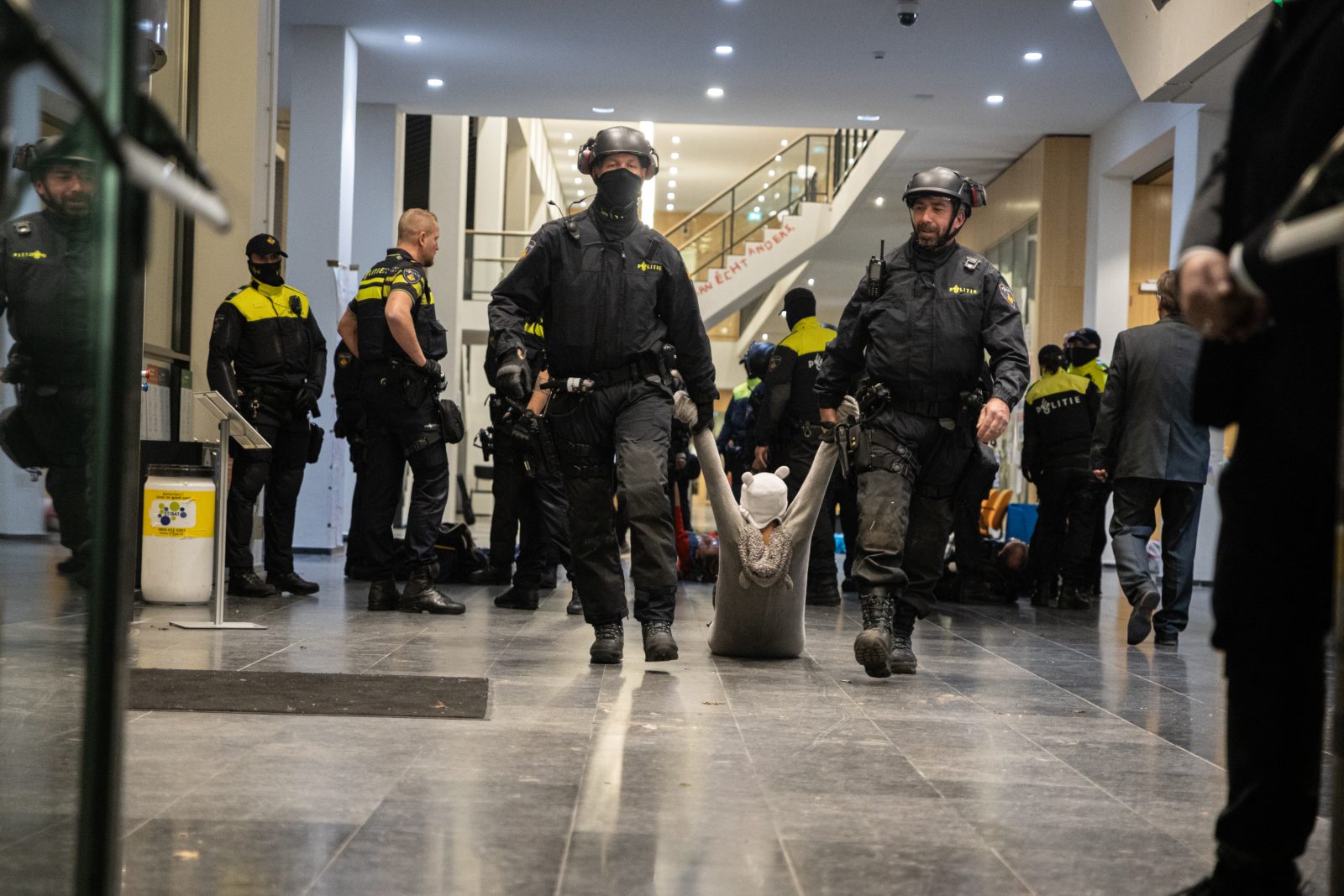
Several students were dragged outside by police officers during an occupation of the Sanders Building in 2022.
Image by: Wouter Sterrenburg
The Executive Board asked the University Council meeting on 10 March for advice on the new rules around protests on campus. Several council members voiced their serious concerns about the proposal. According to the council, the legal basis for several rules, such as a complete ban on face coverings and the occupation of buildings, is shaky. And besides that, council members questioned how desirable some rules are at all, because, for example, face coverings can be justified in certain situations.
Two reports
The council members base their view on two external reports. The proposal is largely based on a template from the Universities of the Netherlands and that template has been examined at other universities. For the University of Amsterdam the law firm Prakken d’Oliveira wrote a note about it and in Utrecht the Study and Information Centre for Human Rights (SIM) also produced a report. Both were highly critical.
According to the SIM report several house rules conflict with the law. This concerns the complete bans on face coverings and on occupying buildings, and the rule that the house rules also apply to ‘digital expressions’ of demonstrators.
Many rules are also formulated too absolutely, write SIM and Prakken d’Oliveira. Restrictions should be tested much more on the basis of necessity and proportionality, the report says.
Obstruction must be possible
The draft house rules state, for example: “Occupying EUR buildings (temporarily taking possession as a form of protest or action) is not permitted.” The European Court of Human Rights has stated, for example, that occupations, even when prolonged, can fall under the protection of the right to protest, the SIM advice reads. “The Court has ruled that physical behaviour that deliberately obstructs the daily course of affairs in order to interrupt the activities of others does not belong to the core of the right, but still falls within its scope and is therefore protected.” Prakken d’Oliveira is also clear on this: “The UvA wrongly assumes that occupations and blockades are by definition not peaceful.”
Another rule is: “The organiser, contact person and participants in the demonstration shall not wear face coverings.” But according to SIM demonstrators have a right to anonymity. Face coverings may only be prohibited by the UN Human Rights Committee for very compelling reasons and are not in themselves evidence of violent intent. And there is no reason for security staff to demand identification just because someone is taking part in a demonstration. According to Prakken d’Oliveira protesters can have a good reason to cover their faces: “Students and staff fear consequences from their institution or employer if they take part in a demonstration.”
In the meeting, council members also pointed out to the Executive Board legitimate reasons to use face coverings, for example because of danger to family members in Iran at an Iran demonstration, or during a possible new pandemic. Executive Board president Annelien Bredenoord stressed that exceptions to the rules are certainly possible, and that these will naturally come to light when a demonstration is registered and discussed in advance. The main point of the rule, according to Bredenoord, is that the norm on campus cannot be that Executive Board members have to speak with completely anonymous demonstrators.
Spontaneous demonstrations
The proposal that demonstrations must be registered in advance by the organiser also met with criticism from SIM. “The requirement to notify a demonstration in advance doesn’t have to be incompatible with human rights and can even serve to facilitate a protest better. But under no circumstances may such a requirement exclude spontaneous demonstrations. It may well be that current events on the day give reason to demonstrate. This type of spontaneous demonstration is also protected.”
'The campus is delimited, but the digital domain is worldwide. Where then does the authority of the Executive Board stop?'
The rules also state that the house rules for physical demonstrations also apply to digital expressions. The University Council sees that as an overreach of the university’s powers. “The campus is delimited, but the digital domain is worldwide. Where then does the authority of the Executive Board stop?”, a council member wondered during the meeting.
Another council member asked whether, based on these rules, the university will monitor demonstrators’ social media, and who would then be counted as a demonstrator at a protest. Students and staff can be deterred from speaking out by all the strict rules, something both reports also conclude. Bredenoord stressed that the university wouldn’t monitor social media in advance.
‘Moral guide’
Executive Board chair Annelien Bredenoord defended the discrepancies between the house rules and legal provisions by pointing out that the rules should be seen as a ‘moral guide’ and not as binding. “We mainly want to describe how we think we should behave with one another on this campus. So when we talk with each other, you do not cover your face. It is not intended as law.”
A council member asked Bredenoord whether breaching the house rules could have consequences if they are not binding. According to Bredenoord that is indeed possible. “The rules cannot restrict someone’s right to protest, but violations can have consequences. In principle we can even file a police report. But these rules are precisely about the grey area.” Several council members then expressed their concern that the strict rules could deter potential demonstrators in advance and thus indirectly lead to a restriction of the right to protest.
The Executive Board seemed receptive to the council’s criticism and will look at the rules again. It may add an introduction explaining that the rules are not binding. The draft will be discussed again later.
Een lijst met artikelen
-
Live: Protest against professor and counter-protest on campus (ended)
Gepubliceerd op:-
Protest
-
De redactie
-
 Elmer Smaling
Deputy editor-in-chief
Comments
Comments are closed.
Ad
Read more in Protest
-
Students will still be allowed to occupy a building, but perhaps not while masked
Gepubliceerd op:-
Politics
-
Protest
-
-
TU Delft will no longer pass activists’ names to police
Gepubliceerd op:-
Privacy
-
Protest
-
-
Pro-Palestinian protests in student cities
Gepubliceerd op:-
Protest
-