Ad

Member of far-right student association given two-year prison sentence
A member of the far-right Greater Netherlands Student Association in Nijmegen was sentenced last week to two years in prison, one year of which is suspended, for illegal possession of weapons.
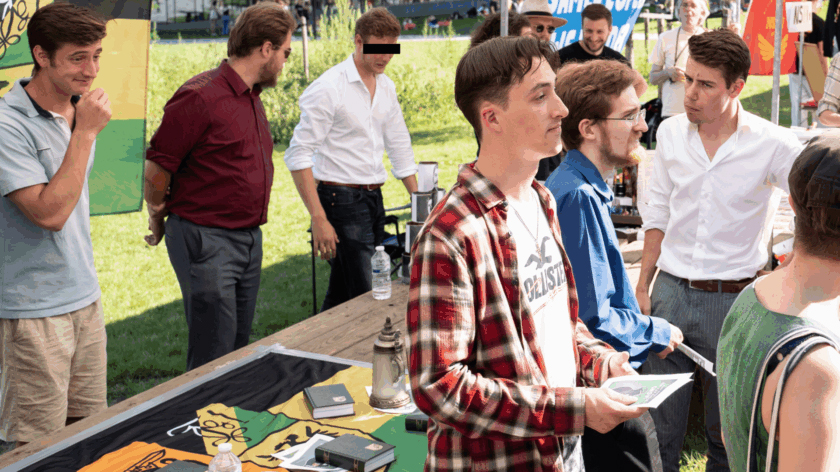
Thomas D. (anonimised) during an information fair in Nijmegen.
Image by: Johannes Fiebig
Thomas D. was arrested last summer on suspicion of preparing a terrorist attack. Weapons and ammunition were found in a building near his home.
They included firearms, bullets, butterfly knives, arrows and airsoft guns. The student had also converted a gas pistol into a functioning firearm. According to the student, he possessed the weapons solely because he has a fascination with weapons and how they work, but the court did not accept this argument. Possessing weapons without a permit “entails a major and unacceptable risk”, the judge stated.
Manuals for explosives
The judge also considers it worrying that the student ‘had the knowledge and skills to manufacture various types of ammunition himself’. He was also found to possess manuals for making explosives, tear gas and 3D-printable weapons.
Despite his young age and lack of a criminal record, a lengthy prison sentence is appropriate, the judge ruled. The student has been given a 24-month prison sentence, 12 months of which are suspended with a probation period of three years.
‘Radicalisation process’
D.’s views played a role in the verdict. The probation service, which issued advice, described the student’s radicalisation as worrying and spoke of a ‘razor-thin line’ between the student’s activism and extremism.
The 25-year-old man is a member of the controversial Greater Netherlands Student Association and of the nationalist Geuzenbond, a far-right youth organisation. Both organisations advocate, among other things, the unification of the Netherlands and Flanders into one nation state: ‘Dietsland’.
The youth organisations regularly refer to extremist ideology, writes de Volkskrant, including by displaying the Prince’s Flag (also used by the NSB) and making the so-called OK sign, which in neo-Nazi circles is regarded as a ‘white power’ symbol.
‘Moderate’ risk of reoffending
The public prosecutor ultimately dropped the terrorism charge. The probation service still considers the likelihood that the student will actually resort to violence to be low.
Nevertheless, the probation service recommends that, in addition to his prison sentence, he should also be subject to a reporting obligation, mandatory treatment and structured daytime activities (education or paid work). The judge has adopted this recommendation.
Read more
-

Brawl during Nijmegen intro event is not an isolated incident
Gepubliceerd op:-
Student life
-
De redactie
Comments
Comments are closed.
Ad
Read more in In court
-

Students are often treated leniently by judges, researchers say
Gepubliceerd op:-
In court
-
-

Community service and suspended prison sentence for founder extreme-right student party
Gepubliceerd op:-
At the neighbours
-
In court
-
-

ESL PhD candidate loses lawsuit over Gaza letter
Gepubliceerd op:-
In court
-