Ad

‘Nothing ever triggers accountability about Diversity Travel’
Michal Onderco, professor of international relations, is a frequent business traveller. His experiences show that the problems with the mandatory travel agency Diversity Travel are not occasional but systemic.

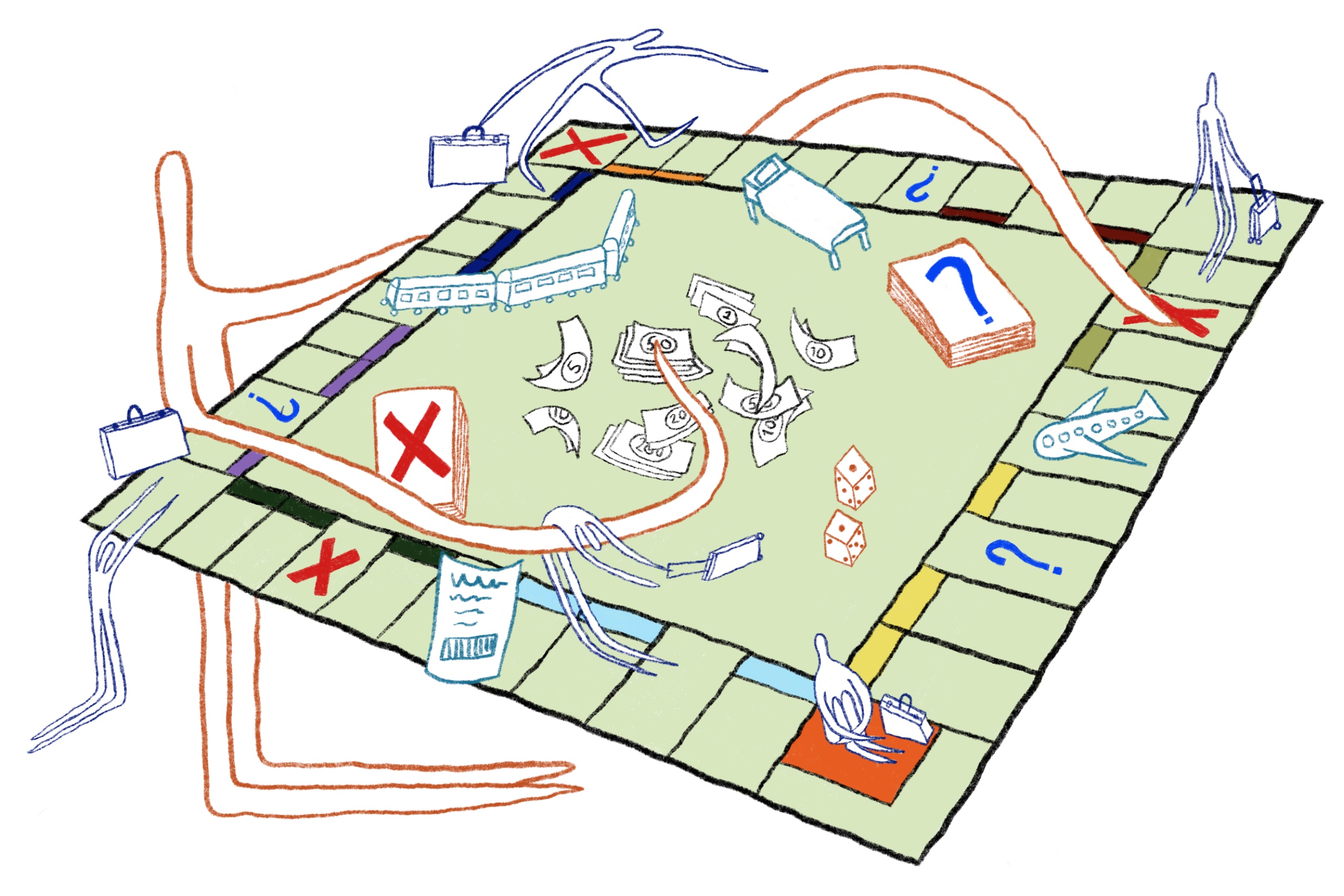
Image by: Ami Rinn
If you work at EUR, chances are you have already complained about Diversity Travel, the university’s mandatory travel agent since January 2025. Since then, Erasmus Magazine has published multiple stories about service failures – usually from the perspective of occasional travellers.
My experience is different. I travel frequently for work, and Diversity Travel (recently renamed to DGI Travel, ed.) knows this. When things go wrong, which they do with worrying regularity, I complain and demand rectification. Over the past year, this has put me in contact with an unusually broad range of Diversity staff, from travel consultants to account managers and even compliance officers. As a result, my interactions with the company have become unusually well documented, persistent, and, as it turns out, revealing. This is a story about what happens when repeated failure meets weak oversight and no effective mechanism for correction.
I still remember my first interaction with Diversity Travel. I needed to book an Erasmus+ Staff Exchange trip and combine it with another journey, which required a simple multi-leg ticket. Diversity’s website failed, a common occurrence unless you know to use Edge, so I contacted the Olive team by email. When the ticket was finally issued three days later, it cost roughly 20 percent more than the price KLM was offering when I first contacted them. At the time, I considered this outrageous.

Image by: Ami Rinn
In hindsight, it was the beginning of a pattern. Over the following months, Diversity booked hotel rooms for the wrong dates, failed to inform me when a travel connection was cancelled, issued incorrect booking codes, mixed up WBS numbers on invoices, took months to reimburse a fully flexible booking, and recently took eleven days to book a straightforward hotel stay.
Consider a recent research trip. I booked what was explicitly sold to me as a ‘double room for single use’ at a hotel in a major European city. Even making the booking proved difficult: Diversity’s website displayed what an agent later described to me as ‘phantom availability’, forcing me to complete the reservation by phone. Upon arrival, I was assigned a single room. When I showed the receptionist my booking confirmation from Diversity indicating a double room, he showed me the booking Diversity had made through its third-party provider. That document clearly listed a single room. In other words, I was sold one product and delivered another.
I requested reimbursement from Diversity Travel. They refused, stating that they first needed to confer with their supplier. After weeks of delays, and with no meaningful intervention from the university, I contacted the Dutch Authority for Consumers and Markets (ACM). Within days, ACM clarified that my contract was with Diversity Travel, not its supplier, and that Diversity therefore bears responsibility. After I forwarded this clarification to Diversity, the company agreed to reimburse 50 per cent of the stay.
Before 2025, booking a hotel was simple: I booked a room online, received what I booked, sometimes even with a free upgrade, as large booking platforms often provide. This time, I spent roughly an hour trying to make the booking, about a dozen hours exchanging emails with customer care, and several more hours preparing a formal query to the ACM.
Evidently, Erasmus University can afford to have a full professor spend the equivalent of two working days resolving issues caused by its mandatory travel agent.
Was this a failure? You be the judge. What is clear, however, is that at least during the first months of the contract, Erasmus University did not have a service-level agreement (SLA) in place with Diversity Travel. As a result, the concept of a ‘delay’ existed in practice, but not in legally enforceable terms.
Yet even without an SLA, one would expect that when things go wrong, such as booking the wrong room, clear escalation and resolution pathways would exist. I learned early on that while there are limited ways to report problems internally, there are very few mechanisms to ensure that the same failures do not recur. Both Diversity Travel and the university consistently treat each incident as an isolated case. But when you have a fever, a runny nose, a cough, and persistent fatigue, it is probably unwise to assume these are unrelated symptoms.
Just as repeated booking errors revealed deeper operational dysfunction, my attempt to access personal data under the GDPR exposed how Diversity’s internal processes (and the university’s oversight) struggle to ensure legal compliance. Diversity first ignored my request, then claimed that their ongoing failure to comply with their obligations was purely administrative. At one point, the university’s Data Protection Officer advised that formal legal action would be the only remaining way to compel compliance.
The final disclosure was incomplete. The process, which should be routine, turned into a months-long exercise that revealed how dispersed and manual the underlying data handling is. The whole case is now subject to a case with the Dutch Data Processing Authority, after EUR refused to intervene in a case which in my view clearly shows Diversity’s informal approach to handling personal data.
You may have noticed that I did not dwell on cost. Yes, Diversity Travel is significantly more expensive than arranging travel independently, and I wish that the university would pay more attention to this. The wrong room mentioned above cost just over 100 euros; Diversity paid around 60 euros. Booking directly with the hotel would have cost 75 euros. Are any administrative savings realised? I doubt it, given the ongoing invoicing issues: each invoice now requires at least two emails from staff. The most ironic part? Before Diversity Travel, overspending on accommodation was flagged by the system. Today, invoices give no indication when guidelines are violated. But in principle, I wouldn’t mind a small extra cost, if the website worked flawlessly, email queries were resolved within the same days, customer care would proactively address issues, and errors would be both rare and compensated. Instead, extra cost brings CO₂ reports for the Executive Board and ‘duty of care’ emails for travellers (why we have to bundle such services with travel rather than insurance is a different query).
But judge for yourself whether a warning about a pro-Palestinian protest 200 km away from your destination a week before the trip is the type of boutique service worth paying for.
Over the past year, each incident has been addressed, or deferred, on its own terms. What never happened was an acknowledgment that these were not isolated problems, but symptoms of a larger failure in service provision and oversight. This is not surprising – what I gleaned from the incomplete GDPR disclosure is that the internal discussions about Erasmus staff are sometimes framed in a way which raised serious concerns for me as a customer.
The most troubling part is not the mistakes themselves, but that nothing ever triggers accountability. Diversity, the Executive Board, and the contract overseers seem to hope these problems simply fade away. They won’t, unless someone acts. So dear colleagues – keep track, complain loudly, insist on resolution and compensation, don’t hesitate to involve authorities, and exercise your rights. This fight will not be fought for you.
De redactie
-
Michal Onderco
Hoogleraar International Relations
Read more
-
Diversity Travel promises improvements, but site is still slow and unreliable
Gepubliceerd op:-
Staff
-
Comments
4 reacties
-
Bauke Visser op 13 February 2026 om 09:48
Erasmus University isn’t the only university where employees are complaining bitterly about travel agent DGI Travel (formerly Diversity Travel). An English business school has already been mentioned in the comments below the Dutch-language version of this piece.
In the Netherlands, four universities have partnered with DGI Travel. Besides EUR, these are:
Wageningen University & Research: contract since April 2023, employees here are also very irritated, even two years after the start, see for example here https://www.resource-online.nl/index.php/2025/05/23/intranet-group-gathers-diversity-travel-horror-stories/?lang=en
Radboud University: contract since March 2025, complaints are pouring in, see for example
https://www.voxweb.nl/nieuws/ondernemingsraad-wil-dat-radboud-contract-met-dgi-travel-stopzet-afdeling-houdt-zwartboek-bij-van-omstreden-reisbureauRadboud switched from another travel agency, VCK, in March 2025. The reason? The many complaints…
RUG, the fourth-largest university in the Netherlands: little information online.
DGI Travel promises improvements. But it seems the company is constantly having to reinvent the wheel (EUR: “at the start, there were technical issues”; Radboud: “partly in response to signals, improvements have been made in the recent period.”). Even in Wageningen, after more than two years of mandatory purchasing, frustration is immense. WUR’s Facilities Department admits: “the service Diversity Travel provides is inadequate.” After two years!
How can a company antagonize so many university employees by providing such poor service, yet still remain active among universities?
-
Lorenzo Pellegrini op 13 February 2026 om 14:00
I can only confirm that this company is a continuous source of distress, and a bottomless pit where we throw time, energy and money.
-
Sebastiaan Kamp op 26 February 2026 om 14:40
On behalf of the UC taskfoce on the topic, I would like to thank you for this insightful and well-argued article!
We also like to express appreciation for the many commenters who have shared useful references and additional information from other universities and contexts – their contributions help to deepen the discussion around the practical challenges people are facing with Diversity Travel.We at the Erasmus University Rotterdam University Council are fully aligned with the concerns raised here.
Since mid-last year, we have been actively working on this topic through a dedicated taskforce on travel and the Diversity Travel system.
The taskforce has collected substantive input from staff across faculties, and we have formally forwarded both thematic feedback and specific individual cases to the Executive Board in order to highlight recurring problems as experienced in practice.
We have also raised (legal) concerns with the Executive Board in relation to DT contractual performance.The Executive Board has previously acknowledged the need for improvements and committed to addressing shortcomings in the system. That said, significant concerns remain among many colleagues, and there is more to be done to ensure that the system functions effectively and without undue burden.
We will be re-raising this topic with the Executive Board at our next scheduled consultation meeting, and will again ask for a formal response and concrete updates on actions taken and planned to address outstanding issues. The University Council shares your concern and looks forward to continued dialogue that leads to meaningful improvements.
Comments are closed.
Ad
Read more in Opinion
-

Are you an EUR student gifted with writing talent? Take part in our columnist competition!
Gepubliceerd op:-
From the editors
-
-

The academic boycott of Israel is creating a culture of fear
Gepubliceerd op:-
Column
-
-

Bags under the eyes as academic currency
Gepubliceerd op:-
Column
-


Mansoob Murshed op 12 February 2026 om 23:00
Terrible to put it mildly. Could not book a reasonably priced air ticket or hotel room. Many times